Paul Allen had a complaint familiar to anyone who has become a regular somewhere without ever being treated like one. He and his wife, Cara, were spending about $150 every two weeks at a pet shop. The people taking their money had barely bothered to learn his name. Even the small courtesies felt scarce. For a business selling things to people who lavish affection on animals, it was a curiously chilly arrangement.
The irritation became a business. In 2007, Paul and Cara opened the first Woof Gang Bakery in South Florida, starting a company that would combine dog treats, retail merchandise and, eventually, grooming. Allen later put the opening stake at a $50,000 loan. The premise was wonderfully ordinary: recognize the person, recognize the pet, and give both a reason to return. A dog might forgive a forgettable shopping trip. Its owner was paying the bill.
Cara belongs at the beginning of this story. She was the co-founder, not a supporting character added after the shops multiplied. The couple wanted a better shopping experience and set out to create it together. Their answer took the shape of a neighborhood store, where the employee or owner would learn customers' names. The chain's name gave the dog top billing. The service had to accommodate the human attached to the leash.
02The biscuit gets you through the door
A bakery is an appealing way to introduce a pet shop. It suggests a counter, a treat, a small indulgence. Woof Gang carried leashes, toys, beds and bowls, but the decorated snacks made the proposition unusually easy to understand. In Savannah, Allen described a carob-chip cookie that resembled a chocolate-chip cookie. Peanut butter and rye flour appeared in the treats, too. The merchandise offered owners a little theatre along with their shopping.
That presentation mattered. A biscuit arranged like a gift is a different invitation from a bag pulled off a warehouse shelf. The pink interiors and chandeliers made the shop recognizable; the neighborhood ambition made it approachable. Allen was working with a category in which customers already had plenty of feelings. The store gave those feelings something tangible to buy, preferably small enough to carry home without rearranging the furniture.
Yet he did not leave the model fixed at the cookie counter. Grooming became part of Woof Gang's early expansion, adding a service alongside the goods. By the company's 2019 Orlando anniversary, grooming accounted for half of systemwide revenue. That is a considerable change in the life of a bakery. The original attraction still had a place, while a much more substantial part of the business was being conducted with a comb.
of systemwide revenue
came from grooming.
03A haircut changes the arithmetic
In August 2009, the first central Florida Woof Gang opened on Dr. Phillips Boulevard in Orlando. The company identified it as its first location to offer professional grooming. That year also brought the headquarters to Orlando. Ten years later, the surrounding market contained 24 open stores, with another six under development. The shop that broadened the offer had become part of a concentrated local network.
Allen credited customers with influencing the decision to add grooming. It is a revealing detail in his career: the expansion of the business came partly from listening to the people already using it. The shift connected the neighborhood-store idea to an appointment. A customer could have a reason to visit even when the cupboard held plenty of treats. The groomer, meanwhile, became another familiar person inside the shop. For Allen, the decision joined two parts of the visit in one place: the shopping people could do for themselves and the service they needed someone else to perform for their dogs.
By 2019, Allen was preparing to talk to independent retailers at Pet Connections Expo about adding services to their operations. His subject was the competitive position of storefront businesses facing large chains and online sellers. It was an argument he could make from the business he had built. A retailer selling products could also develop a service relationship, giving the visit a purpose beyond selecting something from a shelf.
The attraction is easy to see. An online order can deliver a toy; a grooming appointment requires an actual place and people doing the work. Allen's approach gave the store a role in an ongoing routine. His emphasis on personal attention therefore carried practical commercial weight. Remembering the customer became part of the case for returning to the same address, rather than simply choosing the next available seller.
“It’s just about being relevant.”
Paul Allen · 2019
04In Savannah, he borrowed a good idea
Allen could also be refreshingly plain about imitation. In January 2016, Woof Gang had three shops in downtown Savannah, within walking distance of one another: City Market, Drayton Street and River Street. He pointed to B&D Burgers and Byrd's Cookies as examples of local businesses operating multiple downtown locations. He had watched what worked nearby and thought his company could do it too.
There is something pleasing about a founder willing to acknowledge that the neighboring cookie business has already solved a problem. Expansion did not have to begin with a grand theory. It could begin with a walk through town. Allen tied the Savannah shops' progress to social media, product quality, service and connections with the community. He discussed support for rescues, the humane society and local events as work the company deliberately took on.
The neighborhood label asked something of the owner. Opening the door was only the beginning; becoming familiar required participation. In Savannah, Allen described a business drawing strength from the corporate office while giving back locally. That combination would remain central to the franchise proposition: a recognizable company behind a storefront whose daily relationships belonged to the people working there.
05The people behind the pink door
By 2021, Allen's description of a prospective franchise owner was demanding rather than dreamy. He looked for dedication, hard work and a record of building relationships in the community the person would serve. Buying into the brand required more than liking dogs. He wanted people who shared the company's commitment to service and would accept the work involved in delivering it.
“Someone who is not afraid of hard work.” The phrase is Allen's, and it makes a useful companion to the decorated treats. A shop can look playful while asking a great deal of its operator. He also described a shift toward smaller markets, including towns without every large pet chain already present. The ambition was to arrive somewhere the store could establish a meaningful local presence from the start.
The resulting network contained people with their own histories and decisions. Michelle and David Pence, for example, acquired Savannah stores and went on to buy additional locations and a grooming salon in Florida. By May 2022, they owned nine locations across the two states. Michelle credited Paul and Cara's original vision and the support of Allen and his team. For her, the franchise offered practices developed through other operators' experience.
Cara also remained visible in the company's expansion work. When a Woof Gang was announced for Downtown Doral in 2020, she represented the company on the lease. The planned shop occupied 1,375 square feet in a mixed-use community. It was a concrete piece of the neighborhood concept: a modest storefront, a local franchise owner and an address among places people were already using.
- 2007Paul and Cara open their first store.
- 2019Grooming accounts for half of systemwide revenue.
- 2022Garnett Station announces its investment.
06Fifteen years, then a handoff
The business had become substantially larger by its fourteenth anniversary. In September 2021, Woof Gang reported more than 1,000 groomers across its locations and more than one million pets groomed during the preceding year. It also announced a franchise training center at its Orlando headquarters. Training had become part of the apparatus required to support a network that could no longer be managed as a collection of nearby shops.
Allen credited franchise owners, groomers and the corporate team for the company's progress. That allocation of credit fits the structure of the business. The founder could establish the idea and help organize its expansion, but each appointment still depended on somebody at a grooming table. Each store depended on an operator. The figures grew through work distributed across many people, many shifts and many neighborhoods.
In June 2022, Garnett Station Partners announced an investment in Woof Gang. The company had more than 200 locations open or under development across 18 states, and Allen cited more than $125 million in run-rate system sales. Those measures describe the franchise system at the time of the transaction. They also mark the distance travelled from the couple's original loan.
Allen said the preceding 15 years had been built with team members and franchise owners, without outside capital. Now he welcomed new leadership and an investment partner chosen after a long search. The founder who had spent years developing the neighborhood concept was accepting a change in how the company would grow. His account of the moment gave Cara and the people operating the stores a place in the achievement.
200+locations open or under development
18U.S. states
$125M+run-rate system sales
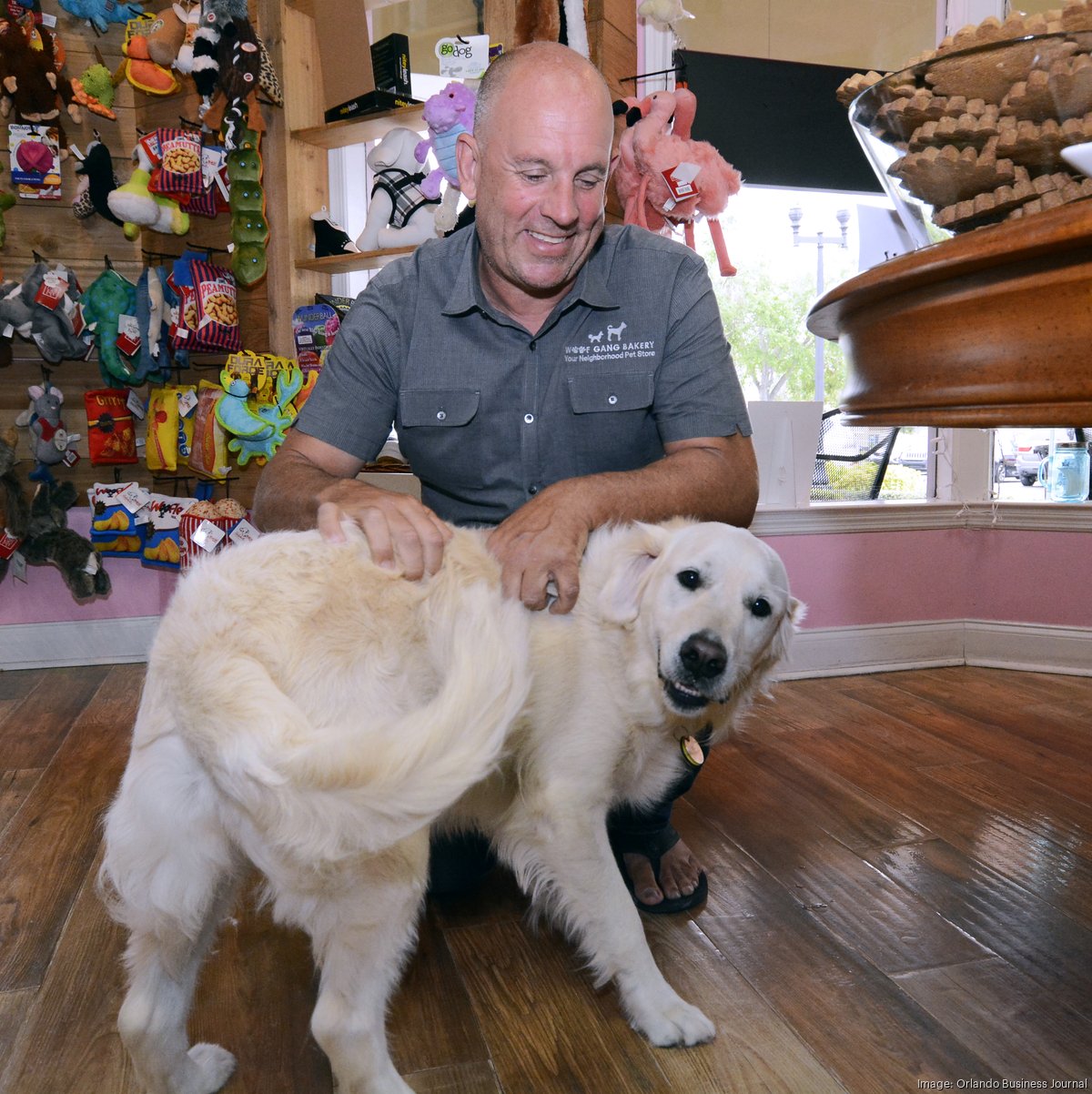
One photograph catches the scale of his idea more simply than the figures do. Allen is crouched beside Elle, the shop dog at the Dr. Phillips location, surrounded by toys and treats. The dog looks entirely at home. The founder has come down to her level. It is a small scene from a business that began with the expectation that somebody ought to know who had just walked in.