There is a useful way to understand Petco that has little to do with squeaky toys. Start with a bag of dog food. It is heavy, necessary and bought again and again. The customer comes to a store or opens an app. Petco then has a chance to sell a groom, schedule a vaccine, recommend a training class or book an exam. Each service creates a reason to return that Amazon cannot put in a cardboard box. The food is the habit. The care is the relationship.
That distinction matters because the San Diego company is halfway between familiar categories. It is a specialty retailer with about 1,400 pet care centers in the United States and Puerto Rico. It is also a service operator with roughly 300 full-service veterinary hospitals in its network, around 1,600 Vetco clinics running each week, grooming salons and positive-reinforcement training. Add e-commerce, same-day delivery, repeat delivery, an app and a two-tier membership program, and the old pet store starts to resemble a care network with shelves.
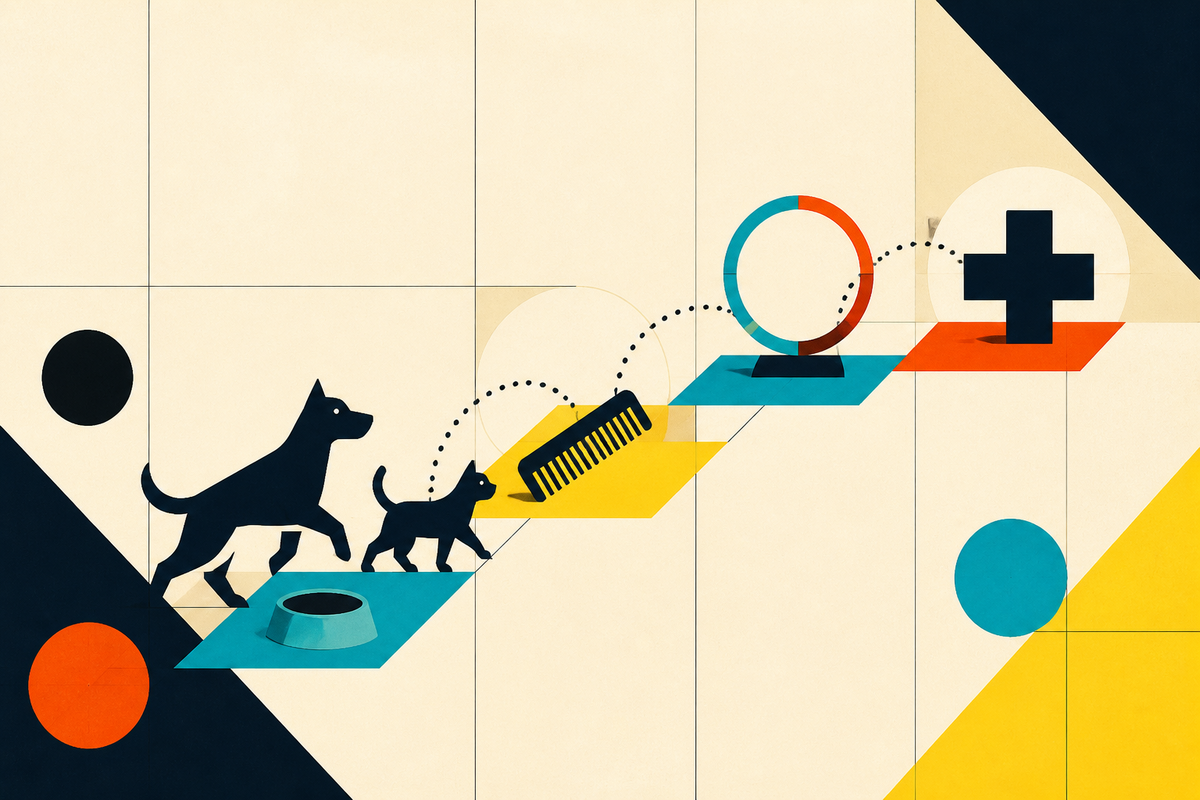
Petco calls this an integrated ecosystem. The less corporate description is a loop: buy, book, return, remember, repeat. Petco.com and the app let customers shop, maintain pet profiles, set reminders and arrange appointments. Stores double as pickup points, delivery nodes, salons, classrooms and clinics. The free Petco Perks program rewards transactions. Its paid Premier plans add monthly credits and discounts on recurring categories such as food, grooming and litter, plus unlimited Petco vet exams on eligible dog and cat plans.
The economics have several layers. Consumables supply the dependable rhythm: bowls empty and litter boxes refill whether the economy is lively or flat. Supplies such as beds, toys and habitats are more discretionary. Services bring skilled labor, appointment capacity and, potentially, a closer customer bond. Owned brands including WholeHearted, Reddy, So Phresh and Well & Good give Petco control over products that cannot be compared item-for-item elsewhere. Membership and Autoship attempt to make the next purchase less of a fresh decision. No single piece is exotic. The business case is that their combination produces more visits and a larger share of a household's pet budget than any piece could win alone.
A mail-order company learns new tricks
The model grew by accretion. Walter Evans began the company in 1965 as UPCO, a San Diego mail-order veterinary-supply business. UPCO became Petco in 1979. The company pushed beyond California in 1980, went public for the first time in 1994 and rolled out grooming nationwide the next year. Petco Love arrived in 1999. Petco.com followed in 2001, and training reached all stores by 2004.
That chronology is more than nostalgia. Petco's original customer needed supplies and animal-health knowledge. Six decades later, the assortment is enormous, but the strategic problem is similar: give a pet owner a dependable place to solve several jobs at once. For a new puppy, those jobs might include food, a crate, a first groom, vaccinations and basic obedience. For an aging cat, they might involve prescription food, litter, supplements and veterinary visits. Convenience comes from collapsing the itinerary.
The moat has a grooming table
PetSmart is Petco's most direct analogue, but competition arrives from every direction. Chewy and Amazon make recurring supply purchases simple. Walmart, Target, Costco and supermarkets can fold pet food into an existing trip. Independent stores offer local expertise. Veterinary groups, neighborhood groomers, trainers, pharmacies and direct-to-consumer brands attack individual slices of the spending.
Petco's answer is breadth with a front door. A customer can compare prices online, but a dog still needs to be physically present for a haircut, a vaccine or a training session. Those services create appointments and human contact. They also generate context that a standalone product order lacks. A groomer notices a skin issue. A trainer sees a behavior problem. A veterinarian recommends nutrition. Done well, the handoffs make the company more useful than any one department.
“The heart of our competitive moat is our differentiated, high-touch store ecosystem.”Petco, on its store strategy
The stores also solve a physical problem for fresh and frozen food. Cold products are awkward and expensive to ship, while a local network makes them easier to stock and deliver quickly. Petco says customers who buy fresh dog food visit more than four additional times each year and spend over 50 percent more annually than customers buying only dry dog food. It is a small behavioral fact with large strategic implications: a better food category can increase traffic for the rest of the system.
The numbers expose the assignment
Fiscal 2025 showed both the attraction and the difficulty. Net sales declined 2.5 percent to $5.961 billion. Product revenue fell from $5.117 billion to $4.936 billion, a 3.5 percent drop. Services and other revenue moved the other way, rising 2.6 percent to just over $1.025 billion. Petco closed the year with 1,382 pet care centers in the United States and Puerto Rico, down from 1,398 a year earlier.
Profitability improved sharply. Operating income reached $120.4 million, up from $7.1 million, and adjusted EBITDA rose to $408.2 million from $336.5 million. The company reported $9.1 million in net income attributable to its common shareholders after a $101.8 million loss the previous year. Cash from operations increased 77 percent. That progress came from less romantic work: tighter inventory, fewer low-return promotions, supply-chain changes, adjusted labor and more productive use of existing services.
It also came with debt still in the picture. Petco completed a refinancing in early 2026 that extended maturities to 2031. The transaction bought time and flexibility, but it did not erase the basic assignment. A turnaround cannot live indefinitely on better expense control. The company needs customers to make more trips, buy more categories and use more of the network.
The customer with mud on her shoes
Petco's research has given that desired customer an earnest name: the “Passionate Explorer.” She is highly involved in her pet's life, wants new products, values advice and does not treat the store as a utility closet. Management says Petco customers over-index toward Gen Z, a group it believes values physical connection and experiences. Hence more events, faster product drops and a revived “Where the Pets Go” identity built around the untidy comedy of life with animals.
This is a notable change in emphasis. Health and wellness language can make a pet retailer sound like a pharmacy. The refreshed positioning makes room for missing slippers, late-night zoomies, costumes and the fact that animals are terrible at respecting a minimalist interior. Petco needs the medical credibility of the clinic without draining the fun from the rest of the store.
Owned brands help complete the spectrum. WholeHearted covers nutrition; Reddy leans into design-conscious gear; So Phresh handles cleanup; Well & Good sits in home health and grooming. Exclusive and private-label products give Petco something other retailers cannot match exactly, while national brands preserve familiarity. New seasonal collections create browsing occasions between the recurring essentials.
A public good beside a public company
Then there is Petco Love, the independent nonprofit the company founded in 1999. Working with thousands of local animal-welfare groups and in-store events, the organizations say they have helped more than seven million animals find homes. The arrangement places adoption inside the same environment where a new family needs food, a bed, training and veterinary care. The commercial logic is evident; so is the practical convenience for shelters and adopters.
Petco has also used partnerships to fill capabilities it does not need to build alone. DoorDash supports on-demand fulfillment. Nationwide provides co-branded pet insurance, including options for birds and exotic animals as well as dogs and cats. JustFoodForDogs expands fresh nutrition. A joint venture with Grupo Gigante operates stores in Mexico and Chile. The network grows through connections as much as store openings.
The useful Petco is not one perfect department. It is the handoff between departments.
What Petco has to prove now
Petco entered fiscal 2026 calling its growth phase “Reach for the Sky,” an unusually cheerful label for a plan grounded in retail mechanics. The four pillars are compelling products, scaled services, a trusted store experience and integrated omnichannel shopping. A more personalized loyalty program, broader Autoship, prescription growth and in-store pickup for some recurring orders are intended to bind them together. In June, Petco reported positive comparable-sales growth for the first quarter and reaffirmed its outlook.
The risks are plain. Stores and hospitals are labor-intensive. Veterinary capacity is difficult to scale. A wide assortment can become clutter. Customers remain price sensitive, and services still represent less than one-fifth of total revenue. Integration can sound elegant in a presentation while feeling like four logins and a coupon at checkout.
But the architecture is credible. Pet ownership produces frequent, unavoidable tasks. Petco already has the locations, trained teams, digital channels, clinical footprint and private labels needed to connect many of them. The next test is not whether shoppers understand the word ecosystem. It is whether a person who came in for kibble leaves with one less problem to solve - and a good reason to come back.