There are cheaper ways to enter fashion than by leaving finance, moving into a shared bedroom in Mountain View, and arriving at a startup accelerator dressed in white denim among people building software. There are also less memorable ways. Jocelyn Gailliot and her co-founders, her younger sister Maddy Grayson and their friend September Votta, chose the version with a little theatre in it. They spent six months learning how to start an internet company, bought a camera, tried a still-novel commerce platform called Shopify, and returned to Washington with $500 and a belief that shopping online should feel more like discovering a good local boutique.
The first Tuckernuck office sat above Gailliot and Grayson's parents' garage in Georgetown. The arrangement was economical and faintly comic: three women with serious intentions, packing the beginnings of a national retail business under the family roof. Yet it contained the pattern that would define Gailliot's career. Tuckernuck could be playful in public because it was disciplined in private. The stripes, colors and holiday mood came with an operator's command of cash, customers and consequence.
Before the garage, there were snow shovels
Gailliot grew up in Washington, D.C., where the enterprise began early and seasonally. She and Maddy ran lemonade stands, babysitting clubs and snow-shoveling operations around Georgetown. The sisters attended National Cathedral School. At Brown University, Gailliot captained the varsity lacrosse team and graduated in 2003. The route after college was tidy enough to reassure any sensible parent: investment banking in New York, then real-estate private equity in Hong Kong.
Finance gave her fluency in the unromantic subjects on which romantic businesses depend. In Tuckernuck's early years she handled fundraising, investor relations, hiring, reporting, legal work and growth strategy, while still helping select each season's assortment. She once described her task as figuring out how to get the company “from point A to point Z.” It was an alphabetically impatient phrase from a founder who would prove operationally patient.
The original frustration was simple. Gailliot and her co-founders were tired of walking into parties wearing the same head-to-toe chain-store uniform as everyone else. They loved the character of boutiques in vacation towns but could not find that mixture online. Tuckernuck would assemble established labels beside smaller discoveries, then surround the merchandise with travel, styling and a friendly point of view. The aspiration was polished. The experience was not meant to be intimidating.
The advantage of having to make the numbers work
Tuckernuck grew without the habit of purchasing growth at any price. Gailliot has said the company never had venture funding to pour into unprofitable customer acquisition. Every customer had to make economic sense from the start. That rule sounds severe until one notices what it enabled: time. The company could test content, refine its assortment and learn what its customer returned for, rather than sprinting toward an investor's calendar.
By 2016, it had a permanent Georgetown shop. In 2019, it introduced its own clothing line after years of spotting holes in the market. The business retained its multi-brand curation, which let a shopper mix a new designer with an old favorite, while private label gave the founders a way to make the missing thing themselves. By 2021, annual sales had passed a reported $100 million without institutional investment.
Then one dress acquired a civic life. The Jackie, a short tweed shift with a stand-up collar, appeared in television studios, at conventions and along the corridors of Capitol Hill. It sold out shortly after its 2022 debut. By November 2024, Tuckernuck had sold more than 100,000 of them. Its popularity among women in politics made the dress easy material for ideological interpretation, but the company kept describing its audience more broadly: busy, successful women who want to look pulled together without exhausting themselves in the process.
Gailliot calls Tuckernuck a “life hack” for its customer. The phrase is useful because it makes fashion sound less like an identity test and more like a solved errand with better earrings.
A company built by three points of view
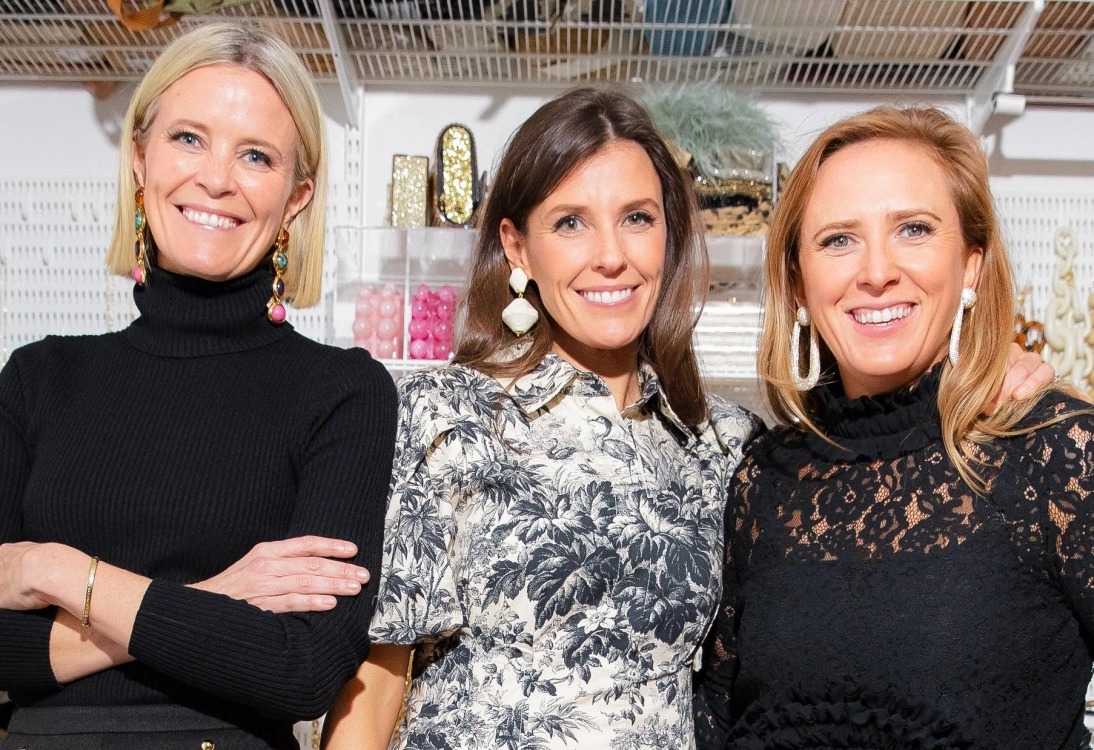
Tuckernuck is inseparable from its trio. Gailliot drives overall vision, new initiatives and much of the strategic arithmetic. Grayson and Votta bring their own strengths across buying, operations and design. Their history offers the ease of old friends and the bluntness of family. It also produces a useful tension: a shared sensibility without a single person pretending to possess every skill.
The culture around them became a measurable part of the story. Tuckernuck reported 100 percent employee retention in 2020 and 2021, followed by 98 percent in 2022. A quarter of its staff had reached five years with the company by early 2023. Gailliot attributed the record to deliberate hiring, direct feedback and values shaped with employees. The lesson was not that work had become a perpetual house party above a garage. It was that standards and warmth need not be enemies.
From a browser window to three very different doors
Physical retail arrived slowly, then geographically. In September 2025, Tuckernuck opened a 4,200-square-foot flagship at 1121 Madison Avenue in New York. Gailliot described stores as “test kitchens,” places where the team can watch what customers touch, try and request. The metaphor is revealing. A shop is not merely a billboard with a cash register; it is research conducted at conversational distance.
The Madison Avenue store was designed as a chic friend's apartment, complete with pale oak, antiques and a shell mirror that nodded to Nantucket. Six months later, Tuckernuck moved into a new 4,000-square-foot Georgetown flagship at 1267 Wisconsin Avenue. The fitting rooms included small service doors, allowing staff to pass in another size without staging the familiar retail farce of a half-dressed customer wrestling with a curtain. It was a tiny piece of design based on a recognizable annoyance, which is often where good retail lives.
In June 2026 came A Sailor's Valentine, a capsule store of less than 500 square feet on Nantucket. Artisans applied more than 40,000 shells across its ceiling and walls over 250 hours. The smallest store carried the largest emotional charge. Tuckernuck was named for the secluded island west of Nantucket, a place the founders associated with discovery and escape. Fourteen years after the garage, the brand had opened a shop near the geography of its own origin myth.
Three co-founders, $500, Shopify and an office above a Georgetown garage.
Tuckernuck launches private label, turning assortment gaps into original designs.
The Madison Avenue flagship opens in Gailliot's adopted home city.
New Georgetown and Nantucket stores open; Gailliot wins EY's Mid-Atlantic entrepreneur award.
The incurable habit of noticing
Gailliot lives near the Metropolitan Museum of Art, which has made it difficult to switch off the part of her mind that is always collecting. She walks through galleries photographing sleeves, necklines and details in portraits. Her children have asked why she takes covert pictures of interestingly dressed strangers on the street. Grace Kelly films, coffee-table books, ski clothes and friends' labels all enter the same visual filing cabinet.
Her own style has been described as “tomboy chic”: cropped trousers, a blazer, a startling shoe or a substantial piece of jewelry. At market appointments and line reviews, the pieces she wants receive the initials HTH, for “have to have.” On the company's founder page, the executive biography becomes more domestic. Her office nickname is JoMoGa. Her happy place is Nantucket. She craves bagels with cream cheese, names Working Girl as her favorite movie, and is known for making bacon pancakes.
These details might look like brand decoration. In Gailliot's case, they explain the mechanism. Tuckernuck sells the idea that efficiency need not be drab, that a busy life can contain a bright print, a useful blazer and a little fun. The CEO embodies the same combination: a financier's respect for constraints, a merchant's eye for the object people reach toward, and a founder's willingness to keep looking long after the first answer worked.
What patience looks like at fourteen
In June 2026, Gailliot was named an EY Mid-Atlantic Entrepreneur Of The Year. By then, Tuckernuck had become large enough to make its garage origin feel polished by repetition. But the meaningful continuity is not scenic. It is the company's method: curate before designing, learn online before opening stores, let a hit dress be a hit without allowing it to become the whole personality.
Fashion runs on the promise of the next thing. Gailliot has built her business by preserving room for the familiar: old photographs, summer places, traditional silhouettes and the friendships that existed before the company. The twist is not nostalgia alone. It is nostalgia managed by someone who knows her numbers. That may be why Tuckernuck has lasted. It sells the pleasure of seeming effortless, while its CEO remains very busy making the effort count.