Ashley Kiolbasa has spent most of her career marketing things that work best when nobody notices them. A fraud decision arrives before the checkout spinner has time to become annoying. A recruiter finds the right candidate without seeing the software sift the haystack. An identity check decides that you are you, then gets out of the way. Invisible machinery is a wonderful product experience and a difficult marketing brief.
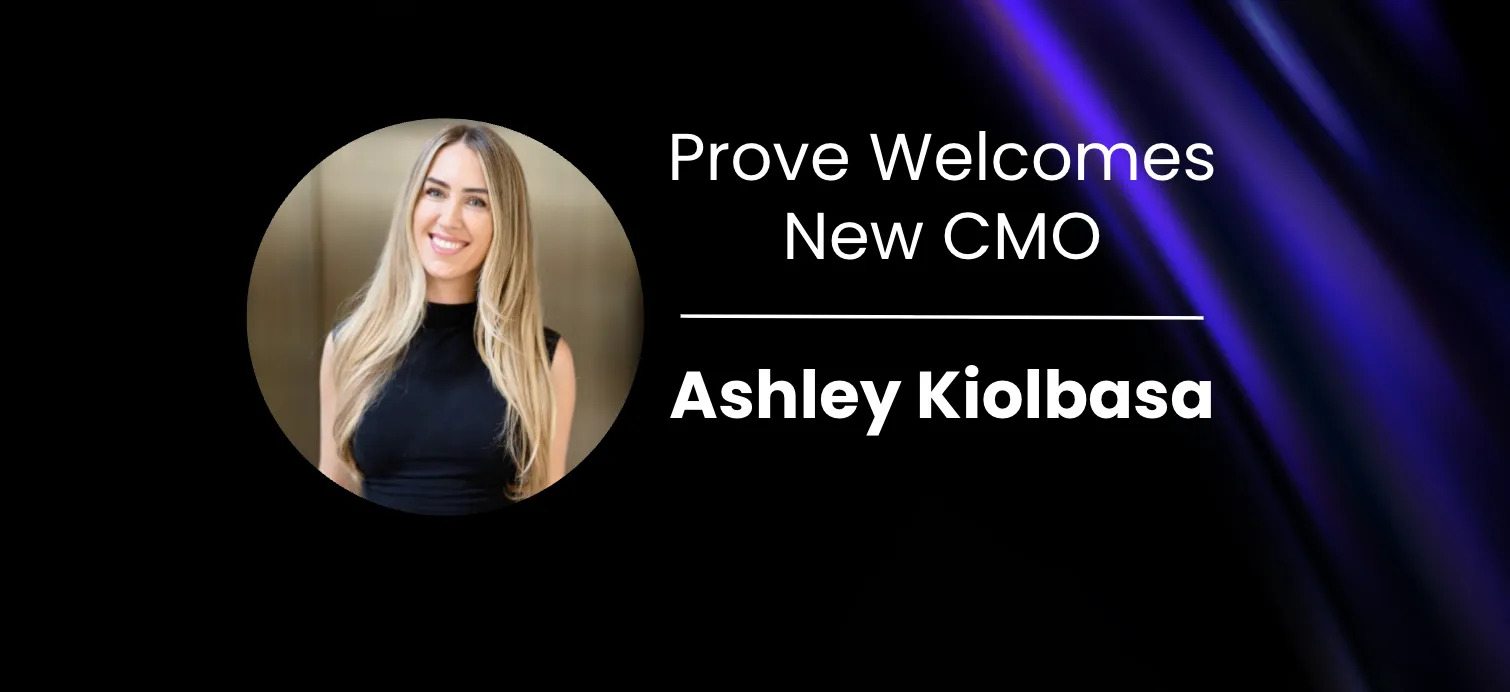
Now, as Chief Marketing Officer of Prove, Kiolbasa is responsible for explaining perhaps the most invisible system of all: digital trust. The company appointed her in May 2025 to oversee global brand, demand generation, product marketing and communications. It was a large mandate attached to a plain human question. When someone opens an account, signs in or buys something online, how can a business let the right person through without treating them like a suspect?
That question has followed her from cybersecurity to recruiting technology, ecommerce protection, checkout and identity. Her résumé looks like a tour of the systems hiding underneath modern commerce. Read from the bottom up, though, it is a study in accumulation: learn the technical product, find the human consequence, make the market care.
A ladder built from difficult subjects
Kiolbasa's public work history begins in 2012 at Christie Communications and then Lastline, a cybersecurity company. At Lastline she moved from administrative assistant to product marketing manager. There is something pleasingly unvarnished about that beginning. Before leading a global marketing function, she learned a technical business from close range and changed lanes from keeping the operation moving to explaining what it made.
In 2016 she joined Entelo, whose recruiting software used machine learning, predictive analytics and social signals to help companies find candidates. She became a senior product marketing manager and led research for an annual recruiting trends report. A former manager later described her as the colleague who could be handed nearly anything and would figure it out - prepared, solution-oriented and rigorous about turning an answer into a plan.
Then came a deliberate interruption. In 2019, Kiolbasa completed an International MBA at IE Business School and spent part of the year as a general management MBA intern at SAP. She returned to operating in 2020 at Signifyd, first as head of product marketing, then director, then senior director of product marketing and communications.
Signifyd put her at the awkward hinge between safety and welcome. Ecommerce fraud tools must stop bad orders, but blunt rules can also reject legitimate customers. A mismatch between billing and shipping addresses may signal theft. It may also signal a birthday present. Security has to recognize the difference quickly, because the customer is already at the register.
“The bigger the network, the more powerful the fraud prevention is going to be.”Ashley Kiolbasa, on machine-learning fraud detection
Her public comments during those years show a marketer comfortable stepping into the details. She spoke about machine learning gaining value from network-scale data. She discussed consumer abuse, the murky territory where the cardholder is real but the claim may not be. During a shortage of infant formula in 2022, she gave reporters a concrete measure of the ugliness: Signifyd had seen attempts at fraud involving the product rise more than 1,500 percent since the beginning of April.
The numbers were newsworthy, but the broader lesson was about consequence. Fraud software is not merely a model with a score. It determines whether a merchant loses inventory, whether a real shopper gets embarrassed at checkout, and whether a scarce product reaches the person trying to buy it. Kiolbasa's job was to translate the model into those stakes.
Friction is not the enemy. Pointless friction is.
After Signifyd, she became vice president of marketing at Skipify in 2024. The setting changed from protecting the order to smoothing the payment. Skipify worked on connected wallets and commerce identity, surfacing cards at checkout so a shopper could move through the purchase with fewer taps. Kiolbasa described one partnership's resulting experience as so frictionless it felt “more like magic than software.”
Magic, in technology, is usually a compliment paid to painstaking systems. Kiolbasa's path shows both sides. She has marketed the lock and the door, the fraud model and the faster checkout. This makes the usual argument between security and growth look incomplete. Customers want both. The craft lies in placing resistance where risk demands it and removing resistance where it adds nothing.
Recognition, faster onboarding and fewer unnecessary challenges make security feel like service.
Identity, device and behavioral signals help reserve friction for interactions that actually carry risk.
That balance is now central to her work at Prove. The company uses phone-centric identity and authentication tools to help businesses verify customers, mitigate fraud and simplify onboarding. When Prove announced Kiolbasa's appointment, founder and CEO Rodger Desai pointed to her experience across identity, security and commerce. Her own statement focused on the arrival of AI and the need for a trusted digital identity network.
When the browser stops browsing
In 2026, Kiolbasa sharpened the argument. Speaking on a live fintech marketing panel, she said people had begun offloading the chore of browsing to AI, changing the customer journey at its foundation. The old path assumed a person would search, compare, click and convert. Agentic commerce inserts software into that sequence - perhaps handling most of it.
The marketing consequences are immediate. A brand may need to persuade an algorithm before it welcomes a person. The identity consequences are even stranger. A merchant needs confidence that the agent has authority to act, that the account behind it is legitimate, and that a smooth automated purchase does not become an automated fraud spree.
At a Money20/20 conversation with Nicole Casperson, Kiolbasa put the new problem plainly: trust is no longer only between people and businesses. It must also account for agents acting on people's behalf. Her point did not require science-fiction staging. The tools are already here; the social contract is catching up.
“Not only do we have to think about this world where we're trusting the businesses that we interact with, we have to think about the agents acting on our behalf.”Ashley Kiolbasa at Money20/20
This is unusually fertile territory for a CMO. The category is technical, the risk is visceral and the vocabulary is unsettled. “Identity” can mean a document, a device, a collection of attributes, a reputation or a persistent relationship. Marketing cannot solve those distinctions by decorating them. It has to give customers a useful mental model.
Kiolbasa's recurring choice is to begin with trust. It is a word broad enough to unite authentication, fraud prevention and customer experience, yet familiar enough to survive outside a product diagram. Used carelessly, trust becomes corporate wallpaper. Used with specifics - the account opened, the agent authorized, the real shopper recognized - it becomes a way to understand the machinery.
The room is part of the system
There is another thread in Kiolbasa's public work: who gets to have the conversation. She has appeared on panels about women leading ecommerce through uncertainty and has helped convene Women Who Prove gatherings. In March 2026, she moderated a breakfast conversation with leaders from Capital One, Fanatics and Amazon Web Services on authentication, gaming, prediction markets, fraud and infrastructure.
Her reflection afterward was concise: “The future of trust is being built by the people in rooms like this.” It is the operator's version of community. A room is not merely a photograph after the panel; it is where people compare edge cases, argue over standards, make introductions and decide which problems deserve resources.
Kiolbasa has also described the value of industry events in distinctly non-transactional terms: friendships, late-night balcony conversations, genuine connection. For a marketer of digital identity, this is more than pleasant symmetry. Trust at internet scale still depends on human relationships among the people building the rails.
Translate the machine into a moment
The stealable idea from Kiolbasa's career is not a campaign template. It is a way of choosing the story. Start with the moment the system touches a life: the customer waved through, the fraudulent order stopped, the card already waiting at checkout, the AI agent recognized as authorized rather than merely active.
Then preserve the tension. Safety and speed are not natural enemies, but neither are they automatically friends. A useful product earns its place by managing both. A useful marketer explains that trade without sanding away the hard part.
Kiolbasa reached the C-suite by returning to that work across several categories. Cybersecurity taught her about adversaries. Recruiting technology taught her about data and decisions. Signifyd taught her the cost of both fraud and false rejection. Skipify taught her how identity can disappear into a better checkout. Prove gathers those lessons beneath a larger claim: the next internet will need a way to establish confidence among people, businesses and the software acting between them.
The best infrastructure vanishes into the experience. The best story makes us notice what its disappearance allows. Somewhere between those two sentences sits Ashley Kiolbasa's job - explaining the lock, the key and the small pleasure of a door that opens exactly when it should.