A mobile phone could be a business before it could be a bank. Rodger Desai saw this in micro-lending work: give someone a handset, and they could rent its use to other villagers. One object, passed between people, could create an income. The useful discovery was larger than the device. A phone could change what somebody was able to do.
Desai has kept finding new jobs for that object. He helped build mobile software companies before the smartphone became an everyday possession. He went on to co-found Payfone, which became Prove. Today, his work concerns a question so familiar that most people answer it several times a day without much thought: how do you prove you are yourself?
The answers usually involve typing, waiting and remembering something inconvenient. A password you last used in February. A code that arrives just as you request another one. There is a particular indignity in being locked out of your own account by a machine that insists it is helping. Desai’s career has gradually converged on making that exchange less laborious.
A phone worth sharing
His professional beginnings included engineering management at ExxonMobil and General Electric, followed by Accenture’s telecommunications practice. He graduated from Rensselaer Polytechnic Institute and attended Harvard Business School. The progression brought him close to both the machinery of large organizations and the networks connecting their customers. It also gave him experience with systems whose usefulness depends on working reliably for people who never need to understand them.
Vettro, which he co-founded and led, developed mobile applications for businesses. In November 2004, he co-founded Rave Wireless. Its early remit included applications for college students, strengthening campus communication and safety. These ventures belong to the period before downloading an app became an almost unconscious gesture. A phone’s role in institutional life was still being worked out, one use at a time.
There is a consistent choice of subject here. Desai kept working on the meeting point between a person, a device and an organization. The organizations changed. So did the tasks. But the device offered a way to make an existing relationship more useful. A student and a campus could communicate differently. A business could put software closer to the employee who needed it.
Campus mobile applications
Mobile payments
A broader identity business
The microfinance work adds another dimension to this pattern. He has supported initiatives using mobile technology for lending in developing countries. His later business sells to enterprises, yet the earlier work places an individual’s ability to participate at the center of the story. Access means little if the person who needs it cannot get through the door.
The business plan that got a new job
Payfone began in 2008. The original business concerned paying with a phone, including using a mobile account to buy digital goods. Beneath the payment sat a valuable capability: the system needed to recognize the account involved. That capability eventually had a wider purpose than the transaction it had been built to support.
By July 2020, Payfone had adopted the name Prove and announced the acquisition of Early Warning’s Authentify business. The new name described a broader assignment. Identity could matter when someone opened an account, returned to it or dealt with a company’s call center. The payment was one occasion among many when a business needed confidence about the person at the other end.
Desai has written candidly about changing course. A founder’s first idea attracts more than capital; it collects loyalty, explanations and years of somebody’s life. Revising it means asking people to reconsider a story they have helped tell. He advises founders to acknowledge the emotional attachment before presenting the new direction. Even the spreadsheet, it seems, must wait for the feelings.
“Permit yourself to fully grieve your initial business case before you explain your pivot to the world.”
Rodger Desai, on changing a company’s direction
That observation gives the Payfone transition a human scale. The useful idea survived because its application changed. For anyone who has defended a plan past its expiration date, there is an uncomfortable amount to recognize in that sequence.
An interrogation at the front door
On the New York Stock Exchange floor in December 2022, Desai sat down with Judy Shaw to discuss the job Prove was doing. The location suited the subject. Financial markets rely on institutions recognizing obligations and trusting that the party on the other side can fulfill them. Online, even the first question about that party can be difficult to settle.
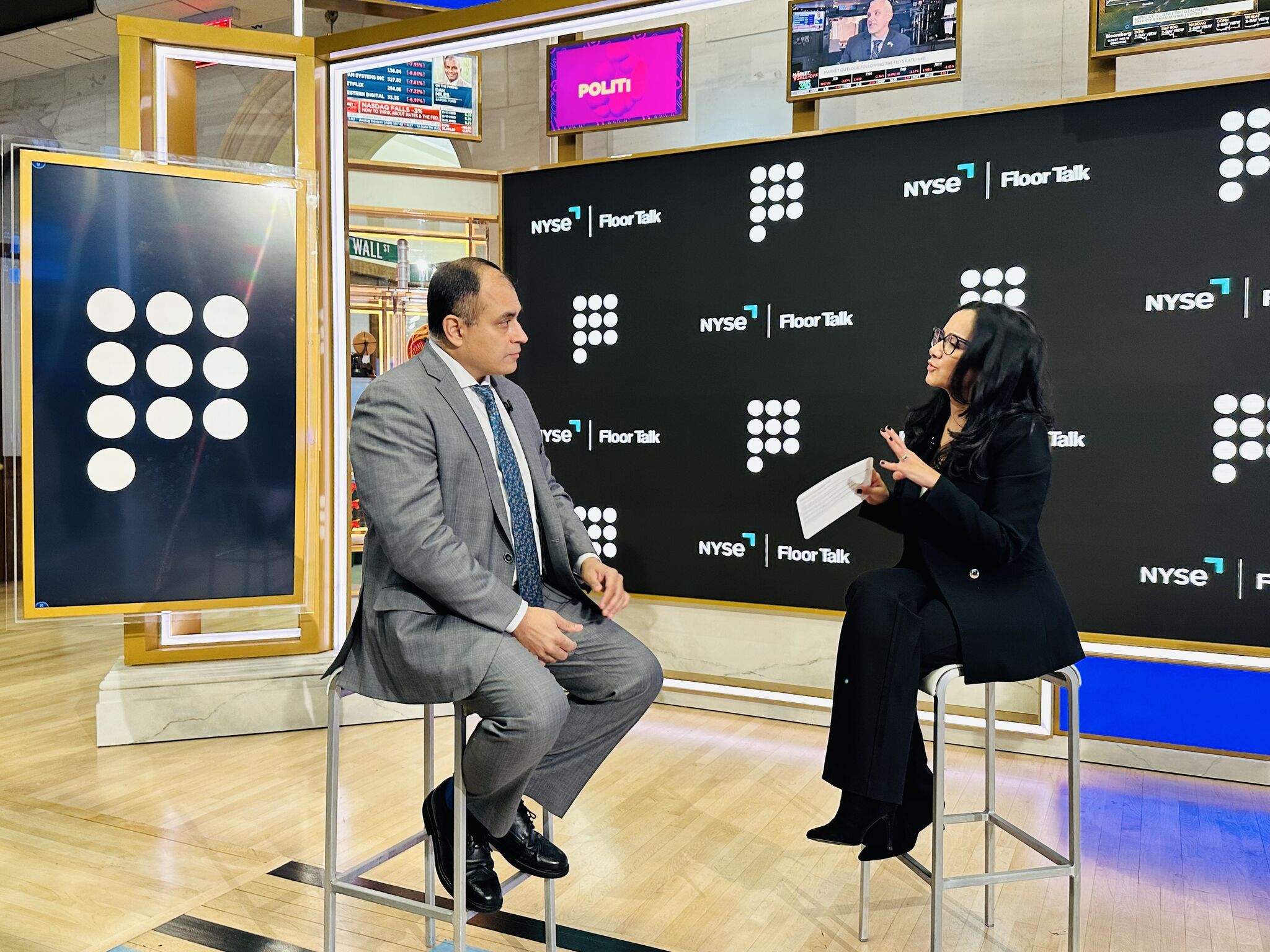
“As we live our lives online, security is paramount,” he said. But his test of a successful system included convenience and privacy as well. People should be able to complete an interaction safely without surrendering unnecessary personal information or navigating a succession of obstacles. Each demand is reasonable. Delivering all three together is the difficult part.
The phone supplies his recurring analogy. Networks already recognize devices as they travel between places and operators. A user can make a call without first reciting a miniature autobiography. Desai’s ambition is to bring more of that background recognition to the internet. The complexity belongs inside the service, where engineers can work on it, rather than in another chore for the customer.
Conceptual illustration. Actual checks depend on the service and transaction.
This is an engineer’s version of hospitality. A good host recognizes a returning guest. An online business needs something more rigorous than a familiar face, but the desired experience has a similar courtesy: welcome the right person without making the welcome itself an ordeal.
The scale behind the small gesture
Recognizing somebody in the background requires infrastructure. In June 2020, Payfone announced a $100 million investment led by Apax Digital. The stated plans included acquisitions, stronger machine learning capabilities and a consortium for sharing fraud and risk signals across industries. A quiet customer experience can require a substantial amount of corporate activity out of sight.
In October 2023, Prove raised another $40 million at a reported valuation above $1 billion.
June 2020
October 2023
That June, Desai had also won an EY Entrepreneur Of The Year New York award. He credited the team and described digital trust as necessary for people to benefit from the digital economy. Awards have a way of making a founder’s name larger than everyone else’s. His response returned attention to the people doing the work and the users meant to benefit.
By 2025, he was included in Okta’s Identity 25. The theme of his account there was borrowing a solution from one industry and applying it to another. That is a useful description of the career: telecommunications as a store of ideas, with the internet supplying fresh problems for them.
A separate number for the security codes
Desai’s public explanations become especially interesting when they reach his own phone. In 2024, he described keeping a dedicated number for two-factor authentication, separate from his everyday number. He also described choosing a carrier without a call center, reducing one route through which somebody might try to take control of it. These are unusually deliberate arrangements for an activity most people regard as routine.
The detail punctures any temptation to treat identity as a solved problem. Even someone who builds authentication systems has to think about where a security code goes and who might persuade an intermediary to redirect it. The machinery around the phone matters as much as the rectangle in a pocket.
His interests extend beyond the company. Desai serves on the board of Freedom House, whose work concerns democracy and human rights. His public biography also places earlier mobile microfinance work alongside his commercial roles. These are distinct commitments, but they broaden the picture of what he chooses to spend time on: institutions, participation and the conditions under which people can act.
His LinkedIn introduction is considerably shorter than this account: “i help start and run companies”. Six words, with little ceremony. After the funding announcements and the technical vocabulary, the understatement is refreshing. Running a company already provides enough opportunities for a longer explanation.
The next caller may be software
In July 2026, Desai returned to the cost of friction. His argument was economic as well as technical: a legitimate customer may leave when a process becomes annoying, while a motivated fraudster has a reason to endure it. Adding work can therefore burden precisely the person a company wants to keep. A queue measures willingness to wait; it offers limited insight into intentions.
AI gives the question another turn. If software can act for someone, a service must consider who authorized it and what evidence deserves trust. Desai’s recent writing emphasizes device possession, behavioral signals and cryptographic authentication. The direction remains familiar: establish confidence beneath the interaction instead of relying entirely on how convincing the interaction looks.
In October 2026, Prove published an announcement extending SIM-based silent authentication to supported Wi-Fi and mobile web sessions. The practical purpose was to verify device possession without requiring a direct cellular data connection or an SMS one-time passcode. It is a specific development in a long pursuit of fewer interruptions.
There is an appealing modesty to the result Desai keeps describing. The customer gets into the account. The purchase goes through. Somebody continues with their day. Years of engineering disappear into a moment that scarcely merits remembering. For a founder whose early lesson came from people sharing a phone, that remains a recognizable measure of usefulness: what did the device let somebody do?