Before a loan comes a surprisingly awkward question: who, exactly, is asking for it? Amartha, an Indonesian financial technology company serving women entrepreneurs in rural communities, has to answer that question across an operation that combines software with visits from field agents. A digital application can move quickly. The identity check attached to it can still move at the speed of paperwork.
- Element supplies identity checks inside other companies’ services.
- Its claimed 2KB biometric model supports local authentication.
- Amartha, Access Bank and Cebuana Lhuillier show three different routes to customers.
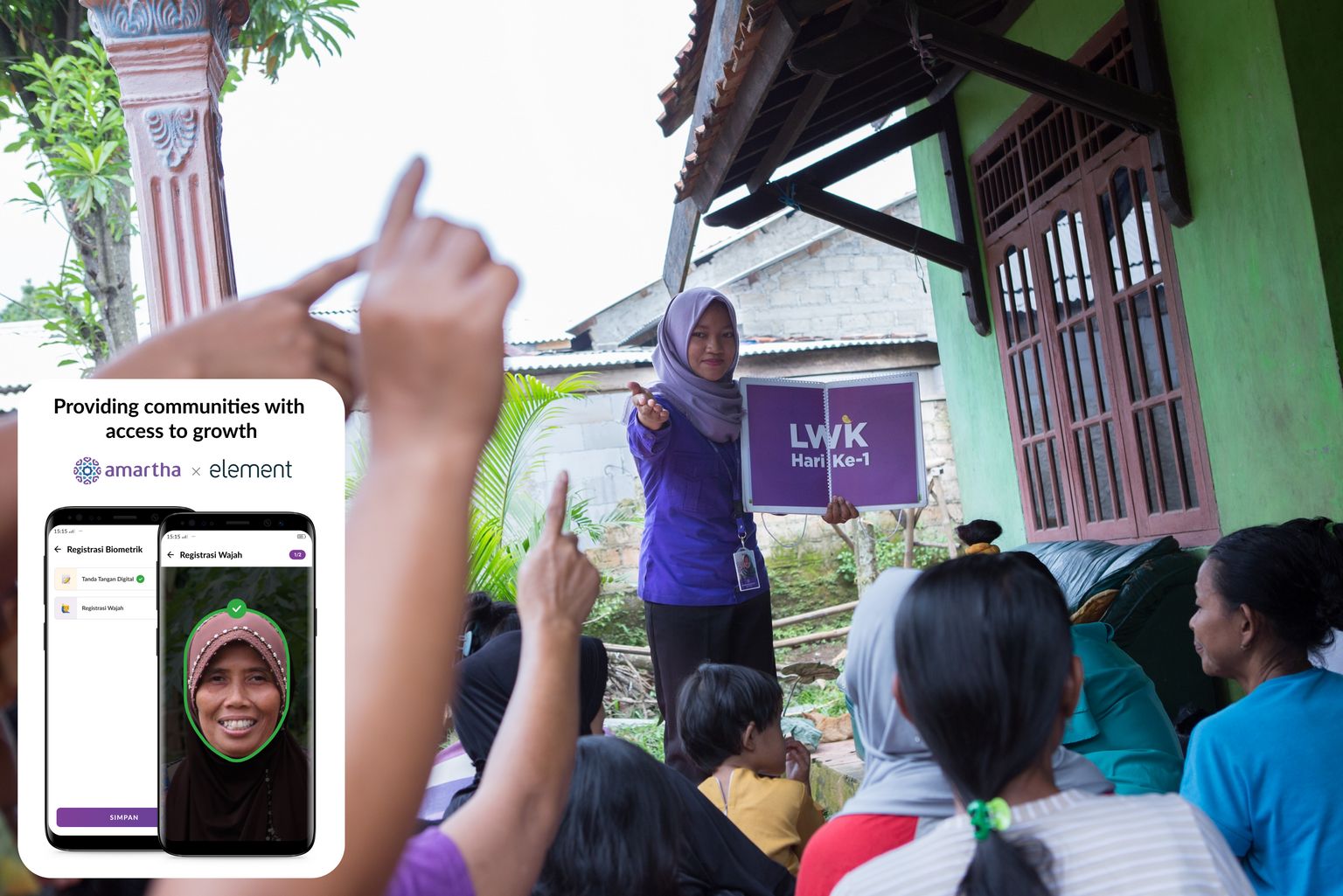
In January 2022, Amartha and Element announced a partnership combining selfie enrollment, liveness checks and automated processing of Indonesia’s e-KTP identity card. The intention was practical: shorten loan approvals, reduce errors and make impersonation harder. The glamorous part of artificial intelligence, in this case, was helping a lender get through the forms.
The identity check before the loan
At the time of that announcement, Amartha described almost 3,000 field agents and operations in more than 19,000 villages. These were Amartha’s figures, not Element’s deployment totals. They nevertheless explain the product problem. The person using an identity system may be a borrower, an agent helping a borrower, or both. Designing only for someone alone with a new smartphone misses a considerable portion of the journey.
Element’s job is to supply the verification machinery. Amartha retains the lending relationship and credit decision. A successful face match does not make a loan affordable. It helps establish that the person presenting an application is the person associated with the identity being checked. That distinction gives the technology a useful, bounded role.
Small enough to travel
Element was founded in 2012 by Adam Perold and Yann LeCun. Its proposition is mobile, software-based biometric identity: turn a camera-equipped device into a means of recognizing a person. Today, the company groups its offering into eKYC, authentication and a risk platform. Banks and digital businesses integrate those capabilities through SDKs and APIs.
The company’s stated biometric user-model size. Configurable for device or server processing; this is not the size of the entire app.
The detail worth lingering over is the user model. Element describes a compressed, portable biometric profile of 2KB, with processing configurable on a device or server. Think of it as a representation used for matching, rather than a miniature portrait. The company also offers real-time selfie authentication on the device, including offline availability.
There is an engineering philosophy here: place less weight on the connection between the customer and the service. Local matching can reduce the need to send each authentication request away for processing. But an offline face check does not make a government database available offline. The document and database portions of a workflow remain separate dependencies.
A selfie is the beginning
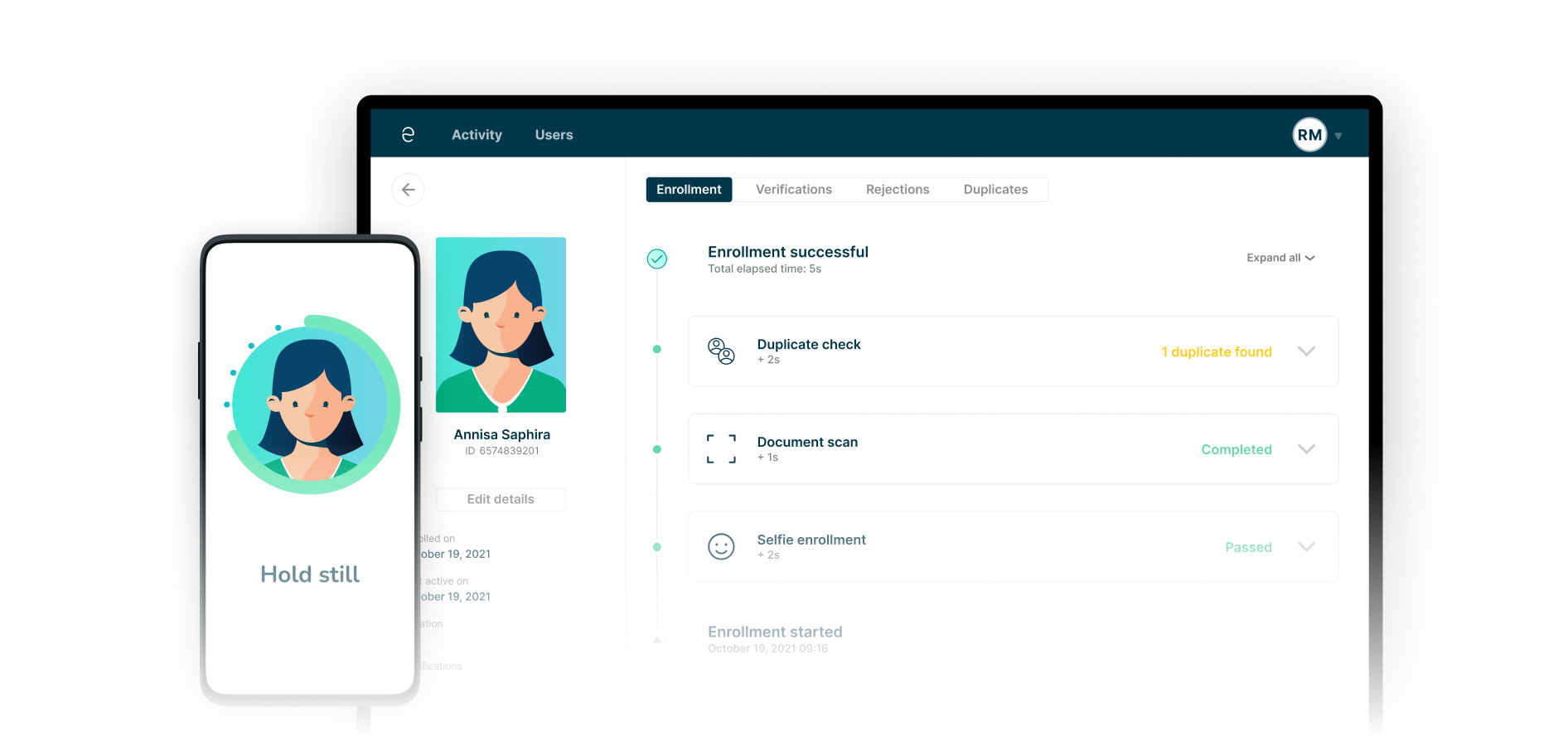
In Element’s onboarding pipeline, a customer scans an approved identity document, enrolls a face, passes a liveness check and receives a matching result. Optical character recognition extracts information from the card. Licensed APIs can connect to regulatory databases. A confidence score can be supplemented by human validation. Each step answers a different question; a cheerful green tick should not obscure that fact.
- 01Read the IDExtract document information
- 02Enroll the faceCreate the biometric model
- 03Check livenessAssess presentation attacks
- 04CompareScore the identity match
Liveness concerns whether the camera is seeing an acceptable live presentation, rather than an attempted spoof. Document verification concerns the credential. Matching concerns the relationship between the face and the claimed identity. Element lets customers configure thresholds and use passive or interactive implementations. Convenience is therefore a design choice to be tested against the institution’s requirements.
Days become minutes
The June 2022 Cebuana Lhuillier partnership supplies a more concrete measure of the bottleneck. Its announcement described a previous manual validation and verification cycle of three to five days, and a mobile process taking minutes. The scope included Cebuana Xpress, a digital pawning and remittance application. That is a reported operational change, not a universal guarantee for every customer.
Reported verification cycle: manual processing → mobile onboarding.
Access Bank’s 2020 partnership covered FacePay, Access More and WhatsApp Banking. Bank BRI’s announcement targeted BRImo and lending applications, with broader embedded-finance plans. Element’s distribution logic becomes clear: supply the identity layer within recognizable services. Customers do not need to adopt another consumer destination merely to prove who they are.
The science behind the sales pitch
In April 2018, Element announced a $12 million Series A led by PTB Ventures and GDP Venture. Banking and telecom venture units participated. The composition matters: an identity provider benefits from relationships with institutions that already possess service networks, transaction flows and reasons to verify people.
“Identity inclusion is a precursor to financial and health inclusion”David Fields, PTB Ventures · 2018 financing announcement
Research remains part of the company’s public identity. Its DECORE post discusses compressing neural networks for memory and computation budgets. A later graph-learning paper, co-authored by Perold, addresses long-range relationships and computational efficiency. The risk page describes graph-based fraud systems being built. Research results and a production fraud-detection outcome are different kinds of evidence.
Element occupies a market shared with identity-verification vendors such as Jumio and Veriff. Its distinctive emphasis combines small portable models, on-device authentication and integrations tailored to regional services. Its privacy language centers on abstracted models it says cannot be reverse-engineered. That promise should be evaluated alongside the documents, permissions and retention practices of the complete customer workflow.
Build for the person holding the phone
The business is enterprise software sold through a sales conversation and embedded in partner products. A buyer’s useful checklist follows from the architecture: device performance, document coverage, connectivity, review paths and the time required to complete the whole application. Measuring a fast face match alone would be an excellent way to miss a slow service.
The copyable lesson is to make the identity check fit the institution’s existing route to people. For Amartha, that route includes field agents. For a bank, it includes familiar apps. Element’s smallest number makes its largest point: access depends on whether the machinery can travel with the person who needs it.