Before he helped banks decide whom to trust, Tommy Nicholas helped people pretend they were sitting in a coffee shop. Coffitivity supplied the background sound: conversation at a distance, the agreeable bustle of other people doing something. You could have the atmosphere without buying another coffee or negotiating possession of the table near the socket. It was a modest piece of internet ingenuity, built by four people in Virginia. Nicholas would eventually work on a question with rather more paperwork attached: what must happen before a stranger is allowed to open a bank account?
His career makes an interesting journey from the audible to the invisible. One early project announced itself through your speakers. Alloy, the company he co-founded in 2015, works beneath the surface of financial products. Its decisions can help determine whether an application proceeds, a transaction needs attention, or another check is required. The ordinary customer generally wants to get on with something else. Nicholas has spent years considering what makes that possible.
A little noise from Richmond
Nicholas graduated from the University of Virginia in 2011. His early work included The City Swig, a Charlottesville venture concerned with nightlife deals, and software development at Shockoe in Richmond. These were concrete beginnings: websites, mobile applications, things people could actually use. Before the institutional clients and risk vocabulary, there was the satisfaction of making a page do something.
Learning to code opened that route. Codecademy later featured Nicholas as an example of someone who arrived with almost no programming knowledge and acquired enough to help develop a working product. That product, Coffitivity, reached TIME’s list of 50 best websites of 2013. The leap was from exercises to something strangers found useful. A lesson completed inside a browser had become a reason for other people to open theirs.
Coffitivity’s other creators were Justin Kauszler, Ace Callwood, and Nicole Horton. In the team’s telling, Nicholas also understood the importance of getting the work seen. Callwood credited his timing in posting the site to Y Combinator’s blog with helping it catch audiences on both US coasts. The site launched on March 5, 2013. The following day brought 45,000 page views, with a server crash included. Public interest has a charming habit of arriving before the furniture is ready.
For Nicholas, releasing the work mattered. A clever idea sitting privately on a laptop had yet to meet the people who could tell you whether it deserved to exist. He described the value of repeatedly shipping changes as the audience responded. There is an impatience in that approach, but a practical one: put something into the world, learn what happens, and have another go.
“So we keep shipping and the idea keeps gaining value.”
Tommy Nicholas, on Coffitivity
A blank page, then a crowded problem
Another early project made the same preference for getting started unusually literal. Nicholas and Scott Clark developed Blank Slate, a browser writing tool introduced in Coffitivity’s Coffee Talk series. Open it and begin typing. The current application lets writers format text, share a public link, and export their work. Its central invitation is wonderfully direct. Here is some space. Use it.
The move into payments brought him up against a less cooperative sort of blank slate. At Knox Payments, where he served as Head of Product in 2014 and early 2015, the work led toward the identity and risk problems that would become Alloy’s business. Building financial technology meant deciding whether customers were who they claimed to be and whether particular activity should be allowed. Those questions kept demanding their own machinery.
Nicholas describes the discovery as a builder’s frustration. Financial companies could buy payments infrastructure, yet were expected to assemble much of their risk decision process themselves. Information existed in separate places. Someone still had to connect it, decide what happened next, and keep a record of the outcome. The gap lay between having signals and operating a system that could act on them.
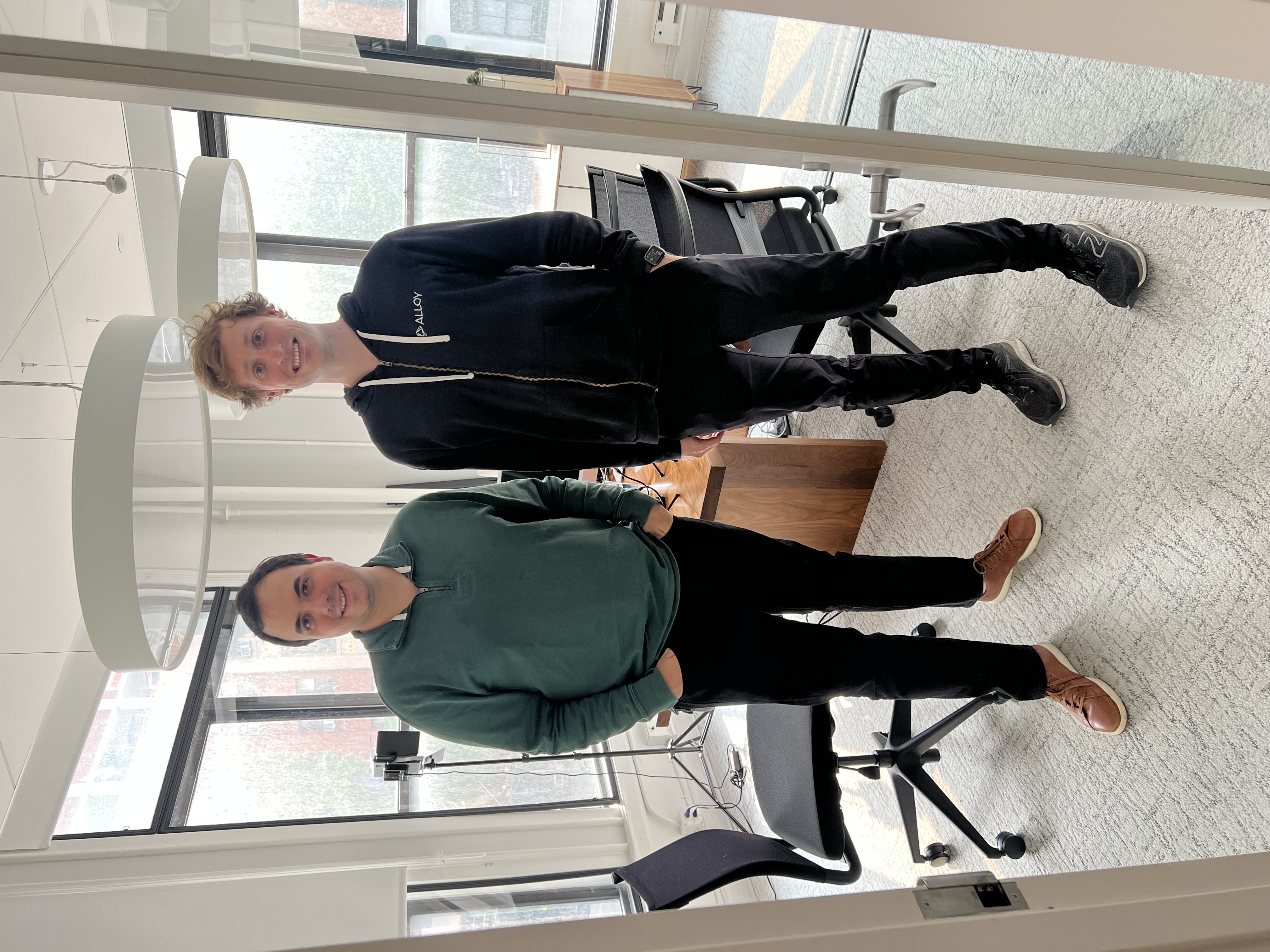
In 2015, he founded Alloy with Laura Spiekerman and Charles Hearn. The partnership is central to the story. Spiekerman became president; Hearn became chief technology officer. Nicholas supplies a deliberately unflattering explanation for his own title, joking that his relative weakness as an engineer made him the appropriate candidate for CEO. It is a useful introduction to his public manner: technically fluent, conversational, and quite willing to make himself the punchline.
The years between announcements
A product that connects other products can sound simple until you count the connections. Alloy’s proposition required financial institutions to entrust important decisions to a young company. Nicholas has described the first four years as difficult, with the business coming close to shutting down. He also acknowledges that the founders had commercial lessons to learn. Understanding the problem did not automatically teach them how a large customer would buy its solution.
That distinction gives his account some texture. Persistence alone is an incomplete explanation of a company surviving. The team had to improve its understanding of selling as well as building. Nicholas’s later advice to founders leaves room for changing course, accepting a lower valuation, or returning money. There is no useful obligation to keep a business alive merely to preserve the appearance of progress.
By September 2019, there was a more conventional announcement: a $12 million Series A led by Bessemer Venture Partners. Alloy said it had run more than two million evaluations during the preceding year. The nouns had changed from page views to evaluations. Both counted encounters with real users; the latter carried the additional consequence of helping a financial company decide what to do.
The $40 million Series B followed in September 2020, led by Canapi Ventures. Nicholas described plans to extend the platform into transaction and credit decisioning, document verification, and stronger analytics. There was also a less glamorous proposal: a learning portal to help customers use the system. Infrastructure needs explanation as well as engineering. A tool does little good if the person responsible for it cannot understand what to do on Monday morning.
Growth also had a human count. When Alloy celebrated its hundredth employee in 2021, Nicholas expressed surprise that so many people cared enough about the company to help build it. That reaction is more revealing than a recruitment boast. A project can begin as a small group’s shared conviction and eventually become the place where a hundred people spend their working days. The arithmetic acquires faces.
In September 2022, Alloy announced another $52 million in funding at a $1.55 billion valuation. It had expanded into 40 countries and was processing more than a million decisions daily. These are dated milestones in the company’s development, each marking a larger surface on which the original problem had to be solved. Every additional market brought more people trying to enter financial services through a digital door.
Who gets through the door?
Nicholas’s interest in access has a specific example attached. In a 2023 essay, he described customers asking to use citizenship information to deny non-US applicants. Alloy changed its terms in 2019 to prohibit that use. The decision made its stated ambitions tangible: a company selling identity infrastructure was setting a boundary around how customers could apply it.
His larger aspiration is a financial industry in which legitimate customers have more ways to participate. That ambition gives the fraud business a second obligation. A system must consider the person it turns away as well as the activity it catches. For a founder, the interesting work sits inside that tension, where a field in a workflow can affect somebody’s ability to use a financial product.
Who is asking?+Context
What is happening?
By June 2025, Alloy reported more than 700 clients globally and offices in New York and London. Its named customers included credit unions, a bank, and UK investment platform IG Group. The company also appointed Dustin Lawler as chief operating officer and promoted Kim Nguyen to chief people officer. The founder’s task now included sustaining an organization serving very different institutions, well beyond the original team’s immediate reach.
The next applicant may be an agent
His recent writing brings the same concern into AI. In June 2026, Nicholas argued for putting automated work inside the existing risk process, where the system can account for earlier checks and permitted actions. A response that sounds plausible is an inadequate basis for a financial decision. The surrounding information, the sequence, and the authority to act matter. His emphasis remains on connecting the pieces.
By September 2026, he was writing about another approaching complication: AI agents acting on behalf of customers. A financial institution would need to determine who authorized an action and what the agent was permitted to do. Simply treating every automated user as an intruder would become awkward when a legitimate customer had sent one. The doorman would need a better question.
That is a fitting continuation of Nicholas’s career. He began by helping people make use of a room they were not sitting in, then helped give writers a place to begin. At Alloy, the question became whether someone could enter a financial service and act within it. Now the visitor might arrive through software of their own. There is still a person behind the request. There is still work to do before saying yes.
Follow the conversation
More from Nicholas, his early projects, and the conversations behind this profile.
- Alloy Company and platform
- LinkedIn Tommy Nicholas
- X / @tommyrva Public profile
- Nicholas on Medium Essays and early writing
- Blank Slate A place to start writing
- Watch: The Peel interview ↗ Company building with Turner Novak
- Watch: Coffee Talk ↗ The early Blank Slate project
- Fintech One-on-One Payments, risk, and Alloy’s beginnings
- Fintech Leaders The early years, with Miguel Armaza
- Meeting the AI moment Nicholas’s September 2026 essay
- Eight years of Alloy His account of access and company values