The most important screen in digital banking may be the one the customer never sees. A person taps “open account,” supplies a name, address and Social Security number, and waits. Behind that tidy form, a small bureaucracy wakes up. Is the identity real? Does the phone belong to the applicant? Is the address plausible? Is the person on a sanctions list? Is this a good customer with a thin file, or a synthetic identity assembled by someone patient enough to look ordinary?
Alloy sits in that hidden room. The New York company connects banks, credit unions and fintechs to hundreds of identity, fraud, compliance and credit-data products, then lets each institution decide how those signals should be combined. One bank may approve an established customer immediately. Another may ask for a document. A third may send the same case to a human. Alloy does not claim that a single database has the truth. Its product is the machinery for reaching, testing and documenting a decision.
That distinction matters in a category stuffed with vendors selling identity scores. Alloy calls itself an identity and fraud prevention platform. The plainer description is a control plane for financial risk. Its customer is not the person opening the account. Its customers are the risk, compliance, product and operations teams trying to let that person through without also opening the door to a fraud ring.
The first thing that failed was more fun
Tommy Nicholas and Charles Hearn were high-school friends who went to the University of Virginia and, after graduating, started The City Swig, an app for finding nightlife. It lasted less than a year. That failure did not reveal Alloy fully formed. It did establish a working partnership, and it sent both founders toward a problem with fewer velvet ropes and more durable budgets.
At Knox Payments, Nicholas led product, Hearn led engineering and Laura Spiekerman handled business development and partnerships. The company was working on faster bank transfers over the Automated Clearing House network. Yet the hard part kept appearing beside the payment itself: verifying the user, checking fraud, satisfying anti-money-laundering rules and proving to an auditor that the right checks had occurred. Fintech companies were individually wiring data vendors into their own products. Every integration created another dependency. Every change asked an engineer to revisit the plumbing.
The three founded Alloy in 2015 around a useful observation: the repeated mess was the opportunity. Their first wedge was a KYC API that aggregated data sources and returned a result. Early customers then delivered the sentence that changed the product: the API was good, but banks needed software around it. They needed to see cases, edit rules, route reviews and show their work. Alloy moved up the stack without discarding the API underneath.
“If we do our jobs right, we're fully in the background, and you would never know we were there.”Laura Spiekerman, co-founder and president
Investors did not immediately applaud. Nicholas has said the team spoke with 100 investors and got 100 noes. Techstars became the practical bridge. Contemporary reporting says its Barclays accelerator supplied $20,000 for 6 percent of the company, while a related fund added $100,000. The terms look expensive from the vantage point of Alloy's later $1.55 billion valuation. At the time, the money, bank adjacency and credibility helped a young team sell mission-critical software to cautious institutions.

One API grew into a risk operating system
An Alloy “Journey” is a configurable sequence. The bank sends an application through the API. Alloy calls selected data partners and internal sources, applies the institution's rules, and returns approved, denied or manual review. If more evidence is needed, the Journey can request a document or trigger step-up authentication. Every decision remains attached to the applicant or business entity, creating an auditable history rather than a folder of disconnected checks.
Anatomy of a quiet yes
The valuable output is not merely a score. It is an explainable action tied to the institution's policy.
The company expanded along the same customer record. Transaction monitoring brought logins, transfers and profile changes into the system after account opening. Credit underwriting added bureau, cash-flow and alternative data. Perpetual KYC and KYB watch for changes in customers and businesses instead of treating compliance as an annual snapshot. Investigations and case management give analysts a place to resolve the exceptions.
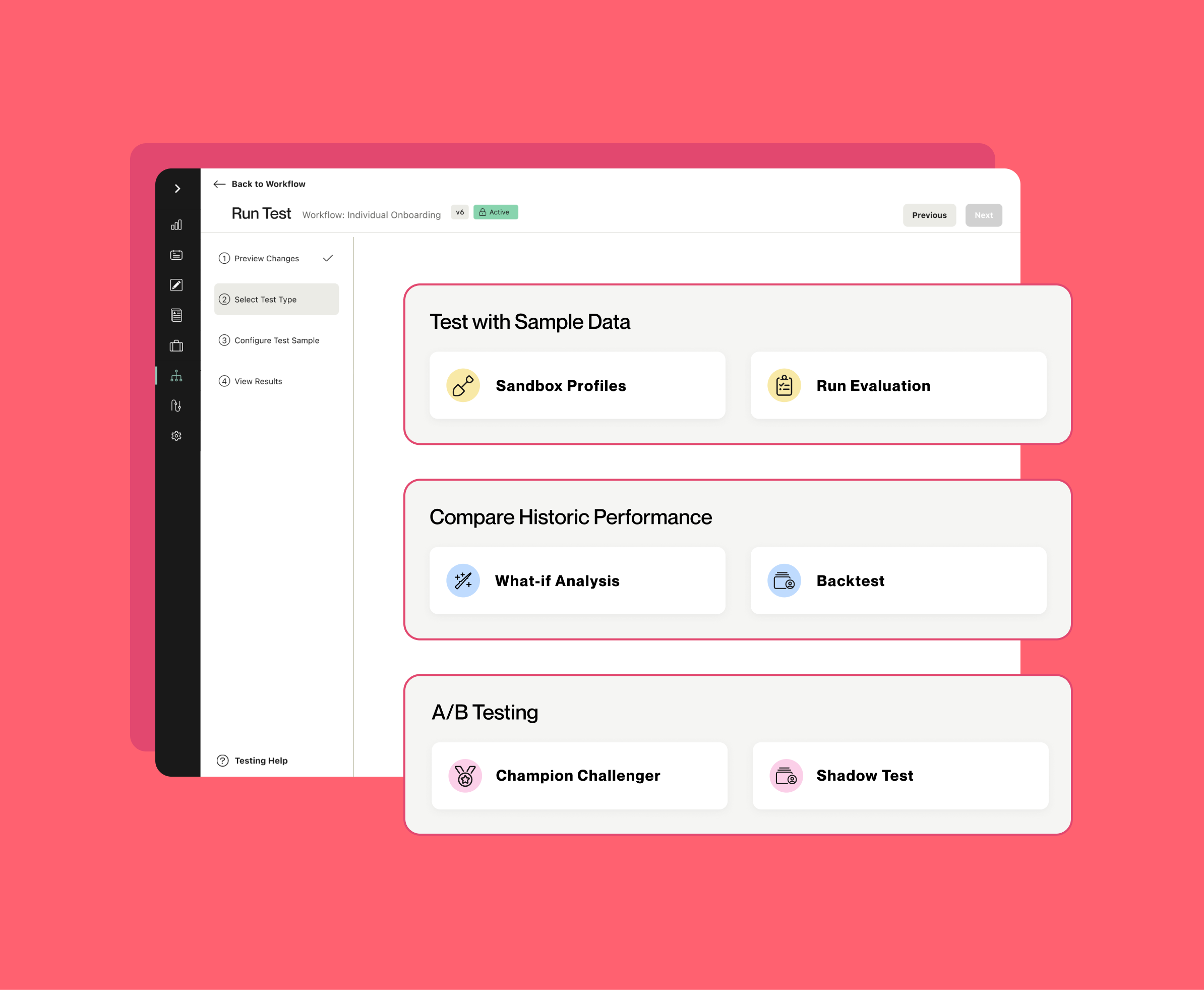
Its testing suite is an especially practical piece. A risk team can run a proposed policy against historical data, see how approval, denial and review rates might change, compare vendors, version the workflow and roll back. This turns risk policy into something closer to software deployment. The institution can experiment, but with an audit trail and without using live applicants as the first test population.
The business is the tradeoff
Fraud prevention is not a contest to produce the most declines. A perfect wall stops every thief and every customer. Financial institutions need to reduce losses while keeping legitimate conversion high and manual review manageable. Alloy's case studies report what that negotiation can look like: IncredibleBank automated 90 percent of account openings; Grasshopper cut manual reviews by 58 percent; Ramp improved fraud-detection efficiency by 75 percent. These are individual deployments, not universal promises, but they reveal what buyers pay for.
Alloy sells enterprise software rather than a consumer product. It does not publish list pricing. The likely bill reflects the platform modules, decision volume, integrations and third-party data used. That matters because orchestration does not eliminate the cost of the underlying checks; it can reduce duplicated engineering, unnecessary calls and manual review. The buyer must compare total operating cost, not simply the platform subscription.
The company has raised about $216.7 million in total funding according to private-company databases and supplied company data. The headline rounds were $12 million in 2019, $40 million in 2020, $100 million in 2021 and a $52 million extension in 2022. That last round valued Alloy at $1.55 billion. Its disclosed customer count climbed from more than 200 in 2021 to more than 900 in 2026. Alloy says one quarter of the 50 largest US banks and six of the 10 largest US credit unions use the platform.
The moat is the neutral middle
Socure, Persona, Sardine, Prove, Trulioo, Entrust, ComplyAdvantage and SentiLink crowd the broad identity and fraud market. Some own valuable proprietary signals; some focus on documents, biometrics, AML data or fraud models; several offer workflow tools. A bank can also build an orchestration layer in-house. Alloy's pitch is that its middle layer remains vendor-neutral. The customer chooses the data products; Alloy connects and sequences them.
That neutrality has two effects. First, Alloy can partner with companies that might otherwise look like competitors. Its public ecosystem includes Plaid, Mastercard, Nova Credit, BioCatch, Equifax, LexisNexis Risk Solutions and scores more. Second, customers can swap or add data providers without rewriting the entire onboarding product. Alloy becomes stickier precisely because it makes the ingredients less sticky.
Scale adds another layer. Working with AWS, Alloy said in 2025 that it could process more than eight billion financial events a month, roughly 1,200 real-time decisions per second and 600 entity onboardings per second. By 2026 its site advertised connections to more than 270 data solutions across 195 markets. The numbers matter because a decision engine that pauses during a bank's busiest hour is not infrastructure. It is an incident.
AI with somewhere to put the answer
Alloy's latest expansion is “Actionable AI.” Fraud Attack Radar looks for coordinated attacks at origination. Fraud Signal applies predictive models across the customer lifecycle. The 2026 AI Assistant summarizes why an application is pending, helps resolve watchlist hits, researches business applicants and recommends the next action. The important design choice is location: the assistant sits inside the same system that holds the policy, workflow history and customer record.
That is less glamorous than a freestanding chatbot and more credible in regulated work. An analyst needs to know why a rule fired, which source supplied a fact, what the policy allowed and where the approved result was recorded. A generic agent may summarize a case yet still force a human to copy the answer back into the system. Alloy's assistant is designed to close that loop while keeping the action auditable. Human approval can remain in the path for sensitive work.
When the playbook does not travel
Alloy is strongest when an institution has meaningful volume, several data vendors, frequently changing rules and a real review operation. A small fintech with one provider and a static policy may be buying a control tower for a bicycle. The model also fails if the organization has no owner for risk policy, poor input data, or weak model governance. Orchestration makes decisions consistent; it cannot make a bad policy wise.
What builders can copy
The portable lesson is not “start a regtech.” It is to look for a repeated integration problem attached to an expensive decision. Alloy entered through one API, then listened when customers needed a control surface around it. It kept the product open to third-party suppliers, so the platform gained value as the ecosystem grew. It expanded along the same object - the customer identity - from onboarding to transactions, credit and continuous monitoring. Each new product reused context already in the system.
There is a sales lesson too. Cautious buyers did not trust three young founders with legal compliance on enthusiasm alone. The Techstars and Barclays relationship offered credibility; sales and legal hires helped formalize contracts; early banks supplied proof. In infrastructure, the product is only half the product. Procurement, security, auditability and implementation are features even when they never appear in the demo.
Alloy's founders traded a visible consumer app for an invisible enterprise layer. The reward is a business whose best moment lasts a fraction of a second: a good customer applies, the machinery does its work, and the bank says yes. No fireworks. Ideally, no waiting. Just a quiet decision that feels obvious because the hard part happened somewhere else.