The snap was perfect. Johnny Ayers was not. In his first college football game, the Boston College punter looked up toward the returner before he had secured the ball. It struck him square in the chest, in his own end zone. He bent to recover it and was flattened near the three-yard line. A freshman's debut had found the shortest route from anticipation to calamity.
On the sideline, Ayers waited for the eruption. Coach Tom O'Brien offered something better. He tapped his whistle against the player's helmet and told him, with admirable economy, that it could not get any worse. Ayers heard encouragement rather than insult. Look forward. Take the next snap. He says he did not drop another one during his college career.
It is tempting to varnish an origin story once the valuation acquires ten digits. Ayers's story resists that treatment because the fumbles remain useful. Socure, the digital identity company he co-founded in 2012, ran out of money four separate times. Before its Series A closed, investor ff Venture Capital wired $100,000 so the company could make payroll. The corporate bank account had its own three-yard line.
“Junior, it can’t get any worse than that.”Coach Tom O’Brien, after Ayers’s first college punt
A crowded scorecard
Ayers arrived at Boston College in 2004 from James Madison High School in Virginia with more than one athletic identity. He had captained baseball, football and basketball. He was an all-state football selection, a 1,000-point basketball scorer and Virginia's district and region baseball player of the year as a senior. Specialization, apparently, could wait.
At college he kept two varsity calendars. As a punter, he appeared in 51 football games across four seasons, kicking 259 times for 10,584 yards. On the baseball diamond, he moved around the middle infield and outfield. His sophomore season supplied a line that still reads briskly: a .340 batting average from the leadoff spot, 73 hits, 55 runs and a .420 on-base percentage. He led the team in each of those four categories.
He studied finance at the Carroll School of Management, earning a bachelor's degree in 2008 and a master's in 2009. The combination feels almost too neat in retrospect: statistics, competition, the management of downside. Yet his next moves were conventional enough. He became a senior consultant at IBM, then worked as COO and director at education venture EiAbroad.
By 26, he was ready to try an idea that sounded less conventional. The internet, commonly treated as the place where identity became slippery, might also provide the evidence to make identity more certain.
The internet as a witness
Socure began with a proposition about signals. Email, phone number, address, device, IP behavior and the connections among them could say more about a person than a static record alone. Combine those signals with graph analytics and machine learning, and perhaps a business could answer two compact questions: Is this a real person? Is the person presenting the identity actually its owner?
The idea had particular force for people poorly served by credit-file checks - younger adults, immigrants and others with thin financial records. A system built mainly around old bureau data could turn absence of evidence into a rejection. Ayers wanted digital traces to help a legitimate applicant pass with less friction while giving fraud a smaller place to hide.
Correct ideas can still have terrible timing, uncertain models and expensive sales cycles. Socure raised four convertible notes and exhausted its cash four times. Product-market fit took years. There were plenty of investor noes while the team was still proving that the models could work. The heroic founder montage, if filmed honestly, would include a remarkable amount of bookkeeping.
Relationships helped keep the experiment alive. Alessandro Piol, an early investor, brought Socure to a New York Angels breakfast. The group and other backers supplied introductions to banks and growing fintech companies. Doors opened toward J.P. Morgan, Bank of America and American Express, and toward early customers including Stash and Venmo. ffVC offered operational help with books, accounting and tax filings before supplying the emergency payroll bridge.
The founder move worth borrowing
Choose investors whose networks touch the customer learning loop. Capital extends the experiment; a good introduction can produce revenue, product feedback and credibility at the same time.
Ayers's lesson from that period is relational, not mystical. Early investors are betting on people, and founders are also betting on the people behind the money. Build those relationships before urgency turns every conversation into a rescue mission. Charm may win a meeting. Trust is what makes someone wire money on payroll week.
From product chief to chief executive
Ayers did not hold the CEO title continuously from day one. He worked across direct sales, channels, growth, strategy and product, becoming chief product officer as Socure expanded its identity platform. In November 2020 he succeeded Tom Thimot as CEO. By then the company served more than 350 customers and had begun to look less like a spirited model and more like infrastructure.
The financing accelerated. A $100 million Series D in March 2021 valued Socure above $1 billion. Eight months later, a $450 million Series E put the figure at $4.5 billion. Those numbers tend to occupy the headline, although the operational change is more revealing: banks, card issuers, fintechs, marketplaces and government programs were using the platform at moments when saying yes to the right person mattered as much as saying no to the wrong one.
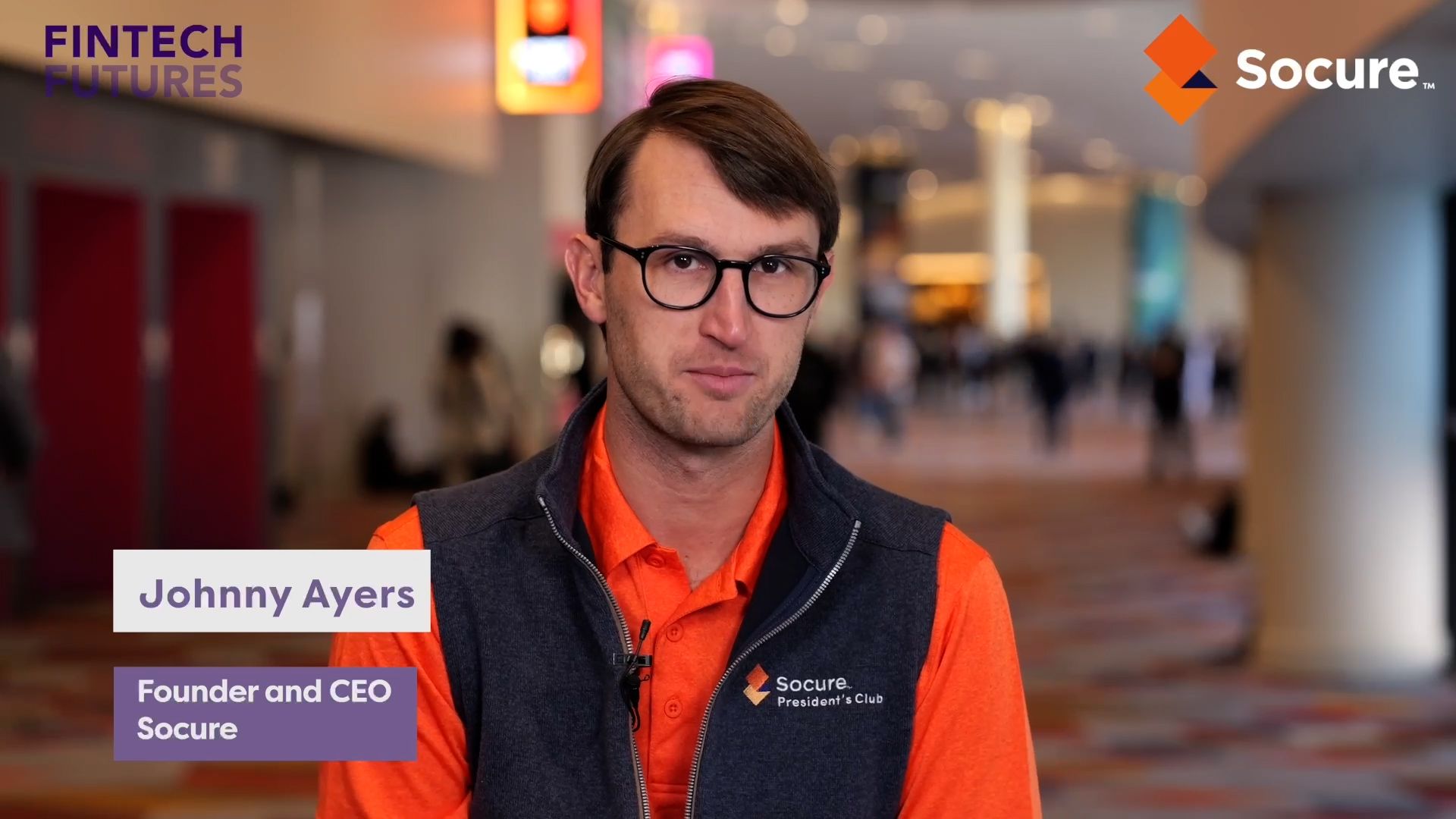
Ayers's language is revealingly mobile. Fraud, he says, “never goes away; it just moves.” Consumer protections create necessary shields, then attackers study their edges. A fraud tool therefore cannot be a monument. It has to behave more like a scouting report revised after every game.
“It never goes away; it just moves.”Johnny Ayers on the changing shape of fraud
The perfection problem
Competition remained a productive fuel until it began producing drag. Ayers has written that earlier in his career he chased perfection because it seemed like evidence of being the best: exact, polished, defect-free. At a growing company, the same instinct could slow execution, create hesitation and make the leader a bottleneck.
His newer rule is “progress beats perfection.” The phrase could sound suspiciously convenient from anyone selling speed. In Ayers's case, it comes with a harder qualification. Identity and anti-fraud systems make consequential decisions. He argues for extensive testing of facial biometrics, accessibility, race, age and geography before deployment. Moving a company faster does not make accuracy optional. It means building an organization in which the CEO does not personally need to polish every edge.
That distinction may be the mature form of his athletic reflex. A punter cannot review the previous play indefinitely. Nor can he skip practice. Preparation is exacting; recovery is quick. Ayers now describes the leadership version as trusting more, empowering faster and allowing teams to take shots without waiting for his review of every detail.
When everyone can wear a mask
The original Socure problem has widened because artificial intelligence has made imitation cheap. Faces, voices, documents, résumés and even job interviews can be synthesized. In a 2026 conversation recorded at Davos, Ayers noted that a person could once spot the difference between a human and a video feed with the naked eye. Now, he said, “You can't see it anymore.”
That observation turns identity from a checkpoint into a continuing condition. A legitimate person at account opening can be compromised later. A good transaction can sit beside a suspicious pattern. Socure's acquisitions trace the expansion. It bought document-verification company Berbix in 2023. The purchase of Effectiv, completed in 2025, brought transaction monitoring and decision orchestration into the platform now called RiskOS.
On August 27, 2026, the company announced its next step: a $156 million strategic growth investment at a $5.2 billion valuation and the acquisition of Fravity. Fravity's software uses AI agents to gather evidence, run screening and draft case summaries for fraud and compliance investigations. At Socure, it will become RiskOS Agents. The direction is plain. The company that began by helping make a risk decision wants to help with the investigative work that follows it.
For Ayers, the ambition remains almost comically absolute: verify 100 percent of good identities and eliminate identity fraud. Absolute goals are useful when treated as a compass rather than a press release. Fraud has not consented to elimination. The practical work is continual - find more good people, catch more bad patterns, reduce unnecessary friction and update the system when the opposition changes tactics.
Away from the standard executive script, Ayers still makes room for competition. His later sporting curiosity is underwater ice hockey, an activity that sounds invented by someone who found ordinary oxygen too accommodating. The detail fits. He seems drawn to situations where information is incomplete, pressure is literal and the next move cannot wait for perfect visibility.
The first dropped snap survives because it offers a more honest symbol than the valuation. A career is not proof that mistakes stop arriving. It is a record of what someone does on the sideline afterward. Ayers has had fourteen years of snaps at Socure: missed forecasts, empty accounts, new fraud schemes, a larger team, a wider product and now machines capable of impersonating the people they were built to serve.
He is still looking downfield. The trick, as ever, is to secure the ball first.
Watch, listen, connect