The most revealing fixture inside many Pet Supplies Plus stores is not a shelf. It is a waist-high tub where a wet dog can shake water over somebody else's walls. The self-serve wash takes a familiar household nuisance - fur in the drain, damp towels on the floor, the sudden escape attempt - and turns it into a reason to visit a store. While the dog gets clean, its person remembers the dwindling food bag, inspects a chew toy and asks a staff member about shampoo.
That little sequence explains the company better than a warehouse full of kibble. Pet Supplies Plus sells ordinary products in a market crowded by PetSmart, Petco, Chewy, Amazon, supermarkets and independent shops. Its answer is to assemble several modest conveniences around one recurring obligation: keeping an animal fed and well. A nearby store can offer advice, grooming, a dog wash, prescriptions, curbside pickup and same-day delivery. A national network can buy, distribute and market at scale. The franchise model attempts to make both statements true at once.
A grocery idea, adapted for animals
Retail veterans Jack Berry and Harry Shallop opened the first store in Redford, Michigan, in 1988. Their reference point was the supermarket, not the old-fashioned feed store: wide aisles, clear overhead signs, full shelves, ample parking and hours suited to an errand. The innovation sounds almost quaint now. At the time, it treated pet food as a frequent household purchase that deserved grocery-level efficiency.
The company began franchising soon after. It reached 100 stores by the mid-1990s and crossed 400 in 2017. Ownership changed repeatedly - Irving Place Capital bought the business in 2010, Sentinel Capital Partners acquired it in 2018, and Franchise Group paid $700 million in 2021. Yet the original design logic survived: a store large enough to carry serious choice, small enough to navigate before a leashed beagle investigates every endcap.
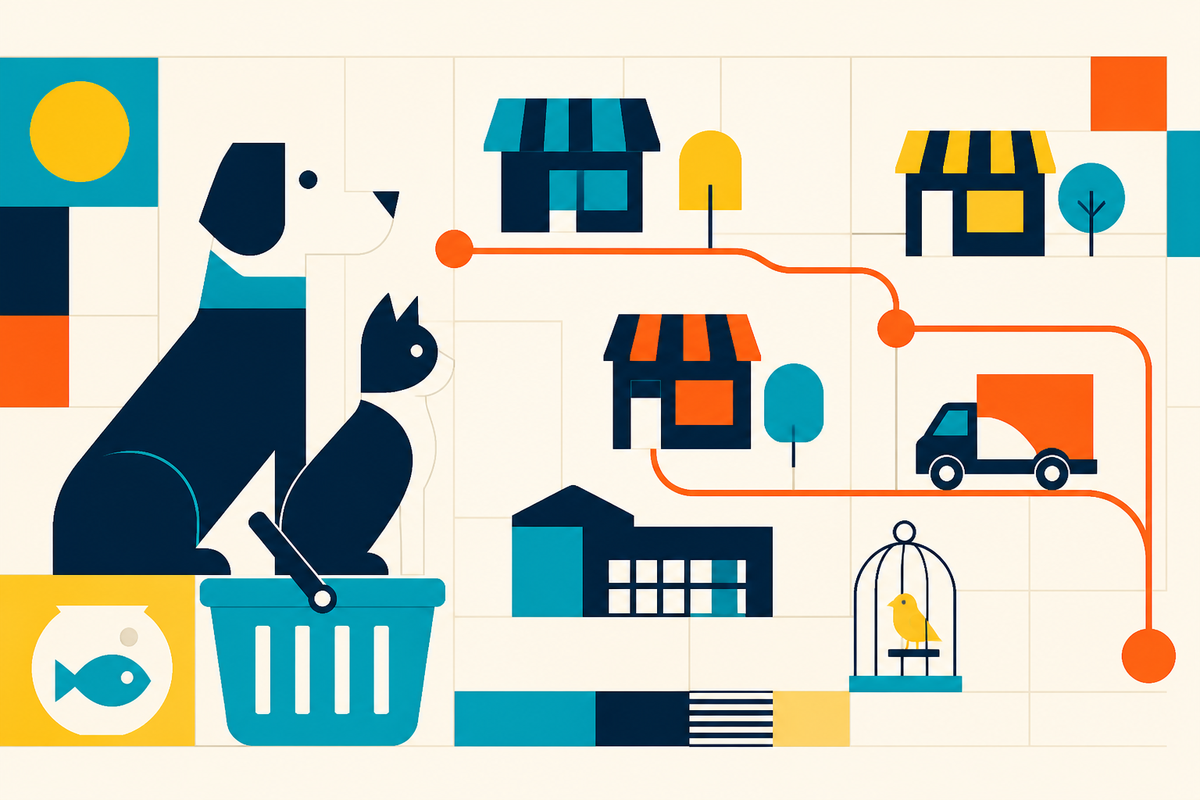
Today the assortment covers dogs, cats, birds, fish, reptiles and small animals. Food and treats create reliable traffic. Toys, habitats, walking gear, cleaning products and wellness supplies expand the basket. The in-house Redford Naturals line gives the retailer a private-label product with more control over positioning and economics. Online prescriptions, Autoship and loyalty rewards help turn an occasional visitor into a known, repeat customer.
“Being local isn’t just about where our stores are - it’s how we show up for pets, pet parents, and communities.”Chris Rowland, chief executive
The four-part retail machine
Pet Supplies Plus is not simply a franchisor and not simply a chain. Company-operated stores generate retail sales. Franchise locations pay royalties and fees. The company also earns revenue by wholesaling merchandise to franchisees. That distribution relationship matters: the store owner gets assortment, purchasing power and operating systems; the parent gets another economic connection to every bag moving through the network.
One customer trip, four reinforcing engines
Food, litter and health products run out. Replenishment creates a steadier cadence than discretionary retail.
Grooming and wash stations solve tactile, messy jobs that cannot be shipped in a cardboard box.
Franchisees supply local knowledge, relationships and capital while operating within a shared system.
Distribution, technology, marketing, private label and data give small stores chain-level infrastructure.
The services are commercially useful because they make the location more than a pickup point. Grooming appointments create scheduled visits. Wash stations produce spontaneous ones. Adoption events bring rescue groups and potential pet parents into the building. Staff expertise helps with questions that a product page handles poorly: which food suits a sensitive stomach, which harness fits an oddly proportioned dog, what an aquarium needs before the fish arrive.
For a franchise owner, the appeal is similarly practical. Pet care supplies sit in a consumer category with repeat demand, but an independent operator does not have to invent the assortment, negotiate every vendor relationship or build an ordering platform alone. The central company supplies a recognizable name and operating rails. The local owner supplies capital, attention and the social memory of the market. That division of labor is the core product Pet Supplies Plus sells to franchisees, even though shoppers mostly experience it as a tidy aisle and a familiar face.
There is a neat asymmetry here. Digital commerce is best at the known repeat order. The store is best at uncertainty, urgency and touch. Pet Supplies Plus covers both. Customers can order online, collect curbside, schedule Autoship or request same-day delivery. A 2024 DoorDash partnership put products from more than 700 locations on the delivery marketplace. The company's first mobile app arrived in December 2025 with shopping, grooming booking, rewards, notifications and biometric login.
A chain that insists on “neighbor”
The company calls customers “neighbors.” Corporate language often tries to manufacture warmth, but here the word describes an operating choice. Most locations are locally owned and operated. Store teams work with nearby shelters, host adoption events and turn checkout traffic into donations. In 2025, Pet Supplies Plus and sister brand Wag N' Wash reported helping 28,546 dogs and cats find homes, above a goal of 20,000. They set a 30,000 target for 2026.
The community work is not separate from the retail model. A franchisee cannot outspend Amazon on software or outbuild PetSmart in every market. The owner can remember a customer's dog, invite a rescue group into the store, carry a heavy bag to a car and understand which local event will draw a crowd. Those acts accumulate into switching costs of a softer kind: familiarity, trust and the mild guilt of abandoning the shop that hosted the kitten adoption.
Sustainability has been given the same local mechanism. Through TerraCycle, participating stores collect flexible pet-food and treat packaging that ordinary curbside programs often reject. The brands said they recycled more than 100,000 pounds during the first two years and diverted more than 3.2 million pieces of packaging. The bin gives customers another small reason to return after the bag is empty.
Scale without the warehouse feeling
Pet Supplies Plus sits between three powerful alternatives. Big-box pet chains offer broad inventories and extensive services. Pure e-commerce companies make replenishment nearly invisible. Independent shops offer intimacy and specialist taste. Pet Supplies Plus borrows from all three: breadth and price parity, app-assisted convenience, and a locally accountable operator.
The compromises are real. Franchise systems must keep hundreds of owners aligned. Store-level service varies. Live-animal care, grooming quality and staffing demand close supervision. Online competitors keep pushing down the friction of repeat orders. Grocery and mass merchants can make pet food one more line on a household receipt. The chain's smaller format can feel convenient only if the item is in stock and the staff can help.
Its response has been steady expansion rather than reinvention. Pet Supplies Plus acquired Wag N' Wash in 2022, adding a dog-focused natural-food, grooming and self-wash concept that can enter markets or trade areas where the larger format may not fit. In 2025, the two brands signed more than 30 franchise agreements and opened 18 stores, including seven in new markets. Management has said it expects to open more than 20 stores annually in coming years.
The ownership story also matters. Franchise Group entered Chapter 11 in 2024, then emerged from bankruptcy in 2025. That December, Pet Supplies Plus and Wag N' Wash completed a separation and described themselves as an independent entity following a securitization transaction. The change removed the brands from a broader collection of unrelated retailers and placed their shared pet platform on its own footing. For a company whose public identity rests on stability and routine, independence is less a dramatic pivot than a chance to concentrate the capital structure around the same expansion playbook.
Supermarket logic meets the pet aisle in suburban Michigan.
Franchise Group acquires a 537-store system spanning 36 states.
A complementary service-heavy franchise expands the format portfolio.
Pet Supplies Plus launches its first mobile app and separates from Franchise Group in December.
The network aims to help 30,000 pets find homes during the year.
The lesson hiding in the bathtub
The transferable idea is not “add grooming” or “call customers neighbors.” It is to find the physical problem attached to a commodity purchase. Pet food by itself is easy to compare and ship. Pet ownership includes questions, mess, weight, urgency, emotion and community. The store earns its place by handling those adjacent realities.
That is why the dog-wash tub matters. It is a small piece of infrastructure with an obvious job. It saves a bathroom, creates a visit and gives the retailer permission to help with the next problem. Around it sits a larger system of trucks, franchise agreements, apps, private labels and rewards points. Customers do not need to see that machinery. Ideally, they see a clean dog and a bag of food already carried to the car.