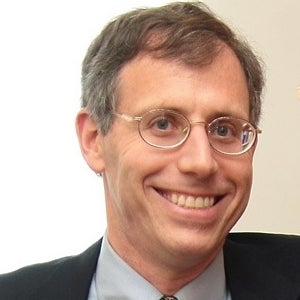
Against the Grain, and Then Some
The office is room 282 in the Peter B. Lewis Building at Case Western Reserve - a Frank Gehry structure whose titanium curves and deliberate disarray have become one of the most photographed buildings in American academia. There is something fitting about that. Scott Andrew Shane has spent three decades producing work that bends the expected shape of things.
He is the A. Malachi Mixon III Professor of Entrepreneurial Studies and Professor of Economics at the Weatherhead School of Management. He holds a Brown undergraduate degree, two master's degrees from Georgetown and Wharton, and a PhD from Wharton completed in 1992 under the supervision of Sankaran Venkataraman - a man who is himself a foundational figure in entrepreneurship research. Shane's doctoral thesis examined cultural differences in how people champion innovation inside organizations. He came into the field asking the uncomfortable questions and hasn't stopped.
The Weatherhead School considers him its most highly cited faculty member. The data on that is not contested.
Only 33% of new businesses survive to their seventh year. America ranks in the bottom third of countries for entrepreneurial activity. Venture capitalists fund less than one-tenth of one percent of all startups. The typical entrepreneur works more hours and earns less than the employed counterpart.
- Scott Shane, "The Illusions of Entrepreneurship" (Yale University Press, 2008)What the Data Actually Says
The book that made Shane famous outside academic circles was not supposed to be popular. "The Illusions of Entrepreneurship," published by Yale University Press in 2008, opens on a simple premise: everything the startup culture says about itself is wrong. Not slightly off. Systematically, measurably wrong.
The romanticized story goes like this: plucky young person bets everything on an idea, works 80-hour weeks in a garage, attracts visionary investors, and disrupts an industry. Shane spent 300 pages showing what the data actually shows instead. Most entrepreneurs are middle-aged. Most new businesses are service companies in local markets. Most startups fail within seven years. Most angel investors don't beat the stock market.
This was not what people wanted to hear. It was, however, what the data showed. The book won the Best Business Book Award, the Best Small Business Book Award, and Taiwan's Golden Book Award. Shane received the Global Award for Entrepreneurship Research in 2009 - the field's top international prize - partly on the strength of this work.
His follow-up, "Born Entrepreneurs, Born Leaders" (Oxford University Press, 2010), went somewhere more provocative: using twin studies - comparing identical twins raised apart with fraternal twins - Shane argued that roughly one-third of the variance in entrepreneurial behavior has a genetic component. Not determined by DNA. But influenced by it. The field, which tends to celebrate the power of education and environment, was not uniformly pleased. The research held up.
DNA accounts for about one-third of the difference between you and your colleagues in job satisfaction, income, and the likelihood of starting a company. The other two-thirds? Your call.
- Scott Shane, "Born Entrepreneurs, Born Leaders" (Oxford University Press, 2010)From Paper to Portfolio
At some point, most researchers who study investing either stay researchers or become investors. Shane did both, and in a way that reflects his contrarian instincts.
He has been making angel investments for nearly two decades, accumulating a personal portfolio of more than 50 direct investments. He also serves as a Venture Partner and Advisor at Right Side Capital Management, the San Francisco-based pre-seed micro-fund that deploys $50K to $200K checks into companies working on robotics, social networks, IoT, logistics, and health - before most institutional investors are even paying attention.
But his most distinctive move as an investor is Comeback Capital, the pre-seed fund he founded to invest exclusively in the Heartland. The thesis is written directly into the fund's rules: no companies in Silicon Valley, San Francisco, New York City, or Boston. This is not a marketing position. It is a genuine research-backed bet that the best risk-adjusted returns in pre-seed investing are in markets where valuations are lower, competition for deals is thinner, and the founders tend to have stronger connections to the problem they're solving.
Three funds in. Three fully deployed. The data is accumulating.
Great entrepreneurship happens everywhere - not just in coastal tech hubs. The next generation of high-impact companies will emerge from overlooked markets.
- Scott Shane, on the Comeback Capital thesisTeaching What He Tests
Since joining Case Western Reserve in 2003, Shane has taught Entrepreneurial Finance and Entrepreneurship and Wealth Creation. His courses are unusual in a specific way: unlike most entrepreneurship programs, which lean heavily on case studies of famous successes, Shane tends to bring in the failure data too. The survivorship bias problem in startup education is something he has written about explicitly.
He writes for Entrepreneur.com and Small Business Trends, translating academic research into the kind of direct, empirical guidance that founders can actually use. His advice tends to be unromantic in the best sense: pick markets with growing demand, not just cool technology; understand that most businesses don't need venture capital; think carefully about whether you're actually the right person to start this particular company.
In 2016, the New England Journal of Entrepreneurship named him the most influential entrepreneurship scholar from 2000 to 2015. In 2017, Case Western awarded him the Faculty Distinguished Research Award. In 2021, the Academy of Management's Neuroscience Interest Group gave him a Best Paper Award for ongoing work on the relationship between genetics and entrepreneurial behavior.
He lives with his wife Lynne Schneider and their two children, Hannah and Ryan. He is 62. He is still at it.