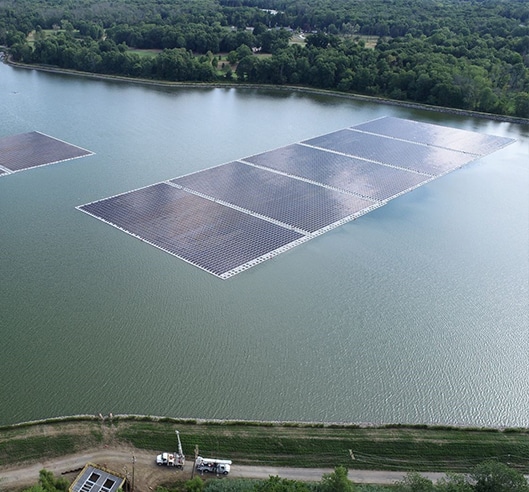
At the Canoe Brook reservoir in Short Hills, New Jersey, the solar panels float. There are 16,510 of them, arranged across 17 acres of water. Their customer is close by: a treatment plant that needs electricity to turn reservoir water into drinking water. The developer, NJR Clean Energy Ventures, belongs to a company whose principal business is delivering natural gas. Begin with that unlikely family resemblance and New Jersey Resources becomes rather interesting.
- A gas utility anchors a portfolio of solar, storage, trading and home services.
- Useful locations and paying customers shape its renewable projects.
- Permits and capital allocation matter as much as the equipment.
At Canoe Brook, the 8.9-megawatt installation was designed to supply approximately 95% of the water treatment plant’s electricity needs. It entered full commercial operation in January 2023. Consider the arrangement: water occupies the land, panels occupy the water, and the plant buys power. A difficult property becomes a useful address.
A utility with several clocks
New Jersey Resources Corporation took its present corporate form in a 1981 reorganization. Its utility roots reach back further. Today, New Jersey Natural Gas supplies approximately 595,000 customers across six New Jersey counties. Clean Energy Ventures had about 537 megawatts of commercial solar operating in seven states by June 2026. Those two numbers describe different jobs: keep existing homes supplied, and build another way to generate electricity.
The other businesses fill in the machinery. Storage and Transportation owns Leaf River Energy Center and Adelphia Gateway, plus half of Steckman Ridge. Energy Services arranges wholesale gas supply and manages transportation and storage positions across North America. Home Services sells equipment, repairs and service contracts. A homeowner with a broken boiler and a wholesale customer booking storage are buying different kinds of reassurance.
This is where NJR sits in the market: between the regulated local distributor, the commercial solar owner and the wholesale energy merchant. Its expertise crosses engineering, commodity management and regulatory finance. Calling it a gas company is accurate, but leaves several rooms unexplored.

The customer buys the arrangement
Solar developers face an awkward question before they buy a panel: where will it go? In a crowded state, an available site can be the scarce ingredient. Canoe Brook pairs a reservoir with a nearby electricity customer. Ciel & Terre supplied floating-system engineering, anchoring design and equipment. NJR’s subsidiary owns and operates the project. The water company gets electricity without becoming a solar operator.
Old Bridge offers another version. In 2023, CEV completed a 2.8-megawatt community solar installation on a former landfill. It acquired the project from AC Power and hired CS Energy to build it. The announced design served about 460 homes, with 51% of generation supporting low- and middle-income residents. Renters and households without suitable roofs could participate. The useful invention was partly an ownership arrangement.
The revenue mechanics differ across the group. Utility earnings depend on regulated rates and approved infrastructure investment. Solar earns from power and renewable-energy certificates. Storage sells access to capacity; trading earns margins from managing supply and delivery. These activities have different customers, rules and risks. Their combination distinguishes NJR from a standalone solar installer or a utility confined to distribution.
The spreadsheet under the reservoir
Canoe Brook’s early obstacle was the incentive calculation. In July 2020, New Jersey regulators found that the applicants had not adequately demonstrated why the project deserved its requested treatment. They assigned a preliminary renewable-certificate factor of 0.6. The parties supplied financial modeling, answered discovery requests and negotiated. In February 2023, the board approved 0.76, below the 1.0 originally sought.
The decision is a wonderfully unphotogenic part of a photogenic project. Engineering made the panels float; financial evidence supported a revised incentive. Regulators expressly said the result would not establish a precedent for other projects. Anyone copying the reservoir idea would still need their own site economics, approvals and case for support.
“limited capital expense and reduced power costs”
Mark McDonough, New Jersey American Water president, on Canoe Brook’s customer benefits, 2023
$367.5 million to wait
Storage makes the value of timing unusually tangible. In October 2019, NJR acquired Leaf River for $367.5 million. The Mississippi salt-dome facility had 32.2 million dekatherms of working gas capacity and connections to six interstate pipelines. Its service is straightforward: gas can arrive before somebody needs to burn it. Customers pay for that flexibility.
Building this portfolio requires substantial money. NJR reported $553 million of capital expenditures, including accruals, during the first nine months of fiscal 2026. Selling assets is also part of the discipline. In November 2024, CEV announced the $132.5 million sale of its 91-megawatt residential solar portfolio to Spruce Power. Existing leases for roughly 9,800 homeowners transferred with it.
Management’s stated reason was a sharper commercial-solar focus, supported by a development pipeline approaching one gigawatt. Proceeds were intended for debt reduction and working capital. The decision narrowed the solar business while keeping renewable investment central to the strategy. Customers with small-commercial power agreements remained with CEV.
The pipeline that stopped
Owning several kinds of energy assets does not remove the possibility of an expensive dead end. NJR recorded a $92 million pretax impairment on PennEast in fiscal 2021. The proposed pipeline encountered permitting uncertainty; development ultimately ceased. Demand for a service cannot, by itself, make a project buildable. Permission has economic value, too.
For readers, the transferable idea is practical: match an overlooked asset to a specific customer, then test the contracts and approvals before celebrating the technology. A reservoir needs suitable engineering. A community project needs eligible subscribers. Storage needs connections and customers who value timing. Each arrangement depends on conditions that a glossy photograph cannot show.
NJR raised its dividend for the 31st consecutive year in September 2026. The next question is how well its spending serves the people buying heat, power and flexibility. Back at Canoe Brook, that question has an unusually visible answer: rows of panels, quietly sharing space with tomorrow’s drinking water.