Consider a tree branch. It grows without consulting an engineer, leans toward a wire, and waits for the weather. Somewhere else, people are discussing megawatts, battery storage and the future of American electricity. The branch has a simpler agenda. Consumers Energy’s effort to modernize Michigan’s power system begins with taking that branch seriously.
- The company supplies Michigan with electricity and natural gas.
- Its grid rebuild mixes tree clearing, stronger equipment and automated switching.
- Customers fund improvements through regulated rates, while federal orders have complicated its coal exit.
This is a company whose product becomes conspicuous when it disappears. A household wants a working furnace. A shop wants its refrigerators running. An industrial customer needs dependable power. Consumers Energy, the principal subsidiary of CMS Energy, handles the generation, purchasing and delivery systems behind those ordinary expectations. It traces its beginnings to Jackson in 1886.
The branch is part of the business
The Michigan Public Service Commission identifies trees and vegetation around power lines as the largest source of outages. That makes forestry an operating discipline with consequences well beyond the roadside. In its March 2026 decision, the regulator described a move from an effective 10.2-year clearing cycle toward clearing the entire low-voltage grid every five years by 2030-2031.
Technology helps with the next problem: containing damage after something breaks. Automatic transfer reclosers detect faults and reroute electricity. Dividing the network into smaller sections can keep one damaged stretch from interrupting service over a wider area. The useful idea is containment. A branch may still fall; fewer people need to discover it through a dark kitchen.
Detect. Isolate. Reroute.
Switching needs a usable alternate path. It cannot repair a broken line.In February 2026, Consumers reported nearly 2,700 reliability projects completed during 2025. The work included installing 32,173 poles, inspecting 26,069 miles of lines, clearing vegetation along more than 8,000 miles and creating 31 automated transfer loops. These are construction counts. They tell us what crews did; customer outage measures tell us whether it helped.
“We promised our customers a stronger, smarter grid”Greg Salisbury / Consumers Energy / February 2026
The distinction matters because the company’s goals remain goals: no customer without electricity for more than 24 hours, and no single weather event affecting more than 100,000 customers. Its February update acknowledged those thresholds had not yet been fully achieved. A utility deserves credit for visible work. The customer is entitled to ask about the result.
The bill for a quieter grid
Consumers operates in a regulated market. Customers pay tariffs; regulators review costs and determine the return the company may earn on approved investment. In March 2026, the commission authorized a $276.607 million electric revenue increase and retained an allowed return on common equity of 9.9%. That percentage is a regulatory allowance, not a guaranteed margin on every dollar collected.
Authorized electric revenue increase
DTE Energy and municipal or cooperative utilities provide useful Michigan comparisons, but most households cannot simply select a different distribution network. Geography shapes the relationship. Consumers’ expertise sits in the combined machinery of electric distribution, generation, gas storage, pipelines and maintenance. Its customer promise must survive both a summer cooling peak and a winter heating season.
The company describes its CE Way operating system as a method for improving everyday work. The practical expression includes inspections, training and prevention. Its Flint Gas City, a 1.4-acre training site, gives gas workers and first responders a miniature setting for real-world situations. Some useful innovation looks like practicing before the emergency arrives.
A coal plant misses its exit
Then there is the equipment the company wants to stop using. Consumers planned to retire the J.H. Campbell coal plant in May 2025. Federal emergency orders required continued operation. This was an imposed timetable change; treating it as management suddenly rediscovering enthusiasm for coal would misread what happened.
In September 2026, a federal appeals court vacated the first order. Michigan’s attorney general reported that a later order still required operation through November 14. The same update put reported Campbell-related costs from May 2025 through June 2026 at $295 million, with Consumers seeking recovery across parts of the regional electricity market. Planned retirement and actual retirement had become expensive separate events.

Meanwhile, replacement generation is tangible. In January 2026, Consumers announced operations at Muskegon Solar: 250 megawatts on 1,900 acres at the county’s Resource Recovery Center. Burns & McDonnell participated in construction. More than 550,000 panels track the sun. The county partnership illustrates a useful advantage of an established utility: it can coordinate land, construction and a connection to an existing system.
The cheapest power can be the power you postpone
Customers have a smaller version of this coordination problem at home. Consumers’ summer demand-response programs reward shifting consumption away from busy periods. Its comparison page lists a $50 joining incentive and $25 after each summer for the Smart Thermostat Program, subject to eligibility. The home needs central air conditioning and Wi-Fi. Reducing peak demand can reduce the need for expensive additional capacity.
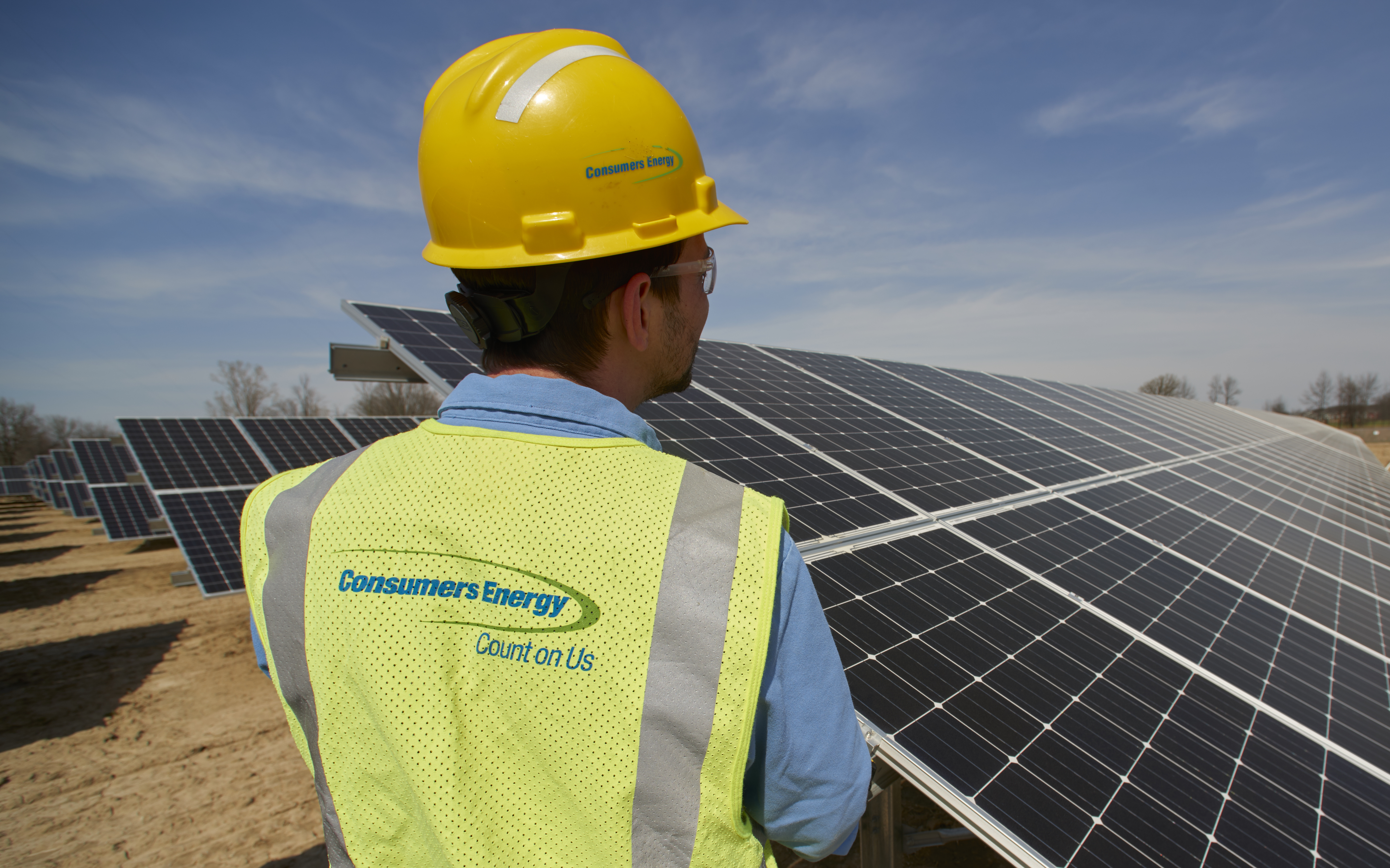
Solar Gardens offers another route: eligible full-service electric customers, including renters, subscribe without installing panels. They pay a monthly fee and receive a credit tied to generation. It is renewable-energy participation, with a cost, rather than a promise of automatic savings.
There is something here other organizations can copy: inspect weak points, contain failures and reward flexibility. Each method has conditions. Switching needs an intact alternate route. Demand response needs customers able to shift consumption. Building new capacity does little for a street with damaged wires. For Consumers Energy, progress becomes convincing at the last connection, when the customer flips the switch and has nothing interesting to report.