Consider the confidence involved in turning a thermostat. A person moves a dial and expects a house to become warmer. Somewhere beyond the wall, gas must have been purchased, transported, stored and delivered at the right pressure. There is no progress bar. The customer learns about the machinery chiefly when something goes wrong.
ONE Gas lives inside that expectation. Through Oklahoma Natural Gas, Kansas Gas Service and Texas Gas Service, it supplies roughly 2.3 million customers. Its territory includes Tulsa, Oklahoma City, Wichita, Topeka, Kansas City, Austin and El Paso. The product is familiar. The coordination required to deliver it deserves a closer look.
- ONE Gas earns through regulated delivery rates; gas purchase costs pass through without a profit.
- Winter Storm Uri exposed an enormous purchasing and financing risk.
- Storage, replacement pipes and customer education are practical parts of its response.
The bill is not the business
The first useful surprise is on the bill. ONE Gas buys natural gas for customers, but its regulatory mechanisms recover that commodity cost without adding a profit. A more expensive molecule can swell reported revenue without improving the underlying delivery business. Reading a utility’s sales figure as though it belonged to a software company would produce a peculiar misunderstanding.
The business rests on its network. Rates provide for operating costs and an authorized return on approved investment. Regulators oversee that bargain. ONE Gas maintains and expands the system; customers pay for service under regulated tariffs. Timing matters because money spent on infrastructure does not automatically become money recovered in rates.
At year-end 2025, the company reported approximately 43,200 miles of distribution pipeline and another 2,200 miles of transmission pipeline. Its divisions were the largest gas distributors by customer count in Kansas and Oklahoma, and third largest in Texas. Those positions reflect established local networks. They do not mean that every household has a menu of competing pipeline companies.
ONE Gas became independent when ONEOK separated its distribution business in January 2014. Shareholders received one ONE Gas share for every four ONEOK shares. The separation gave investors a focused distribution utility. Customers continued to encounter the familiar regional names. Corporate novelty arrived on top of infrastructure with much older roots.
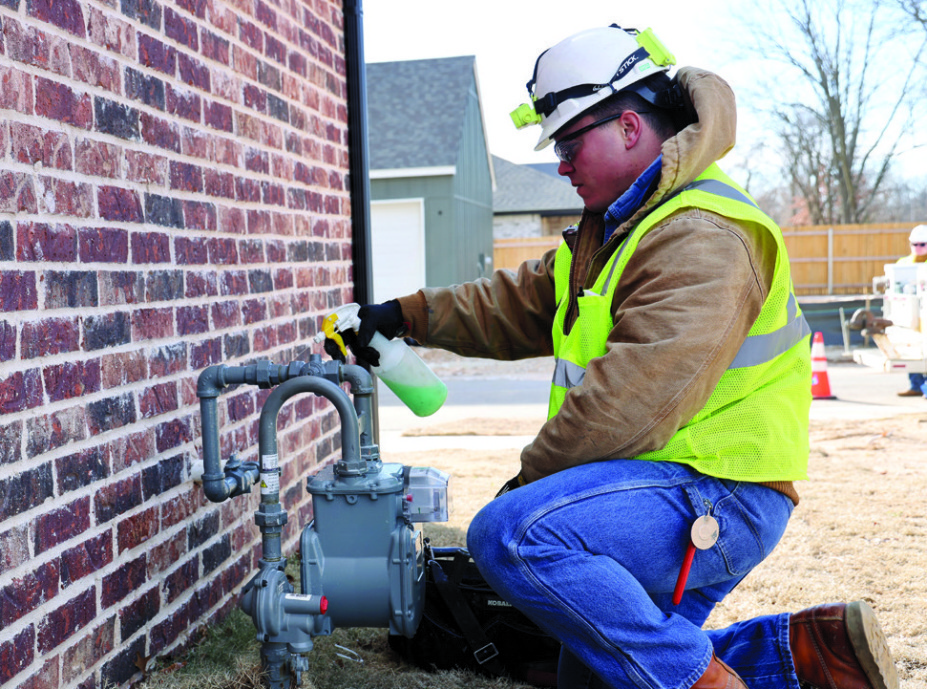
February changed the calculation
Then came a month that made preparation expensive in public. During Winter Storm Uri in February 2021, extreme weather squeezed supply while demand and market prices surged. ONE Gas reported approximately $2.1 billion in gas purchases for that month. It arranged a $2.5 billion term-loan facility, then issued notes that replaced the facility’s commitments.
The revealing stress was the cost of obtaining gas and financing the purchases. Keeping service available did not spare the company a liquidity problem. Reliability had a financial component: being able to pay for supply when the market became hostile. A functioning pipe alone could not settle that bill.
Management subsequently described added storage capacity, system reinforcements and a more diversified supply portfolio. Around Austin, it cited 19 reinforcement projects completed after Uri, with the last entering service just before Winter Storm Gerri in January 2024. Mobile compressed-natural-gas units were positioned at vulnerable points but, management said, were not needed during that test.
The customer learns about the machinery chiefly when something goes wrong.The economics of an ordinary morning
By May 2026, chief executive Sid McAnnally said storage capacity had increased 20% since Uri. During January’s Winter Storm Fern, he said, the additional storage helped save customers $98 million compared with buying gas at spot prices. That is management’s estimate against an alternative purchase scenario. It is still a useful way to make the value of preparation visible.
Planned 2026 capital investment, including asset removal costs.
Company guidance as of August 2026. Planned spending, not completed work.A fryer is a customer strategy
There is a less wintry route into this company: a kitchen. ONE Gas’s Education & Training Area combines commercial cooking equipment with a residential filming space. Food service professionals can request free use. There is a prep kitchen, refrigeration and seating for 40. Vendors donated the commercial equipment. The ceiling accommodates lights and cameras.
The company described demonstrations with the Gas Technology Institute, including a comparison of electric and gas fryers. Here the competitive question becomes tangible. A restaurant owner can investigate how equipment works before choosing it. Electricity competes for the same cooking and heating jobs, even where the local gas network has a settled position.

Households have a more direct route to help: arrange service through the local division and check its efficiency programs. ONE Gas reported 26,477 rebates totaling about $14.1 million in 2025. Eligibility depends on the program and location. The kitchen and the rebates address the same problem from different directions: customers need usable advice about the equipment connected to the meter.
The next ordinary morning
The physical work continues alongside that advice. ONE Gas reported replacing more than 400 miles of pipelines, mains and service lines in 2025. Its 2026 sustainability update estimated a 53% reduction in emissions from distribution pipeline leaks against a 2005 baseline, adjusted for projected system growth. That claim concerns a defined source of operational emissions; burning the delivered fuel remains a separate environmental issue.
The investment plan also needs paying customers, access to capital and regulatory recovery. In August 2026, ONE Gas moved adjusted earnings expectations to the upper half of its guidance ranges. New rates and customer growth supported results, while employee costs increased. Expansion can add business and expense together. Electrification and changing energy preferences remain competitive pressures.
Other operators can copy the discipline of naming a bottleneck, funding a remedy and testing the result under stress. The economics require more specific conditions: an established network, continuing demand and regulators willing to recognize prudent costs. Without those, spending ahead of trouble can become an expensive burden. For ONE Gas, the next test arrives whenever someone expects an ordinary morning.