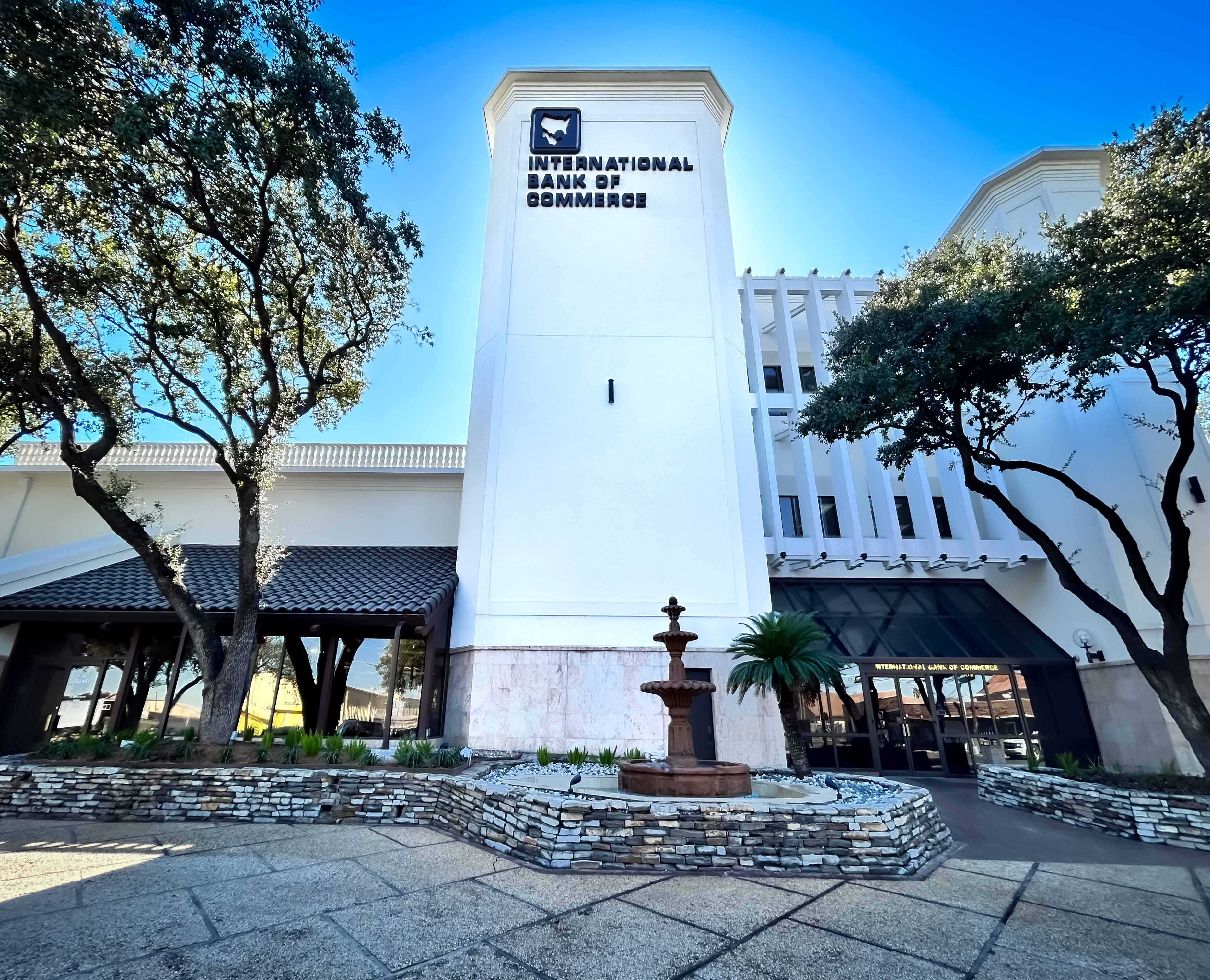
The awkward part of a border is rarely the line on the map. It is the moment a seller wants payment before shipping and a buyer wants the shipment before paying. Each position is perfectly reasonable. Put them together and commerce stops. IBC Bank began in Laredo in 1966, serving small businesses and cross-border trade. Its origin offers a useful way to understand the company: look for the distance between two people who want the same transaction to happen.
- Start with the border. International services sit beside everyday banking.
- Make access practical. Branches, mobile tools and a $10 checking entry point.
- Keep doing the math. Fifty-five branch closures exposed the cost of convenience.
The border is a business problem
The name spells out the premise: International Bank of Commerce. Historical accounts identify A. R. Sánchez Sr. and Honoré Ligarde among its founders. Dennis Nixon arrived in 1975 and helped shape the subsequent expansion. The bank’s present product list preserves its original geography. Alongside savings accounts and mortgages are foreign exchange, documentary collections and letters of credit. A customer’s business can cross a national boundary even when the customer’s bank remains rooted in one region.
A letter of credit gives the importer and exporter a bank’s payment undertaking, subject to its terms. IBC offers import, export and standby versions, as well as documentary collections. Eligibility starts with an IBC deposit or loan relationship. The mechanism matters more than the impressive name. It changes who carries the payment obligation and which documents must support the transaction. That is a specific intervention in a specific hesitation.
Illustrative sequence. Payment depends on the instrument and compliant documents.
“Being bicultural is different than being bilingual.”Roberto R. Reséndez, IBC board member, 2016
Reséndez’s distinction explains the competitive proposition better than a claim about friendly tellers. Translation fixes words. Understanding the customer’s assumptions helps a banker recognize why a transaction is difficult. The attraction for a business owner is having ordinary banking and international expertise available within the same relationship. Whether that relationship earns its keep depends on the actual service, terms and problem at hand.
The $10 doorway
Most customers encounter something less exotic: checking. IBC’s Free Checking requires a $10 opening deposit, with no minimum balance requirement or monthly service charge. An opening deposit is still the customer’s money. It is not an account fee. The account also includes an instant-issue Visa debit card at opening. Online and mobile banking cover familiar chores, including transfers, bill payment and depositing checks with a phone camera.
The adjective “free” needs its own small ledger. IBC’s published fee schedule lists a $35 overdraft fee and a $35 domestic outgoing wire through a bank representative. The checking page specifies inactivity or dormancy charges under different Texas and Oklahoma conditions. Someone choosing an account should match those terms to their habits. A household that rarely needs a wire has a different calculation from a business that sends them frequently.
For businesses, the offering extends into working capital and administration. IBC Link includes direct deposit, wires, Positive Pay and account controls; remote deposit reduces trips to a branch. Merchant services run through Basys, which supplies terminals, point-of-sale integrations and ecommerce payment tools. Regional banks such as Frost and Bank of Oklahoma, national banks and local credit unions offer alternatives. IBC’s case rests on how well this particular collection fits the customer.
The fit is geographical, too. For someone who lives near the network and wants help with a business account, a branch can save effort. For someone who moves frequently outside Texas and Oklahoma, that same network may matter less. Mobile access does not make the physical footprint national. The sensible comparison starts with the tasks a customer repeats every month, then asks which provider makes those tasks easier at an acceptable cost.
Then 55 doors closed
Convenience once meant putting a bank inside the places people already visited. IBC used in-store branches as part of that strategy. In the fourth quarter of 2011, the company closed 55 of them. Its subsequent annual report connected the closures to regulatory changes that reduced debit-card interchange income. The policy changed the revenue attached to serving customers; the company changed the distribution supporting that revenue.
A useful service still has a cost to deliver.
That episode is useful to anyone tempted to copy an expansion strategy from a photograph of a busy location. Foot traffic is one input. Revenue per relationship is another. The branch closures show a limit to the model: accessible locations need an economic reason to remain open. A company can keep its service philosophy while revising the places where it delivers that service.
The arithmetic behind the handshake
IBC earns money through the familiar machinery of banking: deposits fund loans and investments, interest income is offset by funding costs, and services generate additional income. International Bancshares Corporation, its parent, reported $412.3 million in net income for 2025. Interest expense was $213.9 million; non-interest expense was $306.7 million. These are consolidated group figures. They describe the operating bill behind the service promise, rather than a price tag for any single branch or product.

The first half of 2026 brought $198.0 million in parent net income, up 0.5% year over year. Second-quarter profit fell 4.3%, while credit-loss expense increased. Relationships do not remove credit risk. They operate inside it. And regional names need care: Kyle McElvaney leads IBC Bank-Oklahoma. The group’s headquarters remain in Laredo. Oklahoma is part of a banking organization with several charters, rather than the home of the whole enterprise.
The parent’s October 6, 2026 announcement added a different regional gesture: a planned transfer of its stock listing from Nasdaq to the Texas Stock Exchange, scheduled for October 19 with the ticker IBOC retained. The stated rationale emphasized its Texas relationships. Even the proposed trading address became a statement about where the company belongs.
Nearly level profit. The second quarter was weaker.
A miniature town, a real lesson
IBC’s educational work makes the same business oddly tangible. Its Minitropolis program, started in McAllen in 1996, lets elementary pupils run miniature communities, earn play money and pay bills and taxes. It received the Consumer Bankers Association’s Joe Belew Award in 2020. Children discover that an economy consists of obligations between people. Adults sometimes need the reminder. IBC’s most transferable idea is to study those obligations closely, then build around the moment someone gets stuck.
Follow the money
Explore the accounts, watch the tools in action, or keep up with the bank.