A commercial bank’s personality can hide in an expense line. Preferred Bank’s is unusually easy to spot: keep the operation compact, hire lenders who know their customers, and make the relationship earn its keep. That sounds almost quaint in an industry selling frictionless everything. For a business owner waiting on a property loan or an international payment, however, knowing who can make a decision has a certain modern appeal.
The Los Angeles institution has built its pitch around that kind of access. It lends to businesses, finances real estate and handles the daily movement of money. Personal accounts sit alongside those commercial services. The proposition is practical: a company can borrow, collect payments and manage cash with a bank that expects to understand its operation. The interesting question is how much complexity such a compact institution can handle.
A small expense line, a large responsibility
Preferred’s September 2025 investor presentation describes the machinery behind the pitch. It recruits senior lenders and business-development staff with established customer relationships. Routine banking is heavily automated; decisions stay local, with access to senior management. The bank also operates without a holding company. These are specific organizational choices, rather than a vague promise that everyone will answer the telephone cheerfully.
That presentation counted 325 employees and 16 branches. It described a management team averaging 23 years at Preferred and average branch deposits of roughly $380 million. The picture is of substantial customer balances supported by relatively few offices. Its strategy depends on experienced people doing consequential work, with technology absorbing some of the repetition. A sprawling retail network would bring a different cost structure.
Reported efficiency ratio: about 32 cents of operating expense for each dollar of net revenue, before credit costs and tax.
An efficiency ratio helps put that discipline into perspective. Lower operating expense relative to revenue leaves more room before loan losses and taxes. It does not tell a reader whether the loans are safe, whether deposits will stay, or whether customers enjoy the service. A lean bank still has to collect. Preferred’s own history supplies the demonstration.
The bill for getting bigger
The bank opened on December 23, 1991, following an oversubscribed initial capital offering of $20.18 million. Founder Li Yu built it with Chinese American roots in Southern California. That community connection remains visible, but the customer base has widened. The bank now describes its commercial business across California, New York and Houston, serving companies whose financing requirements extend well beyond a neighborhood checking account.
The growth story includes a serious early reckoning. Preferred’s 2010 annual report describes a regulatory consent order requiring stronger capital, fewer troubled assets, reduced construction and land-loan concentrations, and better liquidity management. Contemporary reporting put its June stock offering at approximately $77 million. The pressure was in the loan portfolio and capital supporting it. Repair required fresh money and changes to the balance sheet.
Then came a different test. In November 2015, Preferred bought United International Bank in Flushing, New York, for $22.2 million in cash. The acquisition brought approximately $150.4 million in loans and $157.7 million in deposits, according to its later annual report. It gave Preferred entry to the Northeast through an existing banking operation. Buying a footprint also meant accepting the assets already inside it.
By 2019, the consequences were clearer. The Los Angeles Business Journal reported that Preferred sold a $41.8 million package of delinquent luxury-condominium loans for $36.9 million. The reported loss, after taxes and other adjustments, was roughly $1.4 million. The package had come through the New York acquisition. Management’s response reinforced its preference for organic growth: concentrate on business it could build and oversee itself.
“Do not play the game above your head - or wallet.”Li Yu, speaking to the Los Angeles Business Journal in 2019
That lesson should be read with its date attached. Preferred subsequently established a Houston presence, and its website now announces a Cupertino office. A preference for organic growth allows expansion. It asks management to be deliberate about the people, markets and loans accompanying it.
The customer has inventory to pay for
Preferred’s own description of its middle-market niche includes manufacturers, distributors and service companies with annual sales of $3 million to $50 million. It also serves professional practices, including doctors, accountants, lawyers and entertainment specialists. These customers have distinct cash-flow patterns. A distributor waiting for an invoice to be paid has a different problem from a property owner financing construction or a professional practice purchasing equipment.
Working-capital loans and equipment financing address those timing and investment needs. Real estate lending covers commercial, industrial, residential and other income-producing properties, including construction and shorter-term financing. The expertise being sold is the ability to assess the business or property behind the request. That makes the lender’s familiarity with an industry consequential, particularly when a borrower’s finances resist a simple consumer-credit formula.
Smaller businesses have another route. Preferred advertises SBA 7(a) and 504 financing and identifies itself as a participant in the SBA’s Preferred Lender Program. Its 7(a) offering lists a maximum loan amount of $5 million. The 504 route involves the bank, a Certified Development Company and the borrower, with a focus on major fixed assets such as owner-occupied commercial property. Approval and program eligibility still govern access.
Banking happens between the loan payments
A business relationship becomes more useful when the bank handles the chores surrounding the loan. Preferred offers treasury tools for receiving money, reconciling accounts and controlling outgoing payments. Remote deposit capture reduces the need to carry checks to an office. ACH origination supports electronic payments. Lockbox and cash services address businesses that still receive money through channels that refuse to become entirely digital.
Positive Pay offers a concrete example. Customers provide information about authorized checks; exceptions trigger a notification and a decision to pay or reject. Preferred lists check, payee and ACH versions. The service creates a review point in the payment process. Its value depends partly on the customer supplying accurate information and having someone available to handle exceptions. Buying the service does not eliminate the work of supervising payments.
- 01Send authorized
check details - 02Review items
flagged as exceptions - 03Decide whether
to pay or reject
Illustrative Check Positive Pay workflow. Account agreements govern the actual service.
For merchants, Preferred partners with Elavon to provide card and ACH acceptance, including payments from mobile devices. Importers and exporters can use letters of credit, documentary collections, foreign exchange and international wires. These products address specific commercial problems: accepting a customer’s payment, documenting a trade transaction or moving money across currencies. They are also reasons to keep a banking relationship after the original loan closes.
The app has company: a CD-ROM
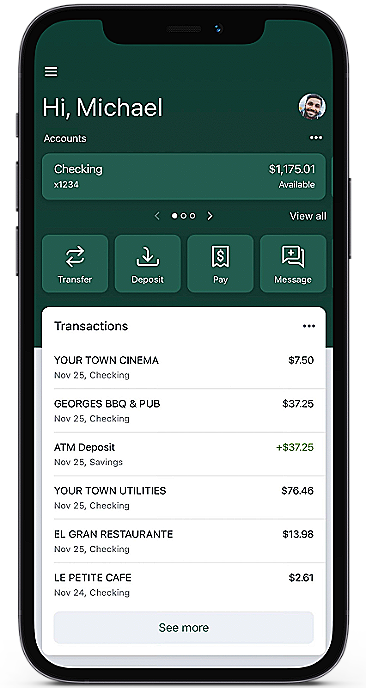
Preferred’s mobile app offers the expected everyday functions: balances, bill payments, transfers, check deposits, alerts and debit-card controls. It also advertises Zelle. The bank says it does not charge for mobile banking, although communications-provider charges may apply. Its Android listing adds transaction tags, notes and receipt photos, and says users must first enroll in internet banking. The app is an access point to an existing bank relationship.
Elsewhere on the same website sits a wonderfully specific survivor: CD-ROM statements. The service offers a mailed disc containing check and deposit images for businesses with heavy transaction volumes that choose paper statements. The juxtaposition is instructive. A banking customer may want biometric access on a phone and a decidedly older method of archiving checks. Administrative habits do not all retire together.
Costs deserve attention at the account level. Preferred’s business-checking page directs customers to its Schedule of Fees and Charges for minimum balances and fees. Its expanded-insurance products carry monthly fees. A useful comparison therefore starts with the customer’s actual pattern of balances, checks, wires and treasury services. An attractive interest rate or convenient app alone cannot describe the total cost of running a business account.
More coverage, with conditions attached
For larger cash balances, Preferred offers IntraFi Network Deposits. The arrangement distributes money among participating banks in smaller increments while the customer continues working through Preferred. Its published menu lists CD placements up to $50 million and demand or money-market placements up to $100 million per account type. Access and withdrawal conditions differ between those products.
The practical attraction is administrative: one relationship can coordinate deposits across a network. Customers must enter a placement agreement, and coverage depends on the applicable program and FDIC rules. A business that needs immediate cash access should pay particular attention to the difference between a demand account and a CD with an early-withdrawal penalty. The product solves a deposit-management problem only when its terms match the cash’s intended use.
A profit figure needs its footnotes
Preferred reported $133.6 million in net income for 2025, compared with $130.6 million in 2024. Its chairman’s annual message emphasized organic growth, overhead control and returning capital to shareholders; the bank repurchased 1.08 million shares during the year. Those are shareholder outcomes, distinct from whether a particular borrower receives favorable terms or a depositor finds the right account.
The July 2026 earnings release adds an important qualification to the current picture. Second-quarter profit was approximately $33.5 million, and nonperforming loans fell 41.5% from the previous quarter. Loan resolutions produced $2.9 million of recovered interest, helping the reported margin reach 3.73%. One loan sale recorded a $950,000 loss. Credit cleanup can improve both risk and earnings, but recovered interest should not automatically be treated as a recurring benefit.
Yu also described stiff competition for deposits. That is the basic squeeze for a spread-dependent lender: funding has a price, and customers have alternatives. East West Bank, Cathay Bank, Hanmi Bank and larger commercial institutions are among the alternatives a business can consider. Preferred’s appeal rests on service, market knowledge and execution. Those qualities still have to justify the proposed terms.
Relationships beyond the balance sheet
Community work makes another part of the relationship visible. Following the January 2025 Los Angeles wildfires, Preferred donated $62,500 to Tzu Chi USA. The relief organization documented a February visit by the bank’s Southern California team to its El Monte service center. The bank also describes career-development work with Thomas House Family Shelter and support for the Asian American Drug Abuse Program.

For another business, the useful idea to copy is precise: know the customers you can serve well, put experienced people near decisions, and automate the repetitive tasks around them. Preferred’s setbacks add a necessary limit. A compact operation can stretch beyond what management can supervise; a low expense ratio offers little protection from a bad loan. The bank’s story is most useful when the profit figures and the repair bills are read together.