In 2021, Texas Capital wrote off $12 million in software assets. Buried in an annual report, the charge sounds like housekeeping. It was also a small, expensive clue to a larger decision: the Dallas bank was reconsidering what it needed to become. Systems bought for one strategy could be wrong for the next. Before a new financial institution could emerge, some old assumptions had to leave.
- A failed merger preceded a fresh strategy in 2021.
- Treasury, advisory and private banking widened the relationship.
- The rebuild carried real costs before meeting its return target.
That is the interesting thing about Texas Capital. A bank sells money, but money is widely available. The harder product to assemble is a relationship that remains useful as a business changes. Texas Capital’s recent history is an attempt to build that product, with all the hiring, technology and uncomfortable accounting that such an attempt entails.
01 / The merger that went nowhere
In December 2019, Texas Capital Bancshares and Independent Bank Group announced a merger of equals. By May 2020, they had mutually terminated it. The companies cited the pandemic’s disruption of markets and their ability to realize the expected benefits. A route to a larger combined institution had disappeared. Texas Capital would have to decide what to do on its own.
The original proposition was already specific. Texas Capital began banking operations in December 1998, backed by approximately $80 million in initial equity. Its founding group included Jody Grant, George Jones and Keith Cargill. In its early public filings, the company described an opening left after the Texas banking crisis: middle-market businesses and wealthy individuals underserved by the banks that emerged afterward.
That customer gap explains the institution better than its name does. A growing business might need more attention than a sprawling bank gives it, while requiring financing beyond a small bank’s capabilities. Texas Capital occupied the space between those experiences. The enduring question was how much of the customer’s future it could actually handle.
02 / Follow the work out the door
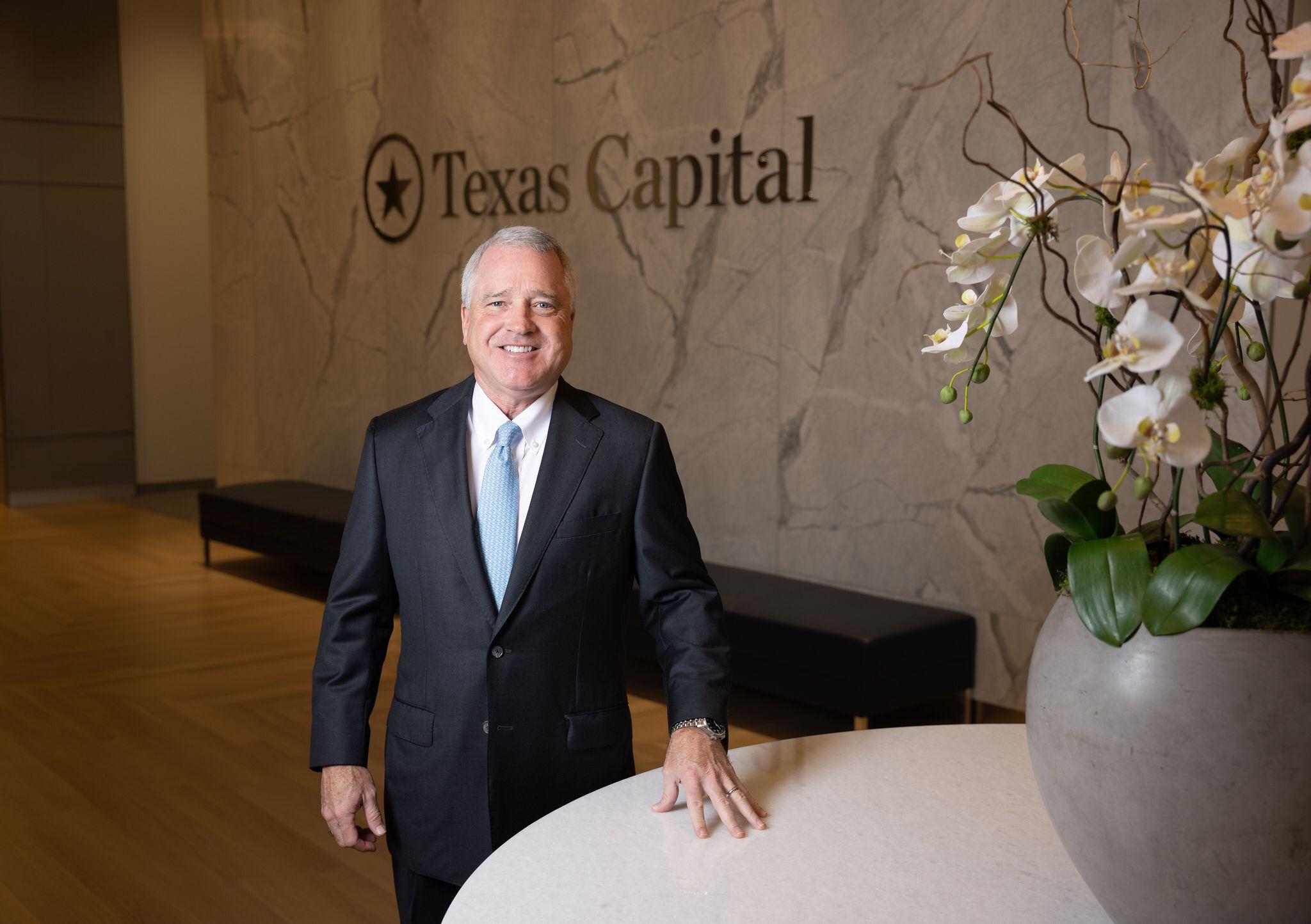
Rob Holmes arrived in January 2021 after 31 years at JPMorgan Chase. The strategy announced that September followed more than seven months of review. Texas Capital would expand its services and client coverage, invest in technology and organize around delivering more to each customer. The company was trying to reduce its dependence on loan growth to drive earnings.
Consider the ordinary life of a manufacturer. Inventory needs financing. Suppliers need paying. Incoming cash needs reconciling. Later, an acquisition may require a syndicated loan; eventually, an owner may need investment advice. These are illustrative needs, but they explain the logic of Texas Capital’s offering. Each problem taken to another institution is a piece of the relationship leaving the building.
An illustrative journey through the service offering.
The response is tangible. Treasury Solutions includes payables, receivables, liquidity tools, commercial cards and fraud protection. Instant payments operate on both FedNow and RTP. Initio, the company’s proprietary commercial account-opening software, is intended to remove another small indignity of business banking: waiting. Texas Capital says a process that once took weeks can be completed in days.
Its investment banking platform adds debt and equity capital markets, mergers and acquisitions advice, syndications, hedging and institutional trading. In May 2025, Texas Capital announced further additions in equity research, sales and trading, and corporate access. Industry coverage includes energy, healthcare, manufacturing and technology. Expertise matters because a hospital’s cash flows and a distributor’s inventory do not pose identical lending problems.
The economics have two main components: net interest income from loans and securities after funding costs, and income from services such as advice, trading and wealth management. More capabilities give the bank additional ways to earn from an existing relationship.
The alternatives include national banks with broad capabilities and regional banks competing on relationships. Texas Capital’s pitch joins that breadth to a Texas headquarters and local bankers. Its reach is national. Consumer accounts, private banking and funds management widen the business further. In 2023, it even launched TXS, an ETF whose index initially held 216 Texas-headquartered public companies.
03 / The bill arrives before the benefits
Those capabilities need people and systems. By early 2025, Holmes said the firm had twice as many client-facing professionals as four years earlier. Management also described a culture of urgency, close customer knowledge and empowered middle-level leaders. The practical ambition was to make specialist advice available before a client had reason to seek it elsewhere.
Alongside the software write-off came a larger accounting hit. In August 2024, Texas Capital sold approximately $1.24 billion of legacy securities yielding 1.23% on average and bought approximately $1.06 billion yielding 5.26%. The sale produced a $179.6 million pre-tax loss. Management projected $35 million to $40 million in additional annual net interest income. That projection was an expectation, not cash already earned.
By the third quarter of 2025, the company reported core return on average assets of 1.30%, exceeding its 1.10% target. Management declared the transformation complete. The adjusted measure deserves its label: it is useful for understanding the company’s chosen scoreboard, while the actual losses remain part of what shareholders experienced.
04 / The useful part to borrow
For another business, the useful exercise is to trace what customers do immediately before and after buying its main product. Which tasks create friction? Which require another provider? Texas Capital invested in those adjoining needs. Its $5 million backing of Lendistry’s Texas expansion in 2022 also showed how a partner could extend access to borrowers outside conventional banking channels.
“When we commit to doing something, we do it.”Rob C. Holmes · October 2025
Copying the strategy requires enough demand to support specialists, technology and regulatory obligations. More services also bring execution risk. In Q3 2026, Texas Capital reported $356.6 million in revenue net of interest expense, including $275 million in net interest income. Lending and the balance sheet still do much of the work. The change is that a customer’s next financial problem now has more possible answers inside the firm.
Texas Capital ↗ Treasury tools ↗ Investment banking ↗ Insights ↗ Latest results ↗
Texas Capital on YouTube ↗ Holmes with Jim Cramer ↗ The turnaround interview ↗