The promotion made Stacy Kymes laugh. He was BOK Financial's treasurer when Stan Lybarger, then the bank's chief executive, suggested a move into credit administration. Kymes had never made a car loan. Now he was being asked to help lead people who made considerably more complicated lending decisions. It was an unusual qualification for a future chief credit officer: an immediate appreciation of everything he still had to learn.
He took the assignment. Years later, the episode offers a useful entrance to a career that can otherwise look deceptively orderly. Auditor. Controller. Treasurer. Credit chief. Chief operating officer. President and CEO. Read the titles in a row and the outcome seems almost inevitable. Put yourself at the moment of the proposed move, and it looks rather different. The next job required him to become a beginner again.
Kymes became BOK Financial's chief executive on January 1, 2022. By then, he had spent a quarter of a century inside the Tulsa institution. His preparation had involved learning its machinery from several directions, including the places where a bank discovers that an attractive opportunity carries an awkward obligation. His story has a useful complication for anyone in a hurry to get ahead: staying at one company can involve a great deal of movement.
A map with several entrances
Before Tulsa, there was Houston, where Kymes graduated from J. Frank Dobie High School. He studied at Harding University in Searcy, Arkansas, graduating with an accounting degree and summa cum laude honors. His public LinkedIn profile places his university years between 1989 and 1993. The academic distinction is easy to put on a résumé. The less glamorous early banking work helps explain the direction that résumé took.
He worked as a teller during high school and college, then spent three years at KPMG before joining BOK Financial in 1996. Public accounting gave him an outside view of financial institutions. Internal audit gave him access to the workings of one particular institution. It is a useful combination: first learn to inspect the accounts, then learn the organization that produces them.
There is an appealing lack of ceremony to this beginning. Banking appears here as work to be understood, with processes, customers and consequences. A teller's counter and an audit assignment offer different views of the same business. Neither comes with the chief executive's authority. Both demand attention to details that somebody else may prefer to hurry past.
- 1996Joins internal audit
- 2021Named chief operating officer
- 2022Takes the CEO role
- 2026Federal Advisory Council
When the controller changed the map
By 2007, Kymes was corporate controller, a title that understates the geographical reach of his work. His responsibilities included mergers and acquisitions, financial reporting and investor relations. He had helped manage the 2005 acquisition of Valley Commerce Bank, which took BOK Financial into Phoenix. In 2006, he directed the strategy for launching full-service banking in Kansas City. He also played a role in acquiring Worth Bancorp, expanding the company's Fort Worth branch presence.
These were assignments with an outward consequence. The person dealing with financial systems was also helping determine where the company would operate. New markets brought new colleagues, local expectations and customers who had no particular reason to care how tidy the corporate organization chart looked. A transaction on paper had to become a working bank.
The mix matters when considering his later appointment. Investors need an intelligible explanation of a business. Employees need systems that work. Customers need decisions. Kymes's earlier jobs put him near each of those demands, sometimes within the same role. The route to general management had already begun well before the title caught up.
The people who handed over the keys
Lybarger's invitation to credit administration belongs to that larger pattern. It required a finance executive to learn from experienced lenders. The story is memorable because Kymes tells it with the doubt left in. Retrospective accounts of executive careers tend to polish away the hesitation. His account preserves the laugh.
In March 2021, BOK Financial named him chief operating officer and put all revenue-generating divisions under his leadership. He had previously overseen specialized banking; the new remit brought regional and commercial banking, consumer banking and wealth management together with those responsibilities. Steve Bradshaw, then president and CEO, described the move as part of the company's attention to leadership development and succession.
The board announced Kymes as the incoming chief executive that August. The timetable subsequently moved forward, and he took over at the start of 2022 after Bradshaw's retirement. Board chairman George Kaiser emphasized the breadth of his experience across business lines and supporting functions. The choice had a clear logic: the candidate had already encountered much of the company from the inside.
Succession can look like a single announcement. Here it was also a series of people making room for someone else's next assignment. Lybarger offered an unfamiliar field. Bradshaw widened the operating remit. The board gave Kymes responsibility for the whole enterprise. Each step increased the number of decisions whose consequences would reach beyond his own desk.
A regional bank with a long address book
As chief executive, Kymes has argued for the economic usefulness of banks headquartered away from the country's coastal financial centers. The argument becomes more interesting when attached to specific work. In a 2024 banking podcast, he discussed energy finance, tribal banking in Oklahoma and New Mexico, and a mortgage product for tribal lands. He also addressed growth in Tulsa, Oklahoma City, Denver, Phoenix, Dallas and Houston.
Those places are more than dots on a footprint map. A regional institution has to know why one customer's financing problem differs from another's. Tribal land, an energy business and a growing middle-market company present different practical questions. The appeal of local knowledge is that somebody recognizes the question before reaching for a standard answer.
“We value relationships over transactions.”
Stacy Kymes, 2022
His company also earns money through activities beyond lending, including wealth management, treasury services and an electronic funds transfer network. That variety gives the chief executive several businesses to understand, each with its own operating rhythm. It also gives his repeated emphasis on relationships a commercial meaning: the bank wants to remain useful through more than one financial need.
In his 2025 annual letter, Kymes described the difficulty of standing out in an industry whose products are often similar. His answer centered on employees, advice and service. The test of that proposition comes after the slogan: whether a client returns with the next question, and whether the people answering have earned the confidence placed in them.
The other balance sheet is Tulsa
Some of Kymes's work has a more visible result than a loan portfolio. He helped with private fundraising of $30 million and the formation of a public entity for Tulsa's downtown minor league ballpark, ONEOK Field. He later chaired the Tulsa Stadium Trust. Financial expertise, in this setting, ends up somewhere people can buy a ticket.
Private fundraising for Tulsa's downtown ballpark that Kymes helped support.A civic project, not a personal donation figure.
He also participated in the public-private effort that changed the Tulsa Zoo's management and served as chairman of Tulsa Zoo Management. His civic record includes work with the Tulsa Regional Chamber and service involving Gilcrease Museum and Philbrook Museum of Art. The projects vary, but they share a practical requirement: people from different organizations have to agree on how something will function and who will carry responsibility.
There is a pleasingly tangible quality to this part of his biography. Corporate development can disappear into a presentation. A ballpark remains inconveniently physical. It needs land, money, governance and people who will turn up. The completed place becomes part of the city's ordinary life, long after the meetings that made it possible.
His current public responsibilities include the Tulsa Community Foundation's board of trustees. That local connection sits alongside his national banking role. For Kymes, the institution he runs and the city where it is headquartered repeatedly appear in the same story.
A bell in New York, a seat at the table
On June 8, 2026, Kymes and BOK Financial's executive leadership team went to Nasdaq MarketSite to mark 35 years as a listed company. He rang the opening bell. In his accompanying public remarks, he directed attention to the company's more than 5,000 employees. It was an occasion for a photograph, certainly, but also a reminder that the person standing at the front represents a much larger working organization.
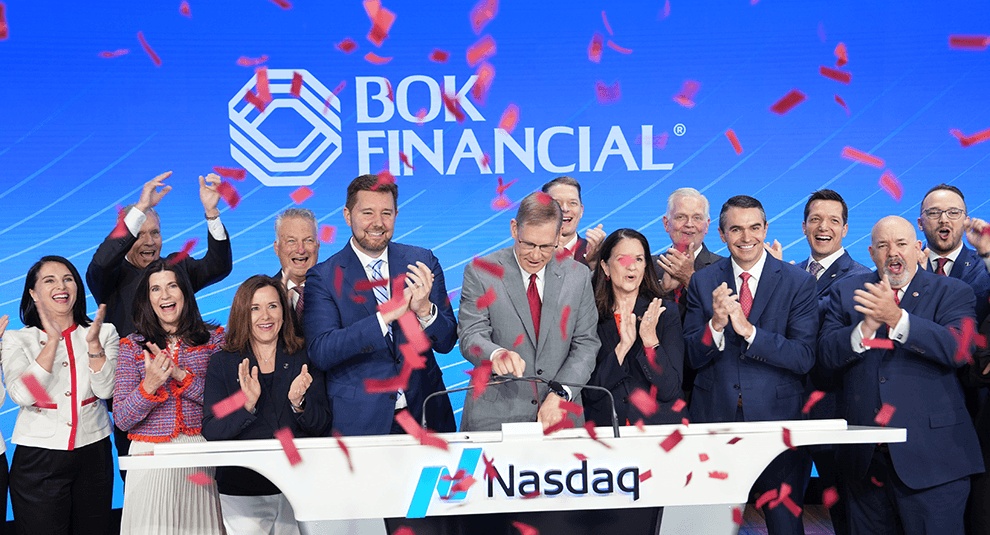
A few weeks earlier, the company had announced his election as the Tenth District's representative to the Federal Advisory Council. The council has one representative from each of the twelve Federal Reserve districts and advises the Board of Governors on economic and banking matters. The appointment adds a different kind of audience to his work: a forum where experience from clients and communities can inform a national conversation.
The latest quarterly figures add another, less ceremonial view. For the third quarter of 2026, BOK Financial reported net income of $159.9 million and period-end loans of $27.7 billion, up $646 million from the previous quarter. Numbers like these are snapshots of the institution under his leadership. They are also a reminder of the scale behind a job that began with checking other people's work.
Room for the unfinished player
Outside work, Kymes is married to his high school sweetheart and is a father of two. He reads presidential biographies and spy novels, and plays tennis. The reading list offers a modest comic relief from executive biography: even someone responsible for a bank is allowed to enjoy a plot in which the paperwork is somebody else's problem.
The revealing detail is how he approached tennis. At 50, he described taking lessons for the first time and finding the experience awkward. It echoes that earlier conversation about credit. Competence in one setting offers no exemption from learning in another.
That leaves a more human picture than the orderly list of promotions suggests. Kymes has accumulated authority while continuing to encounter unfamiliar ground. A new court. A different banking discipline. A national advisory role. The interesting part of the next assignment is still the part he has to learn.