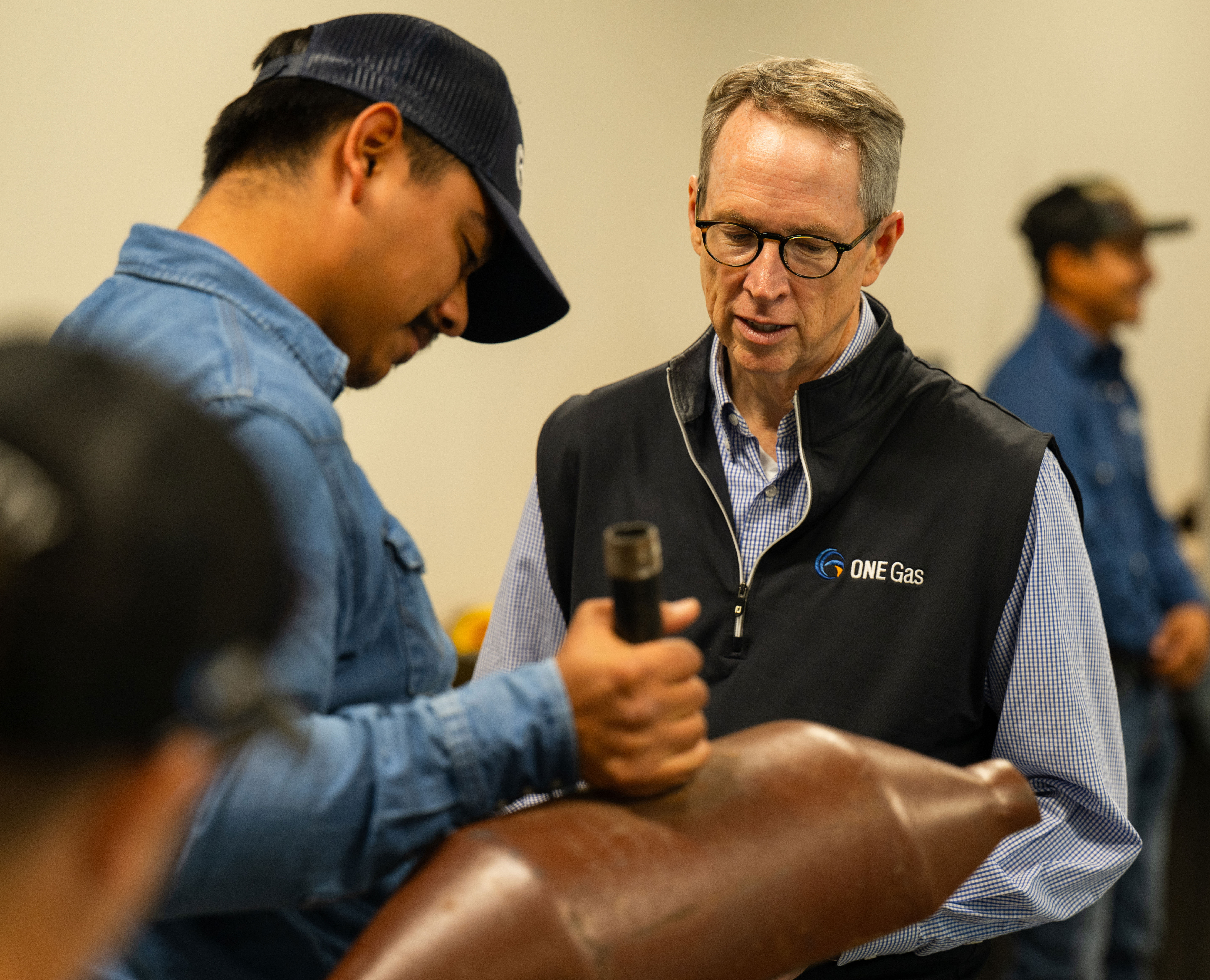
Sid McAnnally’s education in natural gas included a classroom with rather flexible admission requirements: a service center, after the workday, with coffee. He was already a senior executive. The people he sat with knew things he needed to learn. “I’d sit in service centers, drinking coffee after the workday with people who had stories to tell,” he recalled. For a former lawyer moving into operations, it was a sensible place to begin. A job description could give him responsibility for the business. Understanding it would require more company.
Today, McAnnally is chief executive officer of ONE Gas, based in Tulsa, and chair of the American Gas Association’s board for 2026. The company serves more than 2.3 million customers across Kansas, Oklahoma and Texas. Those titles put him in conversations about national energy demand, infrastructure and investment. The earlier coffee conversations offer a more intimate introduction: an executive learning from the people whose working day he had come to oversee.
An education in other people’s problems
His route into that job began in Alabama. He earned a Bachelor of Arts at Auburn University and a law degree at the University of Alabama. His legal work included utility, financial and corporate clients. Before he became responsible for a utility’s operations, he had spent time working on the problems that businesses brought to a lawyer.
Public institutions were part of the picture, too. In July 2005, Auburn announced his appointment as director of external affairs. The university’s student newspaper described an effort to connect Auburn with a wider public, statewide and nationally. It also recorded his work under Alabama governors Jim Folsom Jr. and Bob Riley. Government, universities and companies were already overlapping in his professional life.
His civic interests extended to Alabama Citizens for Constitutional Reform, where he served on the first board and later became the organization’s third president. He stepped down from that presidency in 2005. This was work concerned with how institutions functioned, years before his public biography centered on gas distribution.
Energen’s annual reports place his arrival as vice president of external affairs in 2009. Later came a senior vice presidency in customer service and marketing at its utility subsidiary, Alabama Gas Corporation. The progression brought him closer to the customer-facing side of the business. A utility reaches households through physical infrastructure, but customers also encounter it through bills, questions and service requests. He had worked on that side before taking charge of operations.
Three utilities, one operating job
ONE Gas announced his appointment in March 2015, effective March 16. He would become senior vice president of operations, reporting to Pierce Norton. The assignment covered natural gas distribution operations across three businesses: Oklahoma Natural Gas, Kansas Gas Service and Texas Gas Service. It was a substantial change of geography and responsibility.
The company itself had recently changed shape. ONE Gas separated from ONEOK on January 31, 2014, becoming a standalone, publicly traded, fully regulated natural gas utility. Its heritage reached back to Oklahoma Natural Gas in 1906. McAnnally arrived at a young corporate organization with much older operating businesses beneath it. The stationery was newer than the institutional memory.
By 2020, his promotion to chief operating officer added administrative responsibilities, including human resources and information technology. Operations, in other words, extended beyond the physical network. People needed support; information needed to move; the functions around the field organization had their own bearing on service. His responsibilities were broadening before the next succession decision.
On June 28, 2021, he became president and CEO and joined the board. Norton moved on to lead ONEOK. The appointment followed the board’s continuing succession process. “I’m honored to have the opportunity to lead talented and dedicated employees,” McAnnally said. The emphasis was consistent with his account of learning the business: the workforce appeared in the first sentence.
Tulsa was more than a mailing address
The move from Alabama produced a civic chapter alongside the corporate one. In 2017, McAnnally and his wife, April, co-chaired the Tulsa Area United Way’s Alexis de Tocqueville Society. They had belonged to the corresponding society at the United Way of Central Alabama before moving. Tulsa gave an existing commitment a new address.
They also chaired a fundraising event for the Community Food Bank of Eastern Oklahoma. These were practical ways of becoming involved in a city they had only recently joined. The couple’s Tulsa record includes the familiar work of civic life: gathering support, introducing people to a cause and helping an organization raise money.
McAnnally served as the Tulsa Regional Chamber’s vice chair of economic development in 2017 and 2018, then as vice chair for Tulsa’s Future in 2019. The Chamber recognized him as Economic Development Partner of the Year in its January/February 2020 report. Its account singled out work on the Tulsa’s Future IV strategic plan, including engagement with investors and stakeholders and a new organizational structure.
That recognition supplies a useful detail about his public career. Alongside responsibility for a network serving several states, he was involved in the machinery of one region’s economic planning. Committees rarely produce a picturesque biography. They do, however, leave a record of what someone spent time doing.
The Kansas surprise
In June 2023, McAnnally offered a short observation about a market that had often received less attention than the company’s faster-growing territories. “Kansas has been a surprise,” he said. ONE Gas had frequently discussed growth along the Interstate 35 corridor in Texas and Oklahoma. New industrial development was giving Kansas a different place in the conversation.
At the time, the company expected compound annual customer growth of 0.3 percent in Kansas, compared with more than 1 percent in Oklahoma and Texas. Those were expectations from 2023, rather than a description of today’s results. They explain why new projects in Kansas were worth discussing. Incentives were helping attract battery and semiconductor manufacturing, while the company was becoming more active in seeking development opportunities.
The implications extended beyond individual industrial customers to the housing and commercial activity associated with new workers. For McAnnally, whose career had included customer service and economic development, the subject joined several earlier responsibilities. A utility’s growth prospects could change when the surrounding economy changed. Kansas supplied a reason to look again at a familiar map.
“Kansas has been a surprise.”
Sid McAnnally, June 2023
A bigger table in 2026
His industry responsibilities had been expanding for years. In October 2018, he was elected chair of the American Gas Foundation’s board of trustees. The foundation supports research on energy and environmental questions affecting public policy. It was another setting in which his experience with companies and public institutions met.
For 2026, he became chair of the American Gas Association board. His stated priorities included infrastructure, reliability and affordability as energy demand evolves. In the announcement of his election, he pointed to artificial intelligence, advanced manufacturing and economic development as reasons utilities needed to plan, maintain and modernize their systems. He was speaking as an industry advocate about the work he believed lay ahead.
At ONE Gas, the allocation of work changed again on March 1, 2026. Curtis Dinan became president and chief operating officer, responsible for day-to-day operations of the distribution businesses. McAnnally continued as CEO, focused on long-term strategy, stakeholder engagement and alignment across the organization. Dinan continued reporting to him.
The distinction is worth preserving. McAnnally became president and CEO in 2021; his current title is CEO. The new arrangement placed the presidency with an executive whose ONE Gas experience included finance, commercial leadership and operations. For McAnnally, it gave more explicit definition to the longer view expected of his office.
The numbers beneath the promises
There is a useful check on any executive biography: look at the work being reported beneath the leadership language. ONE Gas’s 2026 sustainability report covered activity during 2025. It recorded replacement of more than 400 miles of distribution mains, service lines and transmission lines. That is a company-wide result, involving work across the organization.
The same report put its estimated reduction in Scope 1 emissions from distribution pipeline leaks at 53 percent against an estimated 2005 baseline, accounting for projected system growth. The company’s goal is a 55 percent reduction by 2035. The qualifications matter: this is a defined category of emissions, with a stated baseline and methodology. The figure should travel with those labels attached.
Distribution mains, service lines and transmission lines replaced during 2025.
Financial performance supplied another measure in August 2026. Second-quarter net income was $46.8 million, compared with $32 million a year earlier. Adjusted net income was $52.1 million, compared with $32.7 million. The company raised its full-year adjusted earnings expectations to the upper half of its previous guidance ranges. Actual earnings and adjusted figures describe different measures; neither should be confused with a forecast.
The company also expected approximately $800 million in 2026 capital investment, including asset removal costs, with roughly $230 million intended for extensions to new customers. Those planned expenditures put a scale on the decisions around system integrity and expansion. For the CEO, strategy comes with a very concrete bill.
Room to think
Outside those responsibilities, McAnnally’s interests include fly fishing, reading and music. He once played in bands. He runs without a playlist, using the time to think through problems, and visits grandchildren in North Carolina and Tennessee. His childhood included a father who worked at NASA and talked through how to break complicated problems into parts.
The details suggest a life with several places to think: a family table, a run, a conversation at work. His career has taken him through law, customer service, operations and the CEO’s office. Each position brought a wider set of responsibilities. The service-center coffee remains an apt opening to that story. Before deciding what a business should do next, there is considerable value in hearing how its day went.