The awkward thing about a variety pack is that the variety usually begins somewhere else. One production run makes one flavor; another makes the next. The shopper wants them together. Between those two facts sits a small industrial headache: gather the products, open cases, assemble a new mix, close it, and send it onward. The cardboard box conceals a surprising amount of travel.
- Move the line. Sojo brings automated packing equipment to customer facilities.
- Keep the hubs. Regional operations handle work that belongs at a fixed site.
- Connect the records. Software follows products after the robot finishes.
Sojo Industries has made that headache its business. Its specialty is robotic variety-pack and multi-pack assembly for food and beverage companies. The interesting part is where it happens. Through Sojo Flight, the company transports its packing equipment to the customer, then staffs and manages the operation. Thousands of cases can stay where they are while the machinery makes the trip.
The expensive ingredient is distance
Barak Bar-Cohen had encountered the problem as chief operating officer at Bai Brands. Mixed-flavor packs were useful to the brand and troublesome to coordinate. Different flavors, different facilities, different retail promotions: each introduced another scheduling dependency. The difficulty was spread across manufacturing, freight and packaging budgets, which made a deceptively simple product expensive to organize.
He and logistics executive Steve Rubin founded Sojo in 2021. Their backgrounds matter because the offer crosses two disciplines. A faster robot helps with assembly. A better logistics plan helps with movement. Sojo combines them by asking whether the assembly equipment needs to remain in one building at all.
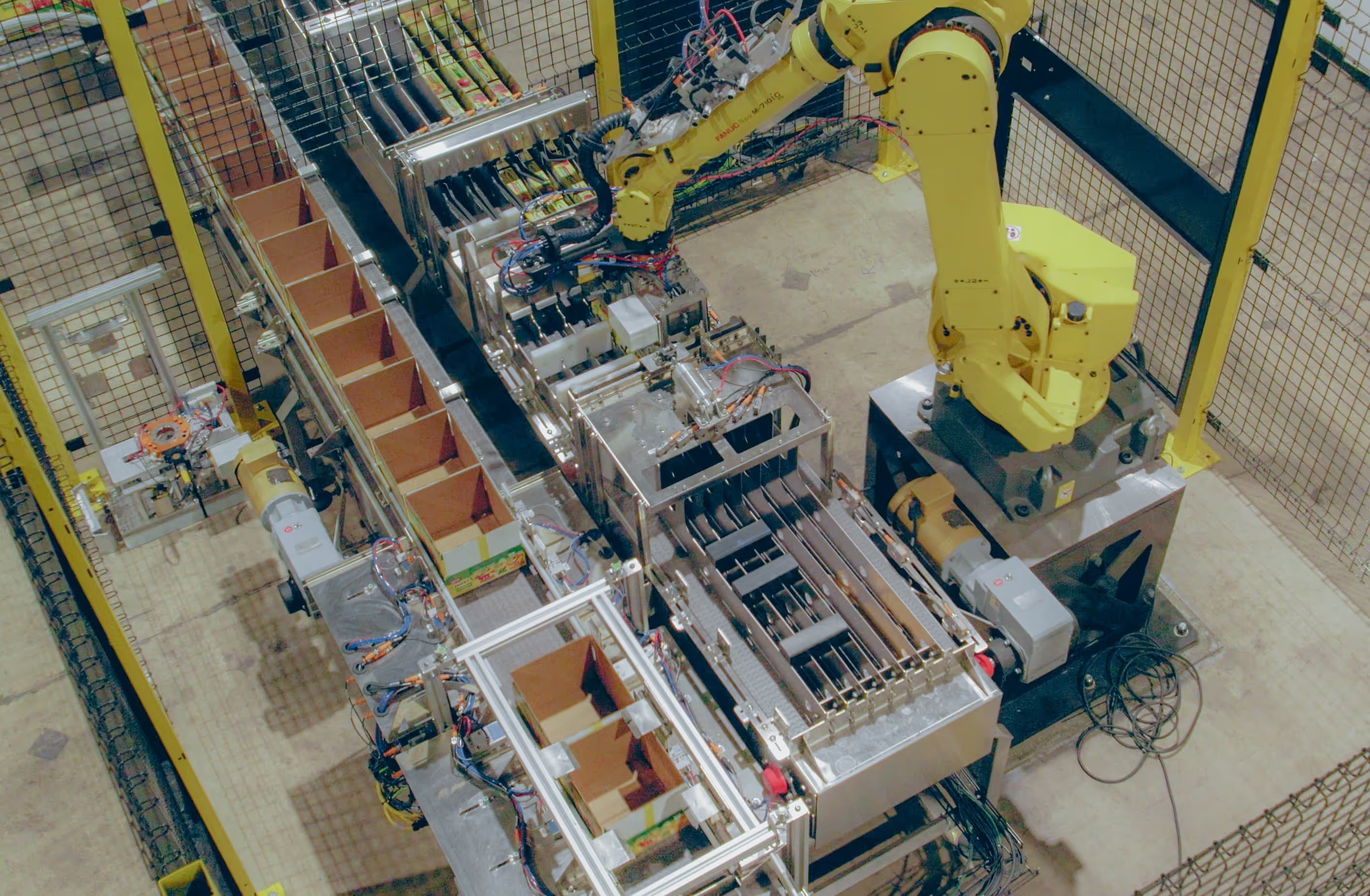
That places the company between conventional contract packaging and a brand buying its own permanent line. Brands can outsource the work at Sojo’s regional hubs, or use mobile production on their premises. The choice is practical: where are the goods, what format is needed, and how much handling would each arrangement require?
A factory with a departure time
Ordinary industrial equipment is not designed for frequent relocation. Sojo’s engineering addresses four unglamorous obstacles: transport, electricity, leveling and stability. Machines sit on transport skids. A single high-voltage power connection supplies the system. Automated leveling reduces adjustment time. The design avoids the extensive floor modifications associated with conventional anchoring.
“We built Sojo Industries on the pillars of mobility and modularity.”Barak Bar-Cohen · November 2024
The company advertises deployment in as little as one hour. That is a setup claim, with a prepared site and a suitable job implicit in the proposition. The meaningful engineering achievement is repeatability: equipment must arrive, align, run safely and eventually travel again. A machine that performs beautifully once is insufficient for this business.
A 2026 Vention case study makes the implementation more tangible. It describes five robotic systems deployed with Sojo, combining industrial and collaborative palletizers within shared software. Operators can select or create pallet configurations, while a mobile rover’s independent 5G connection supports remote assistance. Flexibility includes the person changing tomorrow’s pack pattern.
The customer wanted a different box
Schreiber Foods supplies a useful test of demand. Its venture arm disclosed a $500,000 investment in Sojo in July 2024. Schreiber explained that customers wanted multi-pack and variety-pack options its existing plants could not always supply quickly. Adding capabilities to established lines brought time and complexity. It planned a pilot with Sojo.
This is a narrower, more persuasive reason to buy automation than a general enthusiasm for robots. A manufacturer already has products and customers. The missing piece is a packaging format that can reach them soon enough. Sojo sells access to that capability without requiring the customer to build the entire system first.
Up to 61 cents in freight and packaging, reported by Sojo’s CEO in December 2024. A reported upper bound, not a rate card.
The commercial unit is appropriately ordinary. Bar-Cohen says Sojo simplified packaging pricing to dollars per case. In a December 2024 interview, he reported potential freight and packaging savings of up to 61 cents per case. At one million cases, that upper-bound figure would imply $610,000. That arithmetic illustrates sensitivity to volume; it does not establish a particular customer’s result.
For a buyer, the sensible comparison includes the whole job: transport, handling, packing, available space and utilization. On-site equipment has less to save when products already sit beside an efficient permanent line. Small or irregular runs, incompatible formats, and inadequate site infrastructure can also weaken the case. The map and production schedule deserve as much attention as the robot.
For a growing beverage brand, this suggests a useful way to evaluate the offer. Start with a single pack format and its actual route. Count each transfer, each storage stop and each occasion when somebody handles the same case again. Then compare the existing arrangement with a hub quote and an on-site quote at the same volume. Include the cost of reserving floor space. A cheaper packing price can lose its appeal after transport; a more expensive one can still produce a cheaper case ready for sale.
What happens after the lid closes?
Mixing products creates a second problem: keeping their histories straight. Sojo Shield supplies the software layer, connecting traceability information with product and shipment visibility. Its Built for NetSuite status, announced in February 2025, gives the proposition an enterprise-system connection. The value is being able to retrieve usable records when products and their paperwork have taken different paths.
Sojo Seal extends that idea to a trailer door. The single-use, tamper-evident device incorporates electronics; breaking it generates a location event for Shield. Sojo’s collaboration with Molex addresses design and manufacturing of the device. The familiar shipping seal becomes another point where a physical action produces a digital record.

Expansion has required substantial capital. Sojo announced a $10 million Series A in July 2024 and $40 million from S2G Investments in June 2025. That August, it announced a 215,000-square-foot Langhorne facility supporting production and assembly of mobile rovers. Even equipment that travels needs somewhere to be built.
One early adjustment was commercial. Bar-Cohen says he initially led pitches with climate benefits, then moved cost savings and reduced complexity to the front. The lesson travels beyond packaging: find the buyer’s expensive recurring problem and describe the improvement in their units. In Sojo’s case, the deceptively useful question is how many journeys a box really needs.