SaaS · Customer Support
Social Intents Runs Live Chat From Inside Slack and Teams
The bootstrapped live chat company skips the separate support dashboard entirely - routing website chats, WhatsApp and SMS into Microsoft Teams, Slack and Google Chat, for a flat $39 a month with unlimited agents.
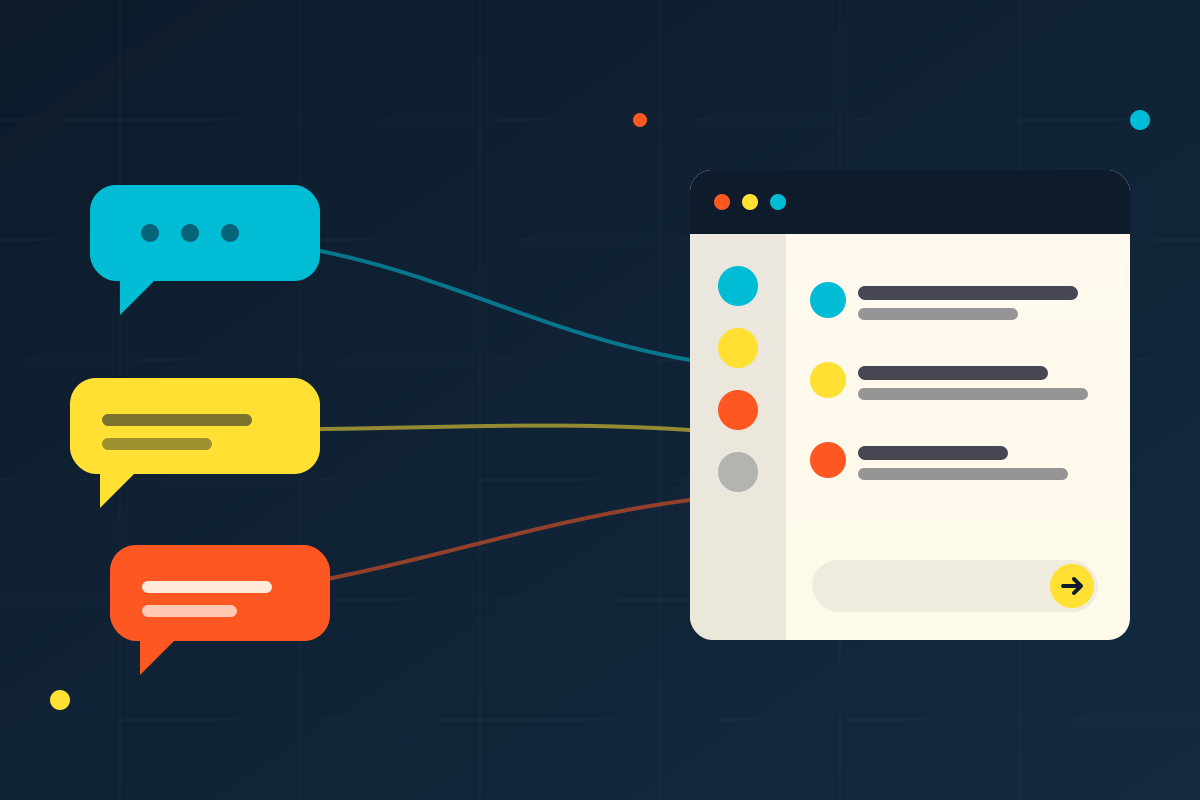
Open your support team's browser on any given Tuesday and count the tabs. There's the CRM, the docs, the ticket queue, the analytics thing nobody trusts, and - somewhere - the live chat dashboard that someone is supposed to be watching. Social Intents was built on a small, slightly stubborn observation: nobody is watching that last tab. The message that matters is sitting in a window that's minimized behind Slack.
So the company did the obvious thing that almost no one in live chat had bothered to do. It stopped asking teams to come to the chat, and started sending the chat to the teams. A visitor types a question on your website. That message shows up as a Slack message, or a Microsoft Teams message, or a note in Google Chat - the same place your colleagues are already arguing about lunch. You reply in the thread. The visitor sees it on the website widget. No new app, no new login, no muscle memory to build.
It is not a flashy idea. It is a placement idea. And placement, it turns out, is a surprisingly durable moat.
The tab nobody opens
Most live chat products are designed around their own dashboard. Intercom, Zendesk, Drift, Olark, Pure Chat, HelpCrunch - the shape is familiar. You install a widget, you get a console, and you're expected to keep an eye on it. That works when support is someone's full-time job in front of a dedicated screen. It falls apart in the far more common case: a five-person startup, a marketing team, a store owner, an agency where "whoever's free" grabs the chat.
Social Intents' answer is to meet those people where they already spend the day. The integrations aren't a side feature; they are the product. Website chat, WhatsApp, Facebook, and SMS all funnel into Teams, Slack, Google Chat, Zoom, or Webex. The result is a response time improvement that has nothing to do with the software being faster and everything to do with the human actually seeing the message.
SMS
💬
answers the
easy 80%
🤖
in Slack /
Teams thread
👤
One pipe: message in, bot filters, human closes - all without leaving the team chat.
The feature isn't the chat widget. Everyone has a chat widget. The feature is where the message lands.
Flat pricing as a stance
The second decision is about money, and it's just as opinionated. Almost every serious competitor charges per seat. Add an agent, pay again. That model quietly punishes the exact thing a growing business is trying to do - add people. Social Intents charges a flat rate, starting around $39 a month, with unlimited agents on every plan.
The math gets loud fast. Line up a ten-person team and the per-seat tools stack up into the hundreds of dollars a month before anyone has answered a single chat. Flat pricing isn't just cheaper on a spreadsheet; it changes the relationship. The vendor stops profiting from your headcount and starts, at least in theory, rooting for you to grow.
What a 10-agent team pays
Illustrative monthly cost, entry tiers, unlimited vs per-seat. Competitor rates vary by plan.
Per-seat figures are approximate list prices for a ten-person team; Social Intents is a single flat plan. Source: company comparison pages, 2025-26.It's the kind of pricing you can only run comfortably if you keep the business lean - and Social Intents has. By its own public numbers it has raised nothing, stayed small, and still serves tens of thousands of businesses.
Small on purpose
Founded around 2014 out of Atlanta, Social Intents has spent roughly a decade doing something the venture playbook rarely rewards: staying tiny and staying independent. While competitors chased platform ambitions and headline rounds, it kept the surface area narrow. Website chat in, team message out. AI where it helps, a human where it matters.
That restraint reads differently once you look at what happened around it. Kustomer, a support platform in the same broad neighborhood, was bought by Meta in a deal reported around a billion dollars, then later spun back out. Pure Chat, the tool Social Intents most often names in its own comparisons, has drifted - short on the automation and omnichannel reach that newer buyers expect. Olark stayed deliberately simple. Front and Trengo went up-market toward shared inboxes. HelpCrunch and GoDaddy's chat each carved their own slice. The category churned. Social Intents mostly just kept shipping.
Whole companies came, got acquired, or went quiet. The survival trick was almost embarrassing: solve one problem well, price it fairly, don't raise money you don't need.
The AI part, handled quietly
The obvious risk to a live chat business in 2026 is that a chatbot eats it. Social Intents' response is not to pretend the bot away or to bet the company on it, but to wire it into the same pipe. You can attach an AI chatbot powered by ChatGPT, Claude, or Gemini to answer routine questions instantly, 24/7. When the conversation needs a person, it hands off - into the same Slack or Teams thread, with the context intact.
That's the pragmatic version of the AI story. The bot takes the repetitive 80 percent. The human keeps the 20 percent that decides whether someone buys, stays, or leaves. Continuity between the two - same thread, no lost context - is the actual product, and it's the part that's hard to bolt on if your architecture assumed a separate dashboard from day one.
There's a second-order effect worth naming. Because the bot lives in the same channel as the humans, a rep can watch it work in real time and step in mid-conversation the moment it stumbles. The AI never has to "escalate a ticket" to some other queue; it just keeps typing until a colleague takes over the keyboard. For a small team, that erases the usual anxiety about turning a chatbot loose on real customers - the safety net is a person one line down in the thread they're already reading.
The honest trade-offs
No approach this opinionated is free of edges. Routing everything into Slack or Teams is a gift when your team lives there and a mismatch when it doesn't - a large contact center with shift-based agents, formal SLAs, and heavy reporting will still want a purpose-built helpdesk console. Social Intents is not trying to be Zendesk, and buyers who need deep ticketing, complex routing rules, or a hundred-seat agent hierarchy will feel the ceiling. The bet is that most teams don't need that, and pay for it anyway.
The flat-price, tiny-team model has a flip side too. A two-person company serving tens of thousands of customers cannot offer white-glove onboarding to everyone, and it won't out-ship a well-funded rival on sheer feature volume. What it offers instead is focus and price stability - the roadmap isn't being steered by a board that needs a per-seat revenue curve to bend upward. For the right buyer, that predictability is the point. For the wrong one, it reads as "too small." Both can be true.
If your pricing punishes the customer for succeeding, you've built a leak, not a moat.
What you can actually do with it
Stripped of positioning, the practical uses are concrete. An e-commerce store can catch a hesitating shopper with a proactive message triggered by time on page or scroll depth, and answer from Slack before the cart is abandoned. A SaaS team can route trial questions straight into the engineering channel. An agency can white-label the whole thing and resell live chat under its own brand at a flat cost. A small business can let an AI bot cover nights and weekends, then pick up the good leads on Monday from the same app it uses for everything else.
Setup leans on the integrations you'd expect - Shopify, WordPress, Wix, BigCommerce, Squarespace, Zapier, and more than fifty others - with proactive triggers, brand-matched widgets, offline message capture, and the analytics to see whether any of it is working. The SOC 2 and GDPR posture is there for the buyers who ask.
The pitch, in the end, is almost anti-software. The best support tool, Social Intents keeps implying, is the one your team never has to remember to open. For a decade, that quiet idea has been enough to build a real business on - no funding, no fanfare, just a message that shows up where people are already looking.
Go deeper
Questions people ask
What does Social Intents actually do?
It's a live chat and AI chatbot platform for websites. The twist is that your team answers visitor chats from inside Microsoft Teams, Slack, Google Chat, Zoom, or Webex instead of a separate support dashboard.
How is the pricing different from Intercom or Zendesk?
Social Intents uses flat monthly pricing starting around $39 with unlimited agents, rather than charging per seat. For a large team, that can be dramatically cheaper than per-agent tools.
Does it have AI?
Yes. You can add an AI chatbot powered by ChatGPT, Claude, or Gemini to handle routine questions, then hand the conversation off to a human agent in the same channel.
Is it a good Pure Chat or Olark alternative?
It markets itself heavily to Pure Chat, Olark, and HelpCrunch users - especially teams that already live in Slack or Microsoft Teams and want flat pricing plus AI automation.
Who is it best for?
E-commerce stores, SaaS companies, agencies, and support teams that already run on team-chat tools and want live chat without training staff on yet another dashboard.