Software · The Chat Box Report
Live Chat Software Can't Agree Where Your Chats Should Live
Userlike, LiveHelpNow, Social Intents and Rocket.Chat all put a chat box on your website. The interesting part is what happens to the conversation after a visitor hits send.
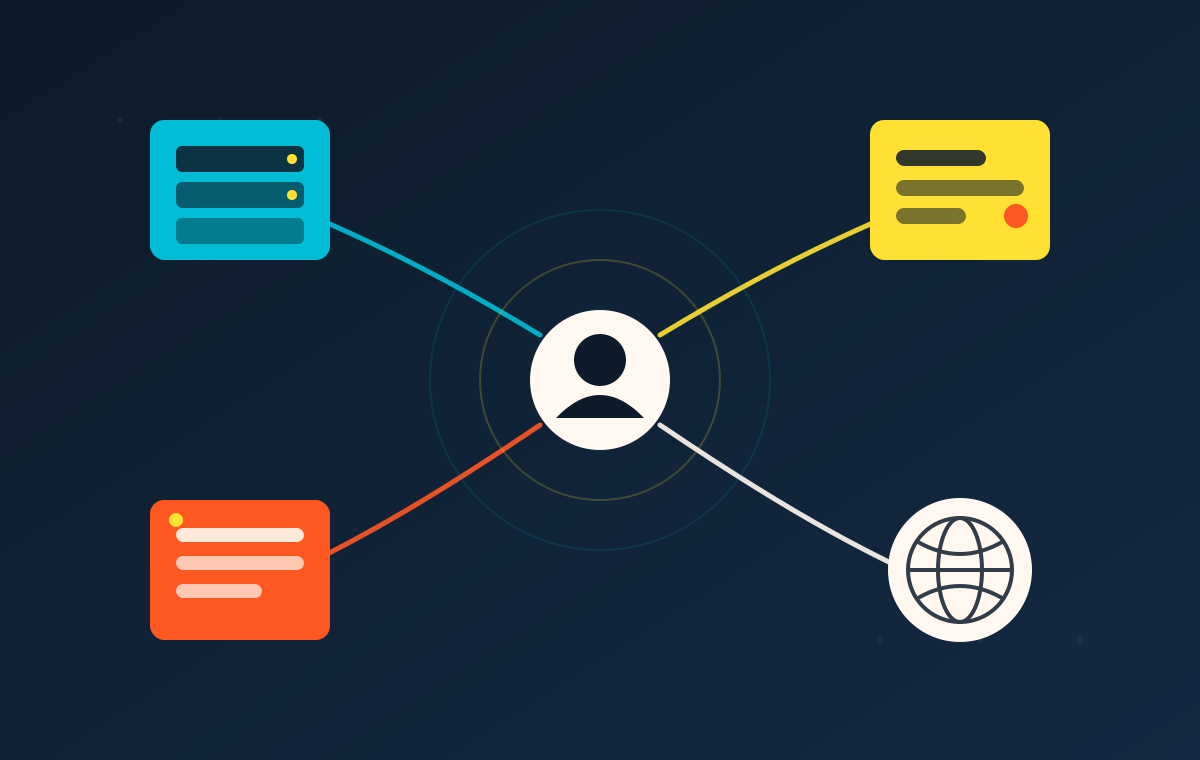
Every live chat vendor demos the same thing. A little bubble in the corner of a website blinks. A visitor types "hi." Someone types back. The screen recording ends, everyone nods, and the actual decision - the one that costs money and headaches two years later - never comes up. The decision isn't the bubble. It's where the sentence goes after the visitor hits send.
Four companies answer that question in four ways that barely overlap. Userlike routes it into a German data center. Social Intents drops it into your Slack or Microsoft Teams. LiveHelpNow feeds it into a full help-desk queue. Rocket.Chat hands you the entire stack and lets you host it on a server you own. Same widget on the page. Completely different businesses behind it.
Line their feature charts up side by side and they look interchangeable: canned responses, chat routing, visitor tracking, an AI bot bolted on in the last two years. The feature chart is a distraction. Read the architecture instead and the four of them split into clean, opinionated camps.
The map
Four homes for one conversation
Here is the whole story in one graphic. Ask a single question - where does the chat physically end up? - and each vendor answers differently. That answer is the product.
Nobody switches live chat software for a nicer widget. They switch because the conversation ended up in the wrong place - the wrong country, the wrong app, the wrong queue.
Camp one
Userlike turned a constraint into a moat
Timoor Taufig and David Voswinkel started Userlike in Cologne in 2011, while they were still students. The German origin was a fact before it was a strategy. Then European data rules tightened, GDPR arrived, and "built and hosted in Germany" stopped reading as a footnote and started reading as the pitch.
Today Userlike says more than 10,000 companies use it - Toyota, Nivea, Allianz, Lufthansa, Porsche, BMW - and the through-line is caution about where customer data sleeps at night. Around 2019 the product widened from live chat into unified messaging, pulling WhatsApp and other channels into one inbox. In 2023 it was acquired by Lime Technologies. The chat box, it turned out, was the door - the messaging platform behind it was the house.
If your legal team flinches at customer data crossing a border, Userlike is doing something the American tools mostly can't say with a straight face: keeping the whole conversation on the continent, with automatic deletion and EU hosting as defaults rather than upgrades.
Camp two
Social Intents skips the app entirely
The quiet insight behind Social Intents is that the best software is often the software you already have open. Most live chat tools ask a team to learn a new dashboard, watch a new inbox, keep a new tab alive all day. Social Intents refuses the premise. A visitor starts a chat on your site, and the message shows up inside Slack, Microsoft Teams, Google Chat, Zoom or Webex - wherever the team already lives.
The pricing follows the same contrarian logic. The industry charges per seat, which quietly punishes you for adding teammates. Social Intents prices flat with unlimited agents, starting around $39 a month. You can wire up the whole company without watching the bill climb. Its AI layer leans on ChatGPT, Claude and Gemini and, by the company's own numbers, handles roughly three-quarters of incoming questions before a human sees them.
Camp three
LiveHelpNow sells the queue, not the bubble
LiveHelpNow is the one that admits the chat was never the point. Its center of gravity sits further down the funnel, in the help desk. Chat, SMS, email, phone and social all pour into a single workspace where each conversation carries its history, its ticket, its routing rules and its analytics.
That makes it the natural pick for a support team drowning in fragmented threads - the outfit that keeps losing context because a customer emailed on Monday, chatted on Tuesday and called on Wednesday, and nobody could see all three at once. Pricing starts around $21 per user per month and scales by the modules you switch on. The bubble on the website is just the intake valve for a much larger machine.
Camp four
Rocket.Chat is the answer when the cloud is not allowed
Gabriel Engel and his team started Rocket.Chat in Porto Alegre, Brazil in 2015, built it in JavaScript and Node.js inside a company called Konecty, and put it on GitHub. It grew into a full communications platform - chat, voice, video, screen sharing, file sharing - usually described as an open-source alternative to Slack or Microsoft Teams.
What sets it apart is deployment. You can run Rocket.Chat on your own servers, in your own cloud, or completely air-gapped with no internet connection at all. Federation lets you talk to partners on Slack or Teams without leaving your own sovereign platform. That combination is why organizations with the strictest requirements - the company lists the US Navy, Deutsche Bahn and Credit Suisse among tens of millions of users across 150-plus countries - land here. Open source didn't lose the enterprise. It waited for the enterprise to start caring about sovereignty.
Buying live chat software is really buying an opinion about data, teams and trust. Read the opinion before you read the feature list.The takeaway
By the numbers
Where the conversation ends up
A rough sketch of how far each platform leans on the two axes that actually decide the purchase - how much control you keep over the data, and how much the tool bends toward the apps your team already uses.
Positions are an editorial reading of each vendor's public positioning, not a benchmark score.
So which one
Pick the home, and the tool picks itself
The honest answer to "which live chat software is best" is that the question is malformed. Reframe it as "where should this conversation live," and the field sorts itself out. Run a small shop and hate paying per head? Social Intents lives in the Slack you already have and won't tax you for growing. Answer to EU regulators? Userlike keeps everything in Germany. Buried in tickets across five channels? LiveHelpNow was built for exactly that mess. Work somewhere the data cannot touch a public cloud? Rocket.Chat runs on your own iron, air-gapped if it has to be.
The AI wave doesn't collapse those distinctions - it sharpens them. When bots resolve most of the routine questions, the human conversations that remain are the hard, high-stakes ones, and where those land matters more, not less. The chatbot is table stakes now. The architecture underneath it is the whole game.
Questions people actually ask
FAQ
What's the real difference between these four?
They put nearly the same chat widget on your site but route the conversation differently: Userlike into a German-hosted omnichannel inbox, Social Intents into Slack or Microsoft Teams, LiveHelpNow into a full help-desk queue, and Rocket.Chat into a platform you can host on your own servers.
Which is best for a small team on a budget?
Social Intents is worth a look because it prices flat with unlimited agents and lives inside Slack or Teams, so there's no new app to learn. Rocket.Chat's open-source Community edition is free if you're comfortable self-hosting.
Which fits when data can't leave the country or the building?
Userlike for EU/GDPR-sensitive teams that want German hosting, and Rocket.Chat for organizations that need self-hosted or fully air-gapped deployments.
Do these tools include AI chatbots?
Yes. All four now offer AI-assisted chat. Social Intents advertises bots powered by ChatGPT, Claude and Gemini that resolve roughly 75% of questions, and Userlike, LiveHelpNow and Rocket.Chat have their own AI features.
Is live chat really different from a help desk?
They overlap. LiveHelpNow leans furthest toward the help-desk end - ticketing, multi-channel history and analytics - while the others start as real-time chat and add support tooling around it.