Story · SaaS & AI
Social Intents Answers Your Customers From Inside Slack
A two-person, bootstrapped company in Atlanta built live chat that lives inside Microsoft Teams, Slack and Google Chat - and now lets ChatGPT, Claude and Gemini field most of the questions before a human ever looks.
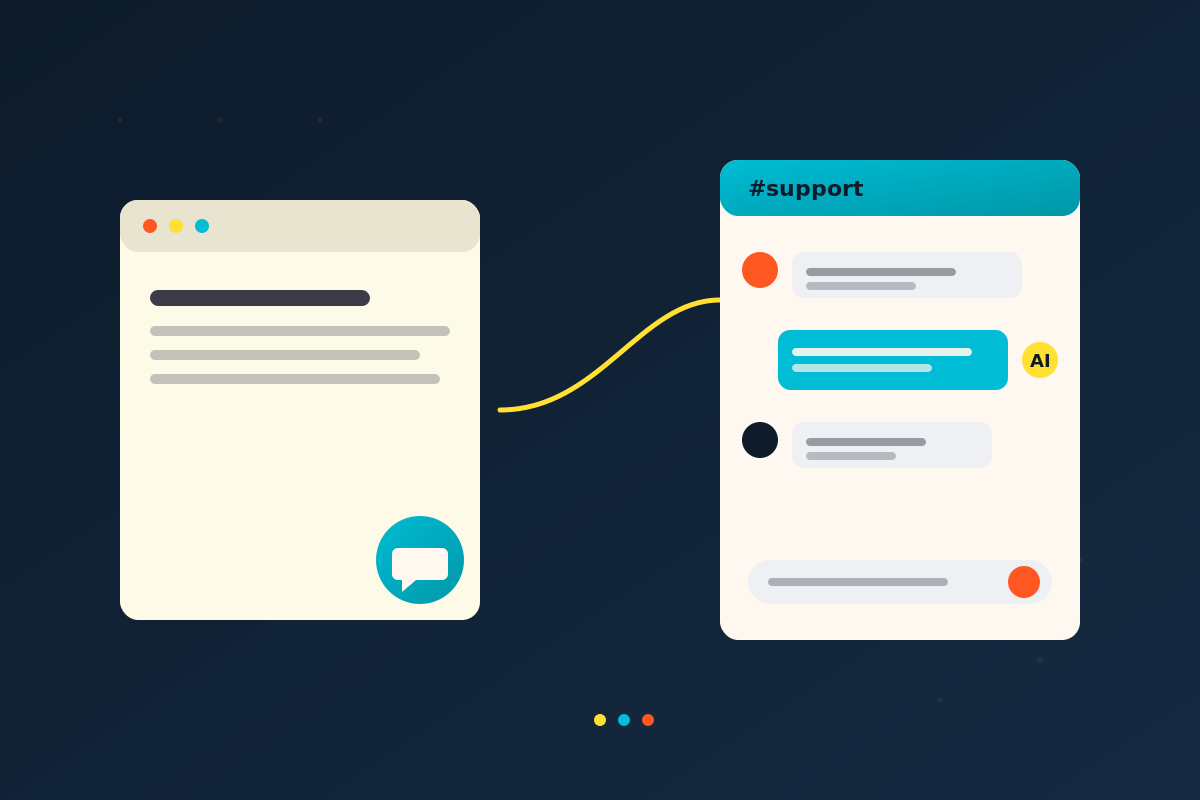
A customer's message leaves the website widget and lands in a team channel, where an AI drafts the first reply and a person steps in when needed. Illustration: YesPress Newsroom.
Open your Slack right now. Count the tabs you already keep open next to it. That number is exactly why most customer support software fails on day two: it asks people to go somewhere else. Social Intents built its whole business on refusing to make you.
The premise is almost too plain to sound like a company. A visitor on your website types a question into a chat box. Instead of piling up in yet another dashboard that someone has to remember to check, that message shows up in the Microsoft Teams, Slack or Google Chat channel your team stares at all day. You reply from there. The visitor sees it on the site. Nobody learned a new app.
That is the trick, and the discipline is in not adding a second one. Social Intents has been shipping this idea out of Atlanta since around 2014, founded by James Brookner and run as a lean, bootstrapped operation - no venture rounds, no growth-at-all-costs org chart. The company reports serving more than 50,000 businesses, which is the kind of number you expect from a floor full of engineers, not from a team you could fit in a single car.
Meet people where they already are
There is a quiet law of software adoption: a tool that requires a behavior change tends to lose to one that doesn't. Support desks are full of agents who live in a chat client all day. Ask them to also monitor a separate ticketing screen and, without fail, some conversations slip. Social Intents sidesteps the whole problem by delivering the conversation into the client they never close.
The integration list reads like the modern workplace roster - Microsoft Teams, Slack, Google Chat, Zoom and Webex - and the customer-side channels fan out from there: website chat, WhatsApp, SMS, Facebook Messenger and email, all landing in one place. On the setup side it plugs into WordPress, Shopify and Wix, so the widget goes live without a developer babysitting it.
The winning feature isn't more AI. It's less friction - the chat comes to your team, not the other way around.
The AI that knows when to step aside
Every company now claims an AI chatbot. The ones people actually like are the ones that know their limits. Social Intents lets you train a bot on your own website content in a single click, pick the model behind it - ChatGPT, Claude or Gemini - and set how far it goes on its own. It can answer first and hand off to a person, work alongside an agent, or cover the after-hours shift when nobody is at a keyboard.
By the company's own account, the bot resolves roughly three of every four incoming questions. The interesting number is the remaining one. That is the question where a person needs to take over, and the handoff into a channel a human is already watching is the part most chatbots botch. Building for that seam - AI first, human when it counts, in 80-plus languages - is a more honest design goal than pretending the machine handles everything.
Small on purpose, not by accident
The unglamorous part of the story is the headcount. Social Intents has stayed tiny - reported at around two people - while carrying tens of thousands of customers and, by its own tally, delivering more than 10 million chats against a 99.9% uptime commitment. That is only possible if the product does the talking, and if the team resists the urge to bolt on features nobody asked for.
Bootstrapping here reads as a strategy rather than a consolation. No outside money means no pressure to inflate the roadmap. The company can keep sanding down the one thing it does - move a conversation from a website into the tool your team already uses - instead of chasing a suite it can't staff. There is a lesson in that for anyone building software: constraints tend to produce sharper products than budgets do.
You don't need another dashboard. You need the message.
What you can actually do with it
If you run a small support team, the practical version is short. Drop a chat widget on your site, connect your Slack or Teams workspace, and let the AI cover the routine questions and the overnight hours. When a conversation needs a person, it is already sitting in a channel someone is watching. For agencies, there is a white-label option, so the whole thing can carry a client's brand instead of Social Intents'.
It won't be for everyone. Teams that want a heavyweight, all-in-one help desk with deep ticketing workflows will find bigger platforms built for that. Social Intents is making a narrower bet: that the fastest support is the kind that never asks your team to leave the room they are already in. On that bet, it has quietly been right for more than a decade.
Explore
↗ socialintents.com ↗ Slack live chat ↗ Teams & Slack apps ↗ Help center ↗ LinkedIn ↗ X / TwitterFrequently asked
What does Social Intents do?
It provides live chat and AI chatbots for websites, but routes the conversations into tools teams already use - Microsoft Teams, Slack, Google Chat, Zoom and Webex - so agents answer without switching apps.
Which team tools does it integrate with?
Microsoft Teams, Slack, Google Chat, Zoom and Webex, plus customer channels like WhatsApp, SMS, Messenger and email, and platforms including WordPress, Shopify and Wix.
How does the AI chatbot work?
You train it on your website content in one click, choose a model (ChatGPT, Claude or Gemini), and it answers routine questions - reportedly around 75% - handing off to a human when needed.
Who founded Social Intents and is it funded?
It was founded around 2014 by James Brookner in Atlanta and is bootstrapped, having raised no outside funding.
How much does Social Intents cost?
Plans range from roughly $21/month for a Lite tier up to about $199/month, with enterprise options and a 14-day free trial.