The best customer-support bot is the one nobody notices doing its job. A visitor asks whether a fitting works with an obscure component, gets the relevant line from page 147 of a manual, sees the source, and goes away happy. Wonderchat is built for that small, useful disappearing act. Give it websites, documents and help-center material, and it turns them into an AI agent that can answer questions, collect leads and wave for a human when the conversation gets delicate.
This makes Wonderchat most interesting to companies with a documentation problem hiding inside a support problem. Think SaaS products with sprawling help centers, manufacturers with diagram-heavy catalogs, schools with the same admissions questions every week, and ecommerce teams explaining ingredients or returns after midnight. A five-page brochure site will not reveal much of its character. A cluttered knowledge base and a busy queue will.
The company was founded in Singapore in 2023 by Vera Sun and Luke Tan. Its original pitch was wonderfully blunt: paste a link and build a custom chatbot in five minutes. The current platform has grown into three neighboring jobs. A support agent answers and escalates. A conversion agent qualifies visitors and collects contact details. Wonderchat Workspace, launched in June 2026 and billed separately, lets employees question internal material across systems such as SharePoint and Google Drive.
Why it earns a closer look
Plenty of products can put a talking bubble in a corner. Wonderchat’s stronger argument sits behind the bubble: retrieval, citations and correction. The agent searches the material a company approves, assembles an answer from that material and can show where it came from. When an answer is weak, operators can flag a correction or see the question as a knowledge gap. That feedback is useful even when the bot fails, because it tells a team which missing paragraph keeps creating tickets.
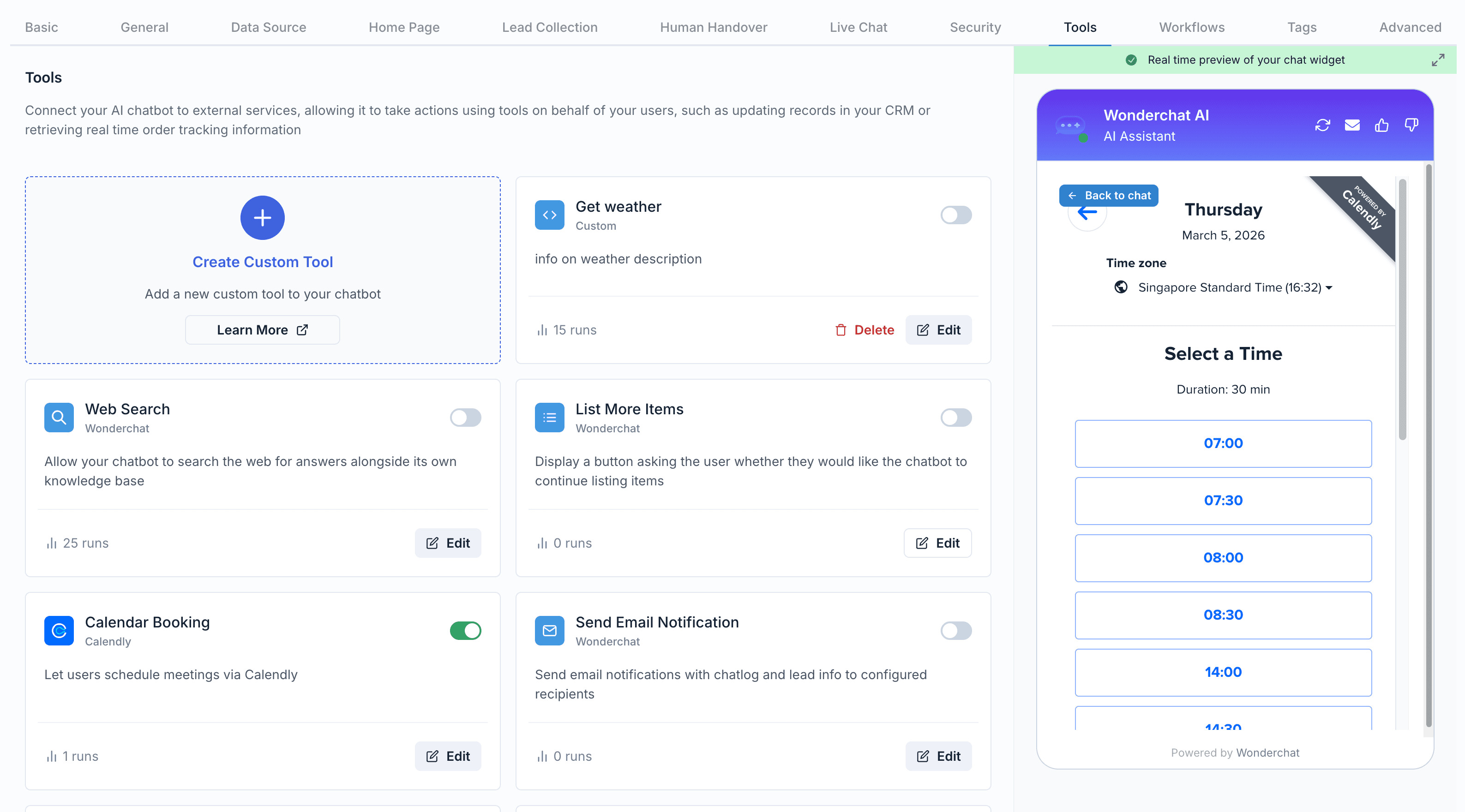
The human stop button matters. Wonderchat supports native live chat, email escalation and helpdesk handoff. A transferred conversation carries its history, sparing the customer a second recital. Zendesk and Freshdesk connections are documented, while integrations and channels also include HubSpot, Slack, Microsoft Teams, WhatsApp, Instagram and Facebook Messenger. Higher plans add voice. For sales, workflows can open on a trigger, ask qualifying questions, collect details and pass a promising visitor to the correct team.
The chatbot bubble is the least interesting bit. The real product is the route from approved answer to graceful surrender.YesPress verdict
There is a sensible philosophy here: automate the repeatable layer, preserve a route to judgment. It is more credible than the fantasy of firing a support department because a demo answered three polished questions. Wonderchat’s own published customer material supports the hybrid case. Dutch accounting platform Jortt calls its agent Femke and reports that it resolves 92 percent of 30,000 monthly inquiries. Encompass reports 75 percent of 30,000 user journeys reaching self-service resolution before Zendesk. Ko-fi reports a 70 percent resolution rate.
Those are vendor-published case results, not a universal forecast. They do show the sort of environment where the product can earn its keep: lots of recurring questions, a deep body of usable content and a team prepared to review what the agent gets wrong.
What the setup actually asks of you
Wonderchat is no-code, but no-code does not mean no work. Start by connecting a site or uploading files. The platform lists support for PDFs, Word documents, text, CSVs and presentations, plus public and authenticated crawling. Set the agent’s persona, memory and response behavior. Add the widget with a snippet, test unfriendly questions, then build the escalation path. Scheduled recrawling helps when the source changes.
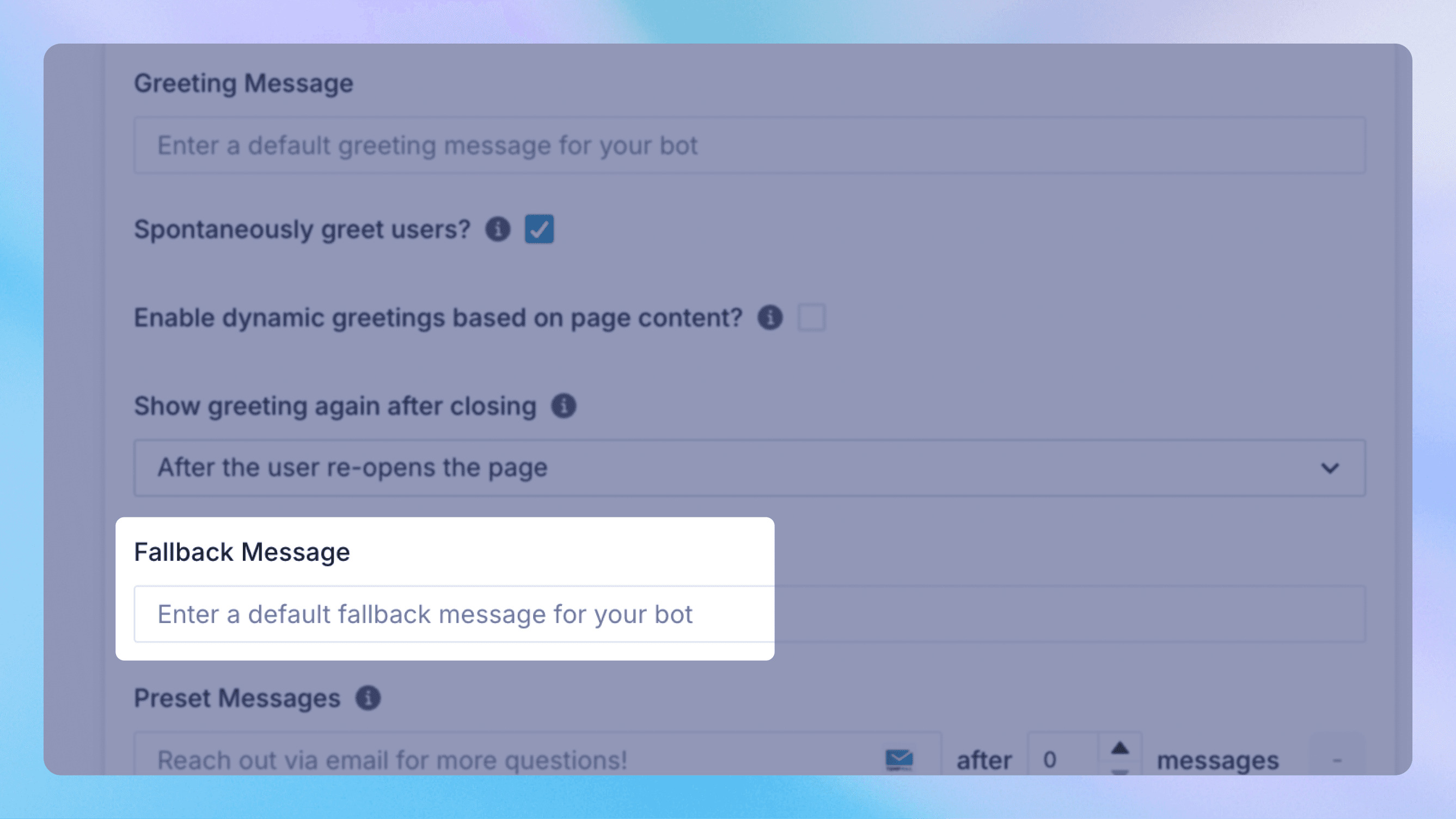
The unglamorous task is content hygiene. Two refund policies with different dates will confuse a retrieval system as efficiently as they confuse a new employee. A screenshot without descriptive text may be less searchable than a clean instruction. Wonderchat can extract media and display images, diagrams and tables from documents, but a tidy source still wins. Its Workspace product addresses stale policies with document invalidation, where a new version can supersede an old one.
A source citation makes an answer inspectable, not automatically correct. Test high-risk questions, restrict actions, and keep people in the loop for refunds, account changes, medical claims, financial decisions and anything else with consequences.
The price is a product decision
Wonderchat has a free tier, though it is closer to a fitting room than a permanent wardrobe: 20 credits, roughly ten resolutions, 50 stored webpages and one agent. On annual billing, the public support-agent page showed Basic at $124 a month, with 5,000 credits and roughly 1,000 monthly resolutions. Scale was displayed at $417 a month, with roughly 5,000 resolutions, larger storage, four agents, analytics, voice and helpdesk integrations. Enterprise pricing was custom, shown as starting at $1,499. Packs of 1,000 extra message credits cost $29.99.
| Plan | Public annual rate | Best read as | Watch closely |
|---|---|---|---|
| Free | $0 / month | A live-site experiment | 20 credits and about 10 resolutions |
| Basic | $124 / month | A small support operation | Usage, page and agent limits |
| Scale | $417 / month | Growing, integrated support | Confirm the current credit allowance |
| Enterprise | From $1,499 | Regulated or high-volume teams | Scope, onboarding and custom terms |
Read the checkout page rather than relying on the headline price. At the time of this review, different sections of the pricing page used both “Scale” and “Turbo” for the upper self-serve tier and showed inconsistent credit totals. That may be a migration artifact, but it is exactly the sort of detail a buyer should settle before forecasting cost. Workspace follows another schedule: free for five members, Premium at $99 a month for five, then $25 for each additional seat, with custom Enterprise terms.
Reviews: promising, still a small room
Independent review volume is thin. G2 showed three reviews and a 5.0 score when checked. One 2023 reviewer praised the “Simple 5 minute set up” and called the combined site-and-PDF bot a “work encyclopedia.” Another liked the ease of training but noted that website protections could interfere with crawling. A 2025 reviewer singled out pricing. Product Hunt showed two reviews, a 5.0 rating and 142 followers. Those numbers are pleasant, not statistically sturdy.
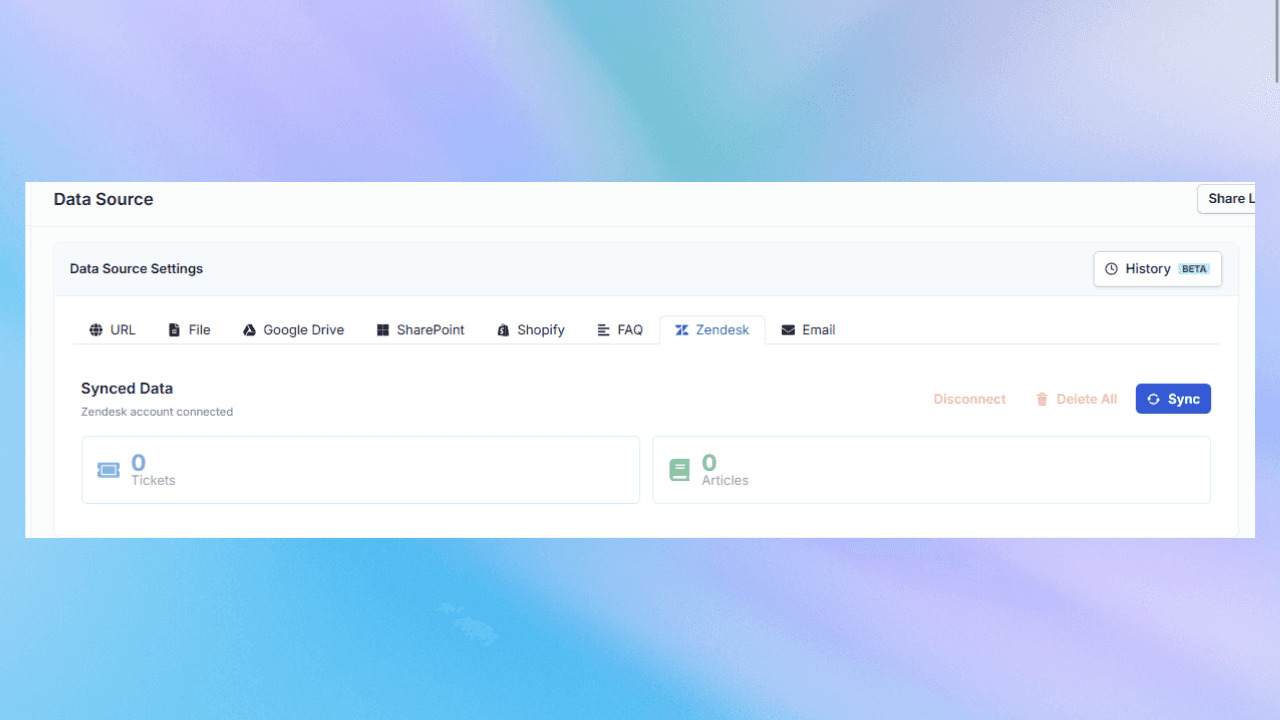
Reddit mentions are similarly modest and should be read with the usual forum caution. A user in a no-code thread described Wonderchat as easy to integrate and train, while appreciating Telegram or WhatsApp notifications and lead collection. More useful than the praise is the recurring caveat across support discussions: FAQ automation is easier than account-specific work. Order status, billing and changes to a system of record require permissions, integrations and a well-defined handoff.
Who should shortlist it
Buy the workflow, not the talking mascot
- You have hundreds or thousands of pages and repeated, document-backed questions.
- You need citations because a plausible answer is not good enough.
- You want AI and live agents in one conversation, or an AI layer above an existing helpdesk.
- You will review transcripts, repair source material and measure completed resolutions.
Skip or delay it if your answers mostly require judgment, your knowledge is stale, your traffic is tiny, or the monthly plan costs more than the queue it removes.
Chatbase and SiteGPT belong on the shortlist for teams that want a straightforward trained-on-your-data bot. Intercom Fin makes more sense to evaluate when Intercom already is the helpdesk and seat workflow. Zendesk AI deserves the same consideration in a Zendesk-centered operation. CustomGPT.ai and Dante AI cover adjacent no-code territory. Glean competes more directly with the internal-search side of Workspace. The right comparison is not a feature bingo card; it is the amount of migration, handoff quality, knowledge upkeep and total cost at your real conversation volume.
A practical seven-day trial
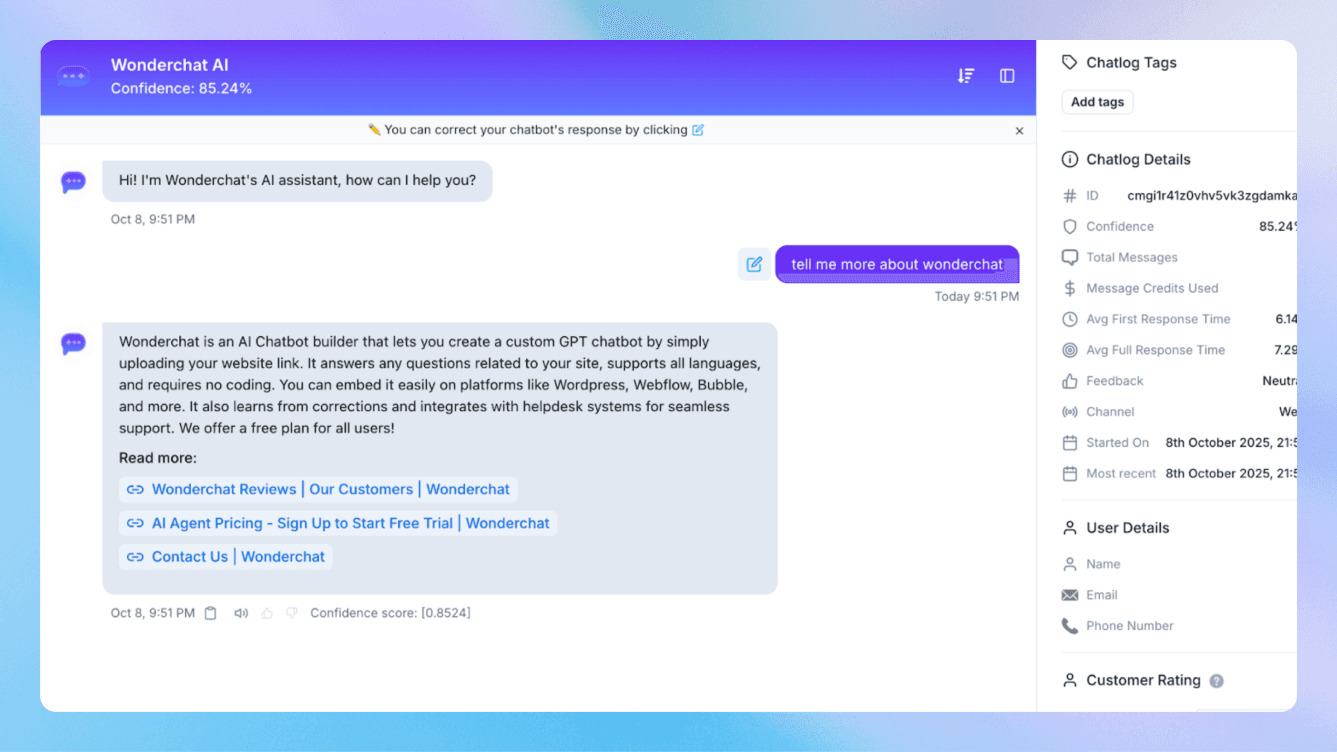
Do not demo Wonderchat on your cleanest FAQ. Pick the ugliest useful corner of the business: one product family, one admissions process or the 100 tickets your team is bored of seeing. Connect only the authoritative sources. Write 30 test questions, including typos, follow-ups, contradictions and requests the agent should refuse. Ask frontline staff to grade the answer, citation and route to a person separately.
Then watch outcomes, not chat volume. Did the visitor finish the task? Did the citation support the exact claim? Did a human receive the transcript and enough context? How many answers exposed missing documentation? Finally, model the bill at ordinary, busy and unpleasant months. If the trial saves time while revealing where your manuals need work, Wonderchat is doing two jobs. If it only produces polished paraphrases of obvious pages, keep your money.
The product’s evolution from a five-minute website bot to a dual external-and-internal knowledge platform is ambitious. The part worth sharing is less grand: a good answer should come with a receipt, and a bad one should know whom to call. Wonderchat has built around both ideas. For teams buried in useful documents and repetitive questions, that is a sensible place to begin.