enterprise-search
(30)
Left Right Mind wants AI to check the fine print
From a $30,000 home-services app to NASA search tools, Left Right Mind has built a business around making information useful. Its next pitch: catching the gaps between what companies promise and what they actually do.

Interact Software Wants to End the Office Scavenger Hunt
Four intranets to check. One policy to find. Interact has built a business around that mismatch - and its next act puts AI inside the everyday machinery of work.

Wonderchat Gives Your Help Docs a Night Shift
Feed it the manuals, policies and webpages your customers ignore. Wonderchat turns that pile into a support and sales agent - with citations, a human escape hatch and a bill worth reading twice.
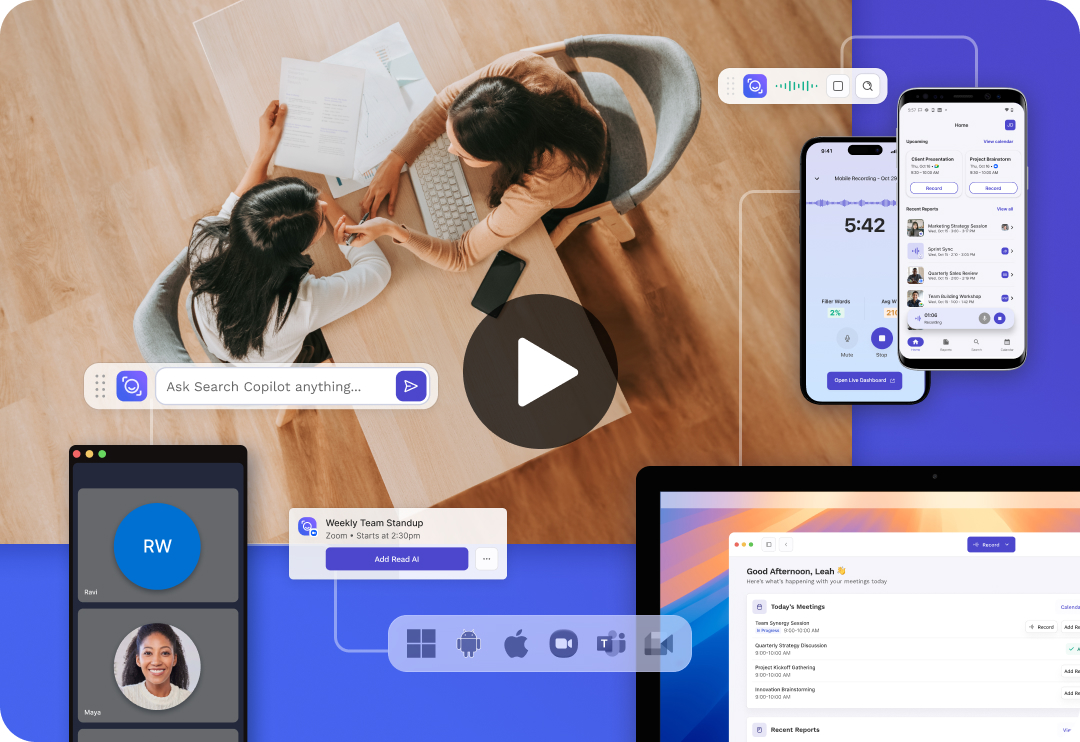
Your Meeting Has a Memory Now
Read AI remembers the call, finds the decision and drafts the follow-up. The useful part starts after the transcript - provided everyone in the room knows the robot is listening.
Notion AI Ate the Busywork
The writing assistant grew hands, learned your filing system, and started attending meetings. For teams already living in Notion, that is either the missing colleague or a very persuasive reason to tidy the office.
Algolia’s First Search Product Flopped. The Pivot Now Handles 1.75 Trillion Queries a Year
A beautiful offline-search engine met a market that would not pay. One customer request later, two French engineers turned the same hard-won speed into an API business used by Under Armour, Lacoste, Slack and thousands more.
Mosaic AI Narrowed Its Bet - Then One Customer Found $375,000 in the Support Queue
Generic copilots know the manual. Mosaic AI wants to know the customer, the configuration and the last five tickets - a narrower bet that turned scattered support data into measurable capacity for enterprise teams.

ProNavigator Turned a 97-Minute Hold Into the Search Bar Insurance Bought
Joseph D'Souza started with a chatbot for stranded policyholders. The more valuable business was hiding behind the call center: helping insurance employees find the one trustworthy answer buried across PDFs, portals, inboxes, and shared drives.
amber Raised €7 Million to Build the Boring Layer Europe’s AI Agents Need
The Aachen startup began with a search box. Now it is betting that Europe’s mid-sized companies need something less visible - a governed context layer that lets AI find, explain and eventually do the work.

David Lanstein Is Building the Search Bar His Old Team Needed
He went from writing software at Splunk to scaling sales at PagerDuty. The costly search habits he watched form along the way became the operating thesis for Atolio.
The Search Box Is Becoming the Company Brain
Coveo spent two decades teaching companies to find their own information. Now that same retrieval machinery is becoming the context layer beneath shopping conversations, support answers and enterprise AI agents.
The Search Engine That Learned Three Jobs
Elastic began with a recipe search problem. Today, the same engine retrieves context for AI agents, traces a failing service and helps a security analyst find the one alert that matters.
The Search Company That Decided Keywords Weren't Enough
Lucidworks grew up inside open-source Solr, then bet its future on a harder problem than matching words: understanding what people mean. Here is how the Salt Lake City and San Francisco company sells relevance to the world's largest catalogs.

Arvind Jain
Arvind Jain spent a career making the world searchable. Then an employee survey showed him the harder problem was hiding inside the office.

Your Knowledge Base Is Now AI Infrastructure
ReadMe, KMS Lighthouse, MadCap Software and Microsoft are turning documentation from a reference shelf into a working layer for AI. The useful question is no longer which tool stores the most, but which kind of knowledge your business needs to move.

Knowmax vs Notion Is a Choice Between Answers and Workspaces
Not every knowledge problem needs the same kind of home. Knowmax turns approved support logic into guided resolutions; Notion turns team knowledge into a flexible, connected workspace.

Knowledge Base Software Is a Workflow Decision
Microsoft, ServiceNow, Archbee, ScreenSteps, HubSpot and Nuclino can all hold an answer. The useful question is which one fits the work that creates, approves and uses it.
Knowledge Base Software Is Eight Different Products Now
Paligo, Confluence, Stack Internal, ProProfs, eGain, Shelf, Stonly and Bloomfire share a category - and almost nothing else. Here is how to buy for the work your team actually needs done.

The Knowledge Stack Has Four Places to Put the Answer
Confluence, Archbee, Spekit and Upland Panviva all promise to make company knowledge useful. The meaningful difference is where each one expects the answer to meet its reader.
Nobody Reads the Company Wiki. Now AI Reads It For You
Atlassian, Notion, Zendesk, Glean and a pack of rivals spent a decade helping teams write things down. The AI scramble of 2025 rewrote the job description - now the software has to read it all back.

Spekit, Glean and the End of Looking Stuff Up at Work
Two well-funded startups are attacking the same quiet tax on office work - the hours people lose hunting for answers that already exist somewhere in the company. One buries the answer inside the sales tools; the other indexes everything and lets you ask.
Your Company's Knowledge Is Lost. These 8 Tools Want It Back
Glean, Whatfix, Zendesk, Salesforce, Slite, Spekit, Archbee and Nuclino all sell the same promise - that your team will finally find what it needs. Here is how the eight of them actually split the work.
Knowledge Base Software Is Splitting Into Two Camps
GitBook, Bloomfire, Salesforce and MadCap are chasing the same buyers with wildly different bets. The real dividing line in 2026 is whether your documentation tool thinks for itself.
Bloomfire
Bloomfire sells companies a cure for their own forgetfulness - an AI knowledge layer that makes video, PDFs and buried Slack answers searchable, and then quietly tells you which of them have gone stale.

Atolio
Atolio is a private, AI-powered enterprise search platform that runs inside a company's own cloud (AWS, Azure, or GCP) or on-premises. It connects to workplace systems like Slack, Google Workspace, Office 365, Salesforce, and ServiceNow, then indexes them with document-level permissions so employees only see what they are already authorized to view. Founded in 2019 by Splunk and PagerDuty veterans, Atolio pairs hybrid semantic-plus-keyword search with permission-aware retrieval-augmented generation, giving enterprises secure question answering across siloed knowledge without their data ever leaving their environment.

Glean
Glean is a Palo Alto-based enterprise AI company that builds a 'Work AI' platform - a permissions-aware assistant, search layer, and agent environment that connects to a company's scattered SaaS tools and documents so employees can find answers and automate work. Founded in 2019 by former Google search engineers led by Arvind Jain, Glean crossed $200M in ARR by late 2025 and was valued at $7.2 billion in its June 2025 Series F.
Vectara
Vectara is a Palo Alto-based enterprise AI company building a trusted, end-to-end platform for retrieval-augmented generation (RAG) and AI agents. Founded in 2022 by former Google AI researchers, it lets companies embed grounded, citation-backed GenAI - conversational assistants, semantic search, and agents - into their products while actively detecting and correcting hallucinations at runtime. Its stack includes the Boomerang embedding model, the RAG-tuned Mockingbird LLM, the open-source Hughes Hallucination Evaluation Model (HHEM), and a Guardian Agent layer, positioning Vectara as a leader in factual, secure, compliance-ready enterprise AI.

VectorShift
VectorShift is an AI platform that started as a no-code builder for generative AI workflows and has sharpened into an 'AI operating system for private market investors.' Founded in 2023 by Harvard classmates Alexander Leonardi and Albert Mao and backed by Y Combinator, it lets firms turn scattered deal documents, diligence notes, and institutional memory into working AI - data-room analysis, IC memos, portfolio monitoring, and LP reporting - through a drag-and-drop interface or a Python SDK, without hiring a machine-learning team.

StackAI
StackAI is a San Francisco no-code platform for building, deploying, and governing custom AI agents that automate back-office work across enterprise systems like Salesforce, Slack, and Google Workspace. Founded in 2023 by MIT robotics PhDs Antoni 'Toni' Rosinol and Bernardo Aceituno out of Y Combinator's W23 batch, it grew to 100+ enterprise customers and processed over a million documents before Asana acquired it in May 2026 for a reported $75 million to anchor its 'operating system for human-agent teams.'

Matt Riley
Matt Riley co-founded Swiftype (YC W12) in 2012, built it into a leading search-as-a-service platform, and sold it to Elastic in 2017. He then spent nearly eight years at Elastic as GVP & GM of Search, overseeing product, engineering, design, and developer relations for one of the world's most widely used search platforms. In late 2025, he returned to Y Combinator as a Visiting Partner - advising the next generation of founders using hard-won lessons from the full founder arc: zero to startup, startup to acquisition, acquisition to enterprise scale.