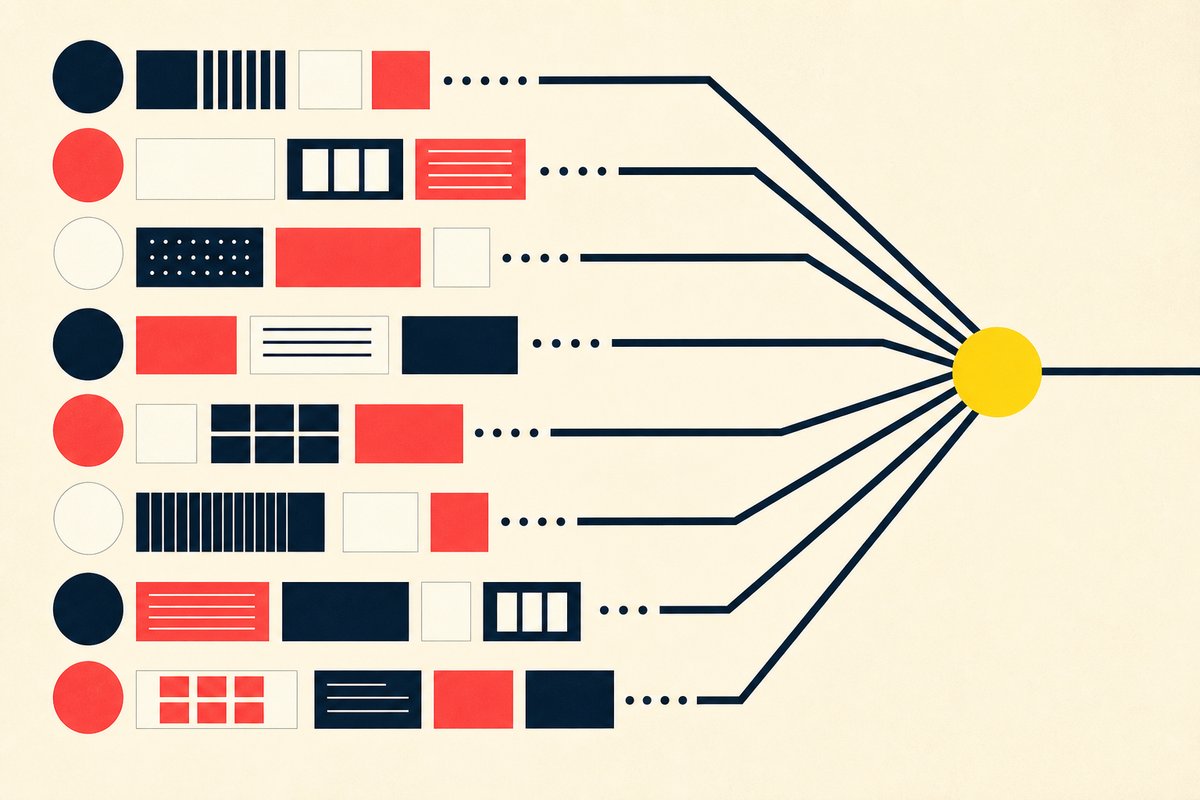
A knowledge-base demo usually begins with search. Someone types a question, a clean result appears, and the room relaxes. But the search box is the last mile. The expensive decisions happened earlier: who wrote the answer, what shape it took, how it was approved, where else it appears, and what happens when it expires. Eight products can produce a convincing search result while running eight very different machines behind it.
That is why shopping the category by feature checklist creates so much rework. Paligo, Atlassian's Confluence, Stack Internal, ProProfs Knowledge Base, eGain, Shelf, Stonly and Bloomfire all promise some combination of content, discovery and access. The overlap is real. So are the differences. One treats a warning paragraph as a reusable component. Another treats an answer as a community artifact. Another turns help into a branching sequence of steps.
The useful first question is not which product has AI search. It is: what must people repeatedly do with knowledge here? Publish it across product versions? Debate it in public? Deliver it to an agent during a live customer call? Walk a user through a task? The verb matters more than the category.
Buy the maintenance loop, not the search box.
Start with the unit of knowledge
Every system has a native object, even when marketing pages call everything “content.” In Paligo, the important object can be smaller than a document: a topic, step, warning or other structured component that can be reused. Change that component and the correction can flow to every publication that includes it. For a documentation team supporting several products, releases, languages and output formats, that is less a writing convenience than a control system.
Confluence starts from the page and the space. Its strength is social proximity to everyday work: meeting notes, project plans, decisions and policies can be written together, commented on and organized in one workspace. The page is permissive. That makes it easy to begin, and puts more responsibility on teams to keep structure and ownership from drifting.
Stack Internal, the product formerly known as Stack Overflow for Teams, starts with the question and answer. Accepted answers, votes, reputation, expert signals and content-health prompts make trust visible. This suits an engineering culture where the valuable fact often begins as an interruption: “Why does this deployment fail in the EU region?” The answer becomes durable only if people ask in the open and experts return to validate it.
components and approvalsParticipatory knowledge
questions and contributions
ProProfs Knowledge Base is closer to the familiar help-site model. Its public feature set spans WYSIWYG authoring, imports, roles, revision history, multiple sites, branding, analytics, multilingual publishing and reusable snippets. It is a pragmatic fit when the goal is to stand up customer or employee documentation without adopting the deeper component model of a CCMS.
Stonly changes the object again. Its product is built around interactive, step-by-step guides that can branch, live in a knowledge base or appear inside another product. This is useful when reading is not the outcome. A customer trying to configure billing needs the next relevant action, not a panoramic essay about every possible setting.
Paligo
Native unitReusable component
MomentMulti-output publishing
Confluence
Native unitCollaborative page
MomentTeam planning and reference
Stack Internal
Native unitValidated answer
MomentTechnical problem solving
ProProfs
Native unitHelp article
MomentSelf-service publishing
eGain
Native unitGoverned service answer
MomentCustomer interaction
Shelf
Native unitQuality-controlled knowledge
MomentAgent and AI retrieval
Stonly
Native unitBranching guide step
MomentTask completion
Bloomfire
Native unitSearchable insight
MomentEnterprise discovery
When the answer has to survive contact
eGain and Shelf move the buying conversation toward the contact center and governed AI. eGain describes its platform around trusted, governed and compliant knowledge for customer-service automation. The distinction is operational. An answer delivered to a service agent during a regulated conversation carries a different risk than a rough project note. Approval, personalization and channel delivery become central rather than optional.
Shelf emphasizes quality problems in the underlying corpus: duplicate, outdated or otherwise risky material, plus connectors, governance, authoring and delivery to people and AI systems. That framing matters because generative AI can make a bad source sound calm and complete. Fluency improves the interface, not the policy. If two return policies conflict, faster retrieval simply gets you to the conflict sooner.
Bloomfire approaches the enterprise layer through connected search, knowledge sharing, authoring, Q&A, analytics and source-grounded conversational answers. Its official platform materials stress connectors that index systems such as SharePoint, Google Drive, Salesforce, Teams and Confluence without requiring every document to move. That is attractive when the organization already has many repositories and the immediate job is discovery across them.
Search can unify access without unifying ownership. A connector may find five versions of a policy. Someone still needs the authority and workflow to decide which one deserves trust.
These products are not sealed boxes. Confluence has templates, permissions, versioning and a large app ecosystem. Stack Internal includes long-form Articles and ingestion as well as Q&A. ProProfs offers reusable content and contextual help. Bloomfire includes knowledge checks and moderation. Shelf offers authoring. Stonly can host a customer knowledge base. The map is about center of gravity, not a claim that any vendor can do only one thing.
A shortlist you can defend
A defensible selection begins with a sentence about failure. “Customers abandon setup because the article contains six irrelevant branches” points toward interactive guidance. “Writers update the same warning in 40 manuals” points toward component reuse. “Engineers answer the same build question in private chat every week” points toward community Q&A. “Agents quote retired policies” points toward governance, review and contextual delivery.
| Recurring failure | Start the shortlist with | Prove in a pilot |
|---|---|---|
| Duplicate technical content | Paligo | One change updates several outputs cleanly |
| Scattered team context | Confluence | People create, find and maintain shared pages |
| Repeated engineering questions | Stack Internal | Experts validate answers where everyone can reuse them |
| A help center needs launching | ProProfs | Editors publish an on-brand, searchable site |
| Risky service answers | eGain or Shelf | Agents receive approved, current guidance in workflow |
| Users get lost in long articles | Stonly | A branching guide increases task completion |
| Knowledge spans many systems | Bloomfire or Shelf | Search finds sources and exposes quality gaps |
Editorial fit guide based on each vendor's public product emphasis. It is a starting point, not a product score.
Then test the loop end to end. Seed the pilot with awkward material, not showcase content. Include a stale article, two near-duplicates, a permission boundary and a question nobody has documented. Ask the people who will maintain the system to do the work themselves. A polished answer from a sales engineer proves little about Tuesday afternoon after the launch team has moved on.
- Name the unit. Is the durable object a component, page, answer, article, document or guide step?
- Assign the owner. Decide who can approve, retire and resolve conflicts before importing content.
- Test retrieval in context. Search from the chat tool, service console, help center or product screen where the need actually occurs.
- Force an update. Change a policy during the pilot and watch how quickly every affected answer becomes correct.
- Measure behavior. Count questions resolved, tasks completed, duplicate work avoided and stale content repaired.
Price will narrow the field, as will security, hosting, integrations, language support and procurement reality. But those filters should operate on products that fit the work. A cheap wiki becomes expensive when a documentation team manually synchronizes 20 versions. A sophisticated governance platform becomes shelfware if a small team only needed to publish a clear FAQ.
The category will keep converging at the edges. Nearly every vendor now has an AI story, and search, analytics, permissions and integrations are table stakes. The durable differences sit deeper: the behavior the product encourages and the cost of keeping its knowledge healthy. That is where the demo should linger.
There is also a political fact hiding inside the software choice. Knowledge systems redistribute attention. A page-based workspace asks many people to document as they go. A Q&A system asks experts to answer where colleagues can see them. A controlled publishing system gives editors more authority over wording and release. A connected search layer asks repository owners to tolerate a common front door. None of those arrangements is neutral, and none arrives automatically with a license.
Before signing, write down the contribution bargain. What does an engineer gain by moving an answer out of chat? How much extra work does a reviewer accept to keep regulated guidance safe? Can a writer reuse approved material without waiting on another team? If the system creates work for contributors and returns value only to management, the content will thin out after the launch campaign.
A small, healthy collection is more useful than a grand import with no owners. Migration can create the appearance of progress because document counts climb quickly. Start instead with the questions or tasks that cost the organization time every week. Make those answers dependable. Let demand pull the next set of content into the system. The first proof is not volume. It is that somebody chose the system over sending another private message.
Frequently asked questions
What is the best knowledge base software?
There is no universal winner. Match the product to the main job: structured documentation, team pages, technical Q&A, help-site publishing, customer-service answers, knowledge governance, interactive guidance or enterprise search.
How is a CCMS different from a wiki?
A CCMS manages granular, reusable components and assembles them into multiple publications. A wiki is generally organized around pages that people create and edit collaboratively.
Which tool fits technical Q&A?
Stack Internal centers questions, accepted answers, votes, expertise and content health. Its fit is strongest when technical teams will participate openly and maintain answers over time.
Which products focus on customer service?
eGain emphasizes governed knowledge for customer-service automation. Shelf emphasizes quality, governance and delivery to agents and AI. Stonly emphasizes guided customer self-service.
What should a pilot measure?
Measure whether users find the right answer, trust it, complete the task and keep the source current after a real change. Adoption and maintenance are product requirements, not post-launch chores.