The support ticket looked ordinary until it did not. A customer had uploaded diagnostics for PostgreSQL 15.5. Somewhere inside the case were logs, an account history, a product configuration, old conversations and probably a colleague who had solved a cousin of the problem six months earlier. A generic chatbot could retrieve a manual. A good support engineer would reconstruct the scene. Mosaic AI has built a company around the distance between those two things.
The Toronto-headquartered enterprise software firm, previously called Ask-AI, connects the systems where customer truth tends to hide - Salesforce, Zendesk, Slack, Confluence, Jira, SharePoint, Snowflake and more than 100 other sources. Its software structures that material into what it calls a Customer Context Model. On top sit four principal products: Assist for reps, Self-Service for customers, Knowledge for filling documentation gaps and Intelligence for finding patterns before they become a parade of identical tickets. A no-code Agent Builder lets support leaders configure their own workflows.
The pitch is pleasantly concrete. Resolve cases faster. Interrupt fewer senior engineers. Catch a bad release before another hundred customers report it. Turn a solved case into an article a human can approve, then let that article answer the next customer. This is not the glamorous part of AI. It is the part with a queue, an escalation policy and a finance partner asking why support headcount keeps climbing.
The first product was an answer. The customer wanted an outcome.
Founder and CEO Alon Talmor arrived with unusually relevant scar tissue. He had co-founded BlueTail, sold it to Salesforce, served as a chief data scientist there, then completed a PhD in AI and natural-language processing. Around 2020, before “generative AI strategy” became a reliable way to fill a conference ballroom, he began building what amounted to enterprise search with Google-like answers. The company formally opened in 2021 after work with design partners.
That first idea addressed a real failure: company knowledge was scattered across chat, email, documents, CRM records and customer conversations. Search could bring the fragments closer. Yet the broad employee-sidekick category came with a blurry buyer and a fuzzy scorecard. A clever answer was not necessarily a changed business result. Meanwhile, early customers were using the technology around support, where complex questions ricocheted from frontline reps into Slack and then into product and engineering.
“The same gap kept appearing: B2B support teams were sitting on enormous volumes of customer intelligence ... with no systematic way to act on it before something went wrong.”Alon Talmor, founder and CEO
That changed the company's mind. Ask-AI did not abandon search so much as put it to work in a harder job. In January 2026, the company renamed its platform Mosaic AI. In June, it formally launched the expanded platform for enterprise B2B technical support. The metaphor does useful labor: one support artifact is a colored tile; the account, product, history and evidence together make the picture.
The product is the layer under the chat window
Mosaic's central argument is that context must be prepared, not merely indexed. Raw tickets and calls are messy. Customer names vary. Versions matter. Permissions matter more. The platform says it enriches every case with the relevant account, configuration, product and history, while inheriting access controls from connected systems. Answers are linked back to trusted material so a rep can inspect the evidence before it reaches a customer.
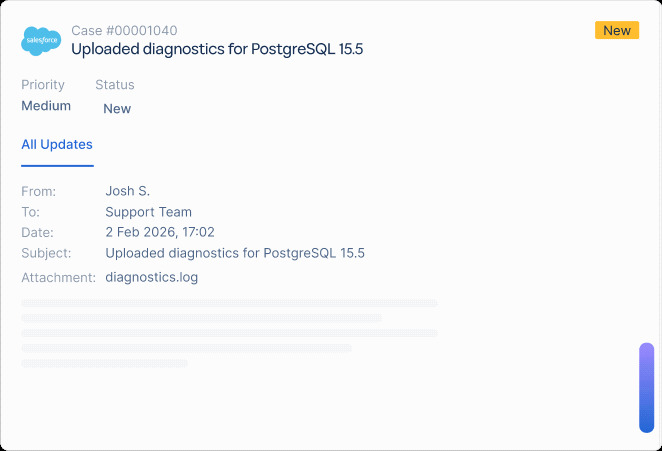
Assist is the visible worker. It can review logs, traces, screenshots, files and diagnostics; search prior cases; draft a cited reply; update the case; and escalate with the full history attached when judgment is required. Self-Service takes a related capability to help centers, portals and in-product surfaces. Intelligence groups cases into recurring issues, sentiment shifts and risk signals, then routes an alert to the team that can act. Knowledge looks for missing documentation and drafts material from resolved cases for human review.
The loop is the differentiator. Many support bots are only as current as the knowledge base they were pointed at on launch day. Mosaic pairs Self-Service with Knowledge so a failure can improve the underlying corpus. The customer asks; self-service finds a hole; a rep solves the case; software drafts an article with its receipts; an expert edits and approves it; the next customer gets a better answer. Every resolution can become training material without silently publishing whatever the model invents.
The proof is hiding in the queue
Mosaic publishes named customers including Rapid7, HiBob, Unity, Clarivate, Cority, AssetWorks, Yotpo, Planview, Point of Rental, PrismHR and Kaseya. The results are company-reported, so they deserve the same scrutiny as any vendor case study. They are still more useful than an abstract promise to “unlock productivity.”
Rapid7 runs a support operation handling more than 7,000 complex cases a month across more than 11,000 customers. Mosaic says the security company handled tickets 30 percent faster, created 35 percent more rep capacity and maintained 95 percent frontline CSAT. Early use in support expanded into Customer Success and Solutions Engineering. Point of Rental, meanwhile, moved phone support from roughly three quarters of volume to under half, reached 92 percent CSAT and freed $375,000 to reinvest in customer experience. AssetWorks reported a 39 percent reduction in support costs within 90 days.
Those outcomes reveal the ideal customer: a sizable B2B operation with complicated, configurable products; enough ticket volume for recurring patterns to matter; expertise trapped in a few expensive heads; and a stack fragmented enough that finding context consumes meaningful time. A five-person support team answering password resets does not need a Customer Context Model. A global portfolio company supporting many products and versions might.
What it costs - and the sales move worth stealing
Mosaic sells enterprise SaaS through tailored plans. Its pricing page lists configurations for rep efficiency, case resolution, self-service and broader team efficiency, but no dollar amounts. That makes a public cost comparison impossible. The more revealing offer is a five-day proof-of-value pilot, run on the prospect's own ticket-level data, with no engineering required and no upfront commitment. The company says it hands the buyer a business case at the end.
This is a neat answer to the first failure of enterprise AI sales: the immaculate demo that collapses on the buyer's untidy data. Instead of debating benchmark scores, both sides can ask whether handling time, deflection or escalation changed in a real queue. It also creates a natural stopping point. If the measured case does not improve, nobody needs to commission a twelve-month transformation program to discover that fact.
What another builder can copy
- Choose one workflow with a visible owner and a metric Finance already recognizes.
- Use the customer's real data in a short, bounded pilot.
- Capture a baseline before the software touches the workflow.
- Keep citations and human approval at the risky edges.
- Turn every resolved exception into reusable knowledge.
- Expand only after adoption and ROI survive ordinary working conditions.
Where the bet breaks
The flywheel does not spin by magic. It needs accessible case history, product data and knowledge. It needs enough repeated work to generate patterns. Someone must own integrations, permissions, quality review and the definitions of “resolved” and “deflected.” If employees keep working around the tool, the context model learns from an incomplete picture. If nobody approves the drafted articles, the knowledge gap simply acquires a nicer interface.
It can also be the wrong architecture. Teams with simple consumer FAQs may get better economics from the automation already inside their help desk. A young company with little historical data may need to document its product before building an intelligence layer over the empty shelves. Organizations unable to connect sensitive systems, establish governance or agree on a success metric should expect a pilot to stall. Mosaic itself argues that adoption, ownership and change management sink AI programs more often than raw model capability.
A crowded market, a specific corner
Mosaic sits awkwardly, and perhaps usefully, between enterprise search, help-desk AI and agentic workflow software. Its claim is not that incumbents lack AI. It is that their AI is attached to systems built for narrower records or generic content, while technical support requires a shared model of the customer and product. The hard question is whether that context layer remains distinctive as the large platforms improve their own retrieval, data graphs and agents.
The company has $20 million in disclosed funding: a $9 million seed round in 2022 and an $11 million Series A led by Leaders Fund in 2024. LinkedIn places its team in the 51-to-200 band, while supplied company data estimates about 110 employees. Mosaic says more than 30 percent hold advanced AI or machine-learning degrees. Its stated principles - transparency, accuracy, accountability and impact - fit the product's obsession with cited answers and measurable outcomes.
The broader lesson is not that every startup should chase support. It is that “enterprise AI” becomes more credible when it acquires a department, a pile of ugly data and a number that can go down. Mosaic's first act made scattered knowledge searchable. Its sharper second act asks whether the company can make the support queue teach itself. That is a less cinematic ambition than a robot replacing the office. It may be a much easier one to invoice.