There is a small humiliation built into modern office work. A person can spend weeks learning a job, open the software on Monday morning and still freeze before a field labeled “status.” Which status? At what point? According to whose process? The answer may exist in a slide deck, an old PDF, a help center or the memory of the colleague who happens to be at lunch. The application waits without sympathy.
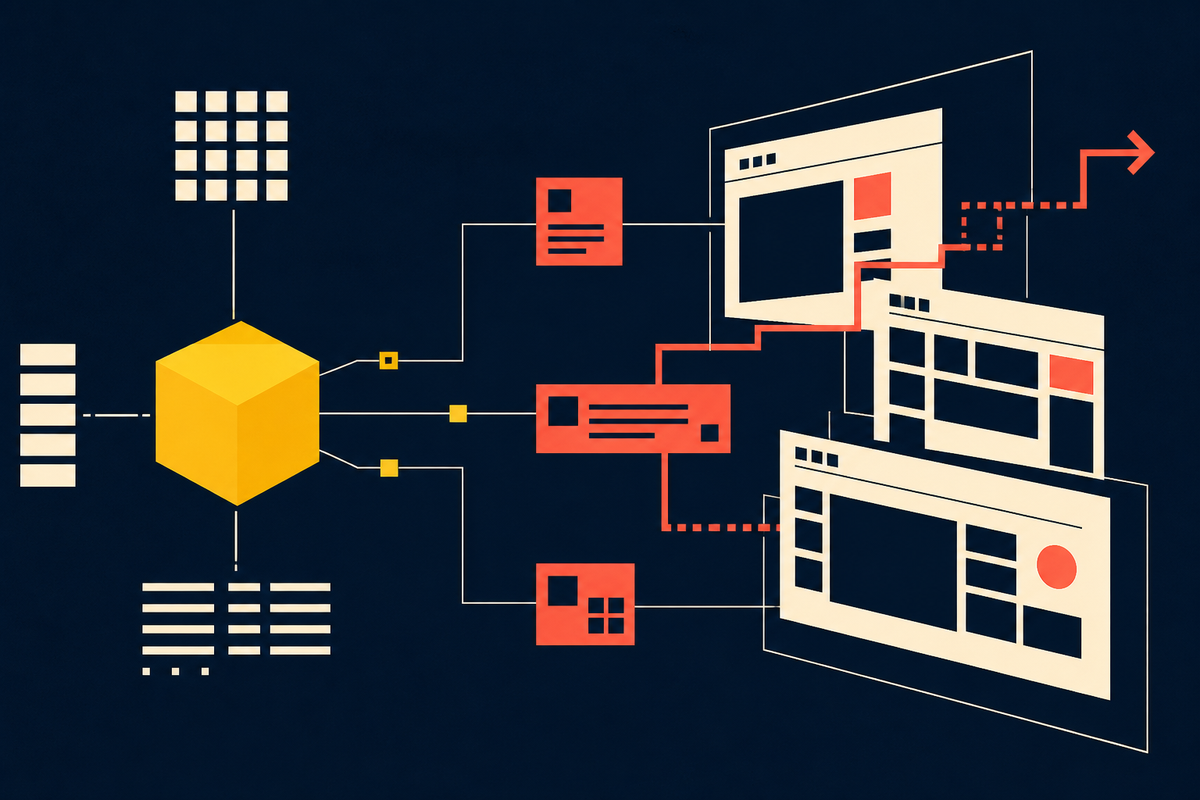
Digital adoption software exists for that pause. It puts a prompt, a path or an answer close to the task. Stonly, Whatfix, Salesforce and MadCap Software each approach the problem from a different layer. One builds interactive support knowledge. One overlays guidance and measures behavior. One owns the service workspace where agents act. One gives documentation teams a structured system for creating and publishing the source material. Grouping them as simple competitors misses the useful lesson: the missing manual is becoming a supply chain.
The answer moved closer to the question
Traditional documentation asks a user to leave the work, translate a question into search terms and judge which result applies. A digital adoption layer reverses that journey. It can know the page, role, field or stage and show a relevant next step. Whatfix describes its product as contextual in-app guidance, with flows, tips, links and media that appear without forcing the user to leave the application. Its Salesforce offering also adds usage analytics and a simulation environment for practice away from live data.
Stonly comes from the customer-service side. Its core format is the branching guide: a person chooses what is true, sees the next appropriate step and avoids reading instructions for every other case. Stonly says those guides can sit inside Salesforce and other agent tools, use case context, fill data and automate parts of a workflow. That is closer to a decision tree than a product tour. It suits the support question that begins, “Which version, region and failure mode are we dealing with?”
The missing manual is becoming a supply chain. Every handoff can improve context or introduce drift.YesPress analysis
Salesforce occupies both sides. It can be the complicated application receiving a guide, and it can hold the knowledge itself. The company’s Enterprise Knowledge documentation says the service combines native Salesforce Knowledge with external sources ingested through Data 360. Search and AI responses can therefore draw on a broader library. MadCap sits earlier in the chain. Flare lets a documentation team author reusable, conditional content and publish from one source to HTML5, PDF or, through MadCap Connect, Salesforce Knowledge.
Four products, four starting points
A buyer should begin with the bottleneck, not the category label. If support agents need consistent branching procedures, Stonly’s interactive knowledge model is the natural place to investigate. If an enterprise is rolling out several applications and needs guidance, safe practice and behavior analytics, Whatfix starts closer to that program. If service already runs in Salesforce and the problem is fragmented retrieval, Enterprise Knowledge addresses the center of the agent’s workspace. If writers are duplicating the same approved paragraph across portals, manuals and PDFs, MadCap Flare attacks the content operation upstream.
A working knowledge supply chain
This distinction matters because software demonstrations tend to collapse the chain. A polished flow looks like proof that authoring, governance and measurement have also been solved. They have not. The sentence inside a prompt may still have been copied from a policy that changed last quarter. The targeting rule may be based on a job title too broad to predict the task. The dashboard may count an impression as a success even when the user abandoned the case two screens later.
Buy the operating model before the overlay
The safest pilot is narrow and slightly boring. Pick one workflow with visible friction, a stable owner and a measurable outcome. Map every source that currently explains it. Decide which one is authoritative. Then design guidance for the moments where people actually hesitate. The first release should answer fewer questions than the team wants. That restraint makes it possible to see whether guidance changes behavior.
- Name the task. “Improve adoption” is too vague. “Submit a compliant refund without escalation” can be tested.
- Trace the truth. Record the policy owner, source location, approval date and every channel that repeats it.
- Choose the moment. Place help where uncertainty appears, not wherever an editor makes placement easy.
- Plan the exit. Define when a prompt should change, expire or disappear for a proficient user.
Ownership is the part vendors cannot install. Product teams may control the interface, enablement teams the rollout, support teams the workaround and legal teams the rule. Someone still needs authority to reconcile them. A small editorial board for each critical workflow can be more valuable than another hundred tooltips. Its job is mundane: review changes, remove duplicates and settle conflicts before software distributes them.
A pilot scorecard
Measure the work, not the furniture
Views, opens and completion rates tell a content team what happened inside the guidance. They do not establish whether the underlying job went well. A flow can reach 100 percent completion while users enter poor data. A help article can receive fewer views because the interface improved, which is a win disguised as declining engagement. The useful metrics sit outside the overlay: task accuracy, handling time, repeat contacts, escalation rate, time to proficiency and the frequency of manual workarounds.
Analytics still matter. Whatfix uses funnels, journeys and cohorts to locate friction; Stonly offers guide and step-level usage data; Salesforce reports can connect support activity to case outcomes. The trick is joining those signals. Ask whether the people who saw guidance made fewer errors than comparable people who did not. Watch for novelty effects after launch. Segment by role and task frequency. A new employee and an expert handling an edge case are not the same audience merely because both clicked “help.”
AI makes clean knowledge less optional
Generative AI adds speed to this system, along with a larger blast radius for neglected content. Stonly offers AI answers and API access grounded in its knowledge base. Salesforce positions knowledge as grounding for Agentforce responses. MadCap’s newer products emphasize structured, governed content that can be prepared for retrieval-augmented generation. Whatfix uses AI across authoring, synthesis, guidance and task assistance. In each case, the model sits downstream from human decisions about sources, permissions and freshness.
That makes contradiction a product problem. If a return window is 30 days in one article and 45 in another, faster retrieval does not resolve the dispute. It merely delivers one version with confidence. Teams need content lineage, review dates and a visible path for correction. They should test citations and permission boundaries before celebrating fluent answers. The goal is not to make the system sound certain. It is to make uncertainty observable and repairable.
AI can retrieve an answer quickly. It cannot decide which forgotten policy was supposed to be true.YesPress analysis
The good manual knows when to leave
Digital adoption is at its best when it feels less like a layer and more like a considerate colleague: present at the difficult moment, specific about the next action and quiet once the lesson sticks. That standard favors systems that can target carefully, reuse approved knowledge and learn from outcomes. It also favors teams willing to delete guidance. Every permanent banner taxes attention; every obsolete tour teaches users to ignore the next one.
Stonly, Whatfix, Salesforce and MadCap offer different pieces of that future. The practical move is not to ask which logo owns digital adoption. Ask where knowledge becomes unreliable on its trip from author to action. Fix that handoff first. The manual can live inside the screen, but somebody still has to edit it.
Questions buyers ask
What is a digital adoption platform?
It is software that adds contextual guidance, self-service help and often usage analytics to other applications so people can complete workflows with less external training or support.
How do Stonly and Whatfix differ?
Stonly centers on customer-service knowledge, interactive decision paths and self-service. Whatfix emphasizes enterprise-wide adoption with in-app guidance, simulation training and product analytics. Fit depends on workflow, audience and scale.
Where does Salesforce fit?
Salesforce can be both the application being guided and the knowledge environment. Enterprise Knowledge unifies native Salesforce content with external sources, while partner tools can surface or publish guidance inside Salesforce workflows.
What does MadCap Flare add?
Flare is a structured authoring and single-source publishing system. It helps documentation teams reuse, govern and publish content to web help, PDF and destinations such as Salesforce Knowledge.
What should a buyer measure?
Measure task completion, error rates, time to proficiency, support demand and content freshness. Views and clicks are useful diagnostics, but they do not prove that users completed work correctly.