A customer types a question into a chat box. The answer may arrive in seconds, polished enough to sound certain. Behind that tiny exchange sits a messier problem: which document did the system trust, who approved it, whether the answer triggered the right action, and how anyone knows the customer’s issue is over. Generative AI made the sentence cheap. It did not make the operating system beneath the sentence simple.
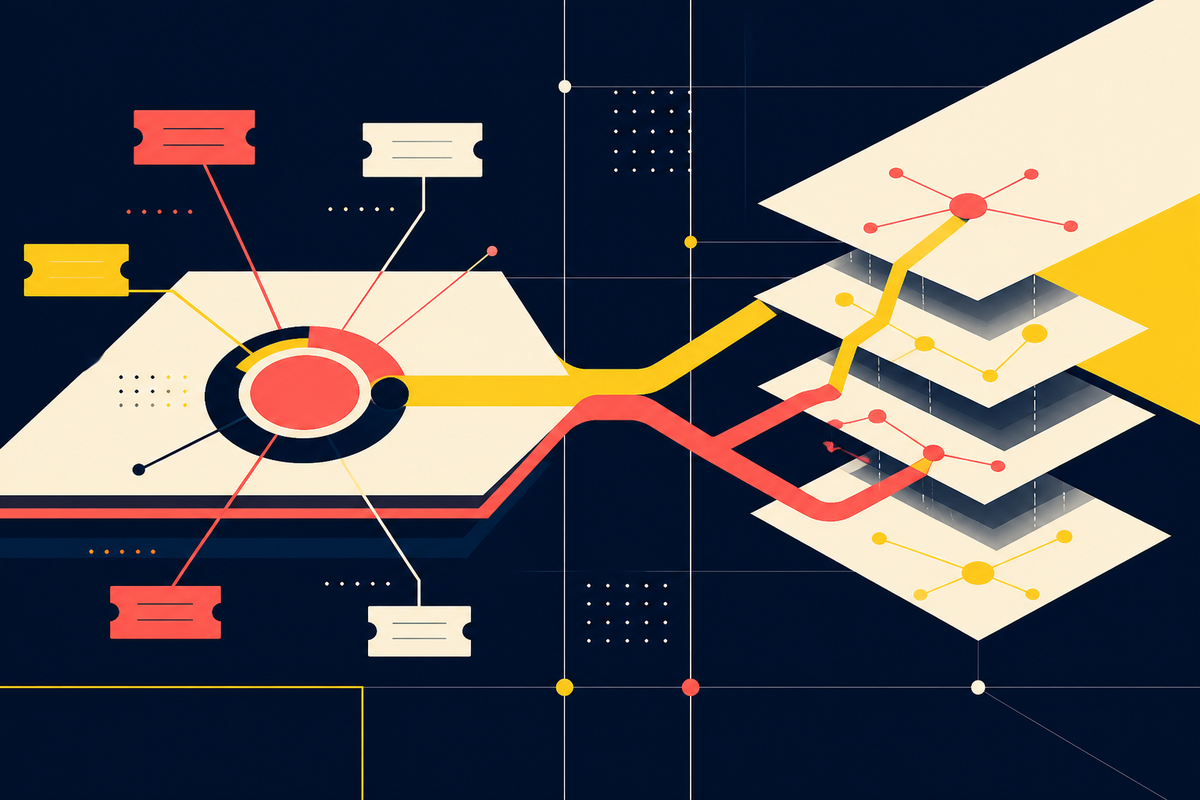
That is where Zendesk and Upland Software’s RightAnswers meet. They overlap in AI-assisted knowledge for customer service, yet they approach the job from opposite directions. Zendesk is building inward, turning its service suite into a Resolution Platform where AI agents, human agents, knowledge, workflows, governance and measurement share one home. Upland is building outward. RightAnswers is meant to be a governed knowledge layer that appears inside Zendesk, ServiceNow, Jira and other places where support work already happens.
This is not a clean boxing match. RightAnswers X explicitly supports Zendesk, so an enterprise can buy both. The more revealing comparison is architectural: should a company consolidate the whole service journey, or keep its institutional memory portable?
The suite wants the whole loop
Zendesk’s answer begins with a deceptively useful word: resolution. In March 2025, the company presented a platform with five connected parts - AI agents, a knowledge graph, actions and integrations, governance controls, and measurement. A year later, it described an “Autonomous Service Workforce” operating across messaging, email and voice, with humans and specialized AI agents working inside the same system.
The important move is not the anthropomorphic workforce language. It is the feedback loop. If the platform can observe the question, retrieve the answer, take an action, record the outcome and use that outcome to improve the next attempt, it can learn where service actually breaks. Zendesk says the foundation is trained on roughly 20 billion ticket interactions and that its knowledge graph powers more than 50,000 active service knowledge bases. Those are company-reported figures, but they explain the scale of its wager.
The useful unit is no longer a message sent. It is a problem demonstrably finished.Zendesk’s product logic, translated from the pitch
Pricing reinforces the idea. Zendesk meters AI-agent use through automated resolutions, not every exchange. Its current documentation describes a resolution as a request completed by an AI agent without escalation to a person, with newer tiers distinguishing kinds of outcomes. Billing systems are never neutral. When a vendor charges for resolution, it nudges product teams to measure completion rather than activity.
For a support organization already committed to Zendesk, that coherence has an obvious appeal. Ticket history can become knowledge. Knowledge can feed the agent. The agent can invoke a workflow. Quality assurance can inspect human and automated conversations. Fewer seams mean fewer integration projects and, in theory, fewer arguments about which dashboard is true.
System of resolution
One platform connects intake, knowledge, action and outcome. Its advantage is a tighter learning loop.
Portable knowledge
One governed answer layer serves several workspaces. Its advantage is reuse without forced migration.
The knowledge layer refuses to stay put
Upland RightAnswers starts from another everyday reality: large companies rarely have one service system. They have a CRM acquired by sales, an IT service desk chosen by technology, a collection of SharePoint sites, old manuals, a customer portal and knowledge that lives in the heads of a few patient employees. Replacing all of it may be politically impossible. Finding across it is merely difficult.
RightAnswers is built around that difficulty. Upland describes it as a KCS v6 Verified enterprise knowledge product with AI search, content creation, federated sources, analytics and self-service delivery. In 2025, Upland said it offered more than 20 out-of-the-box integrations. RightAnswers X, introduced in 2022, uses a browser extension to surface search and capture tools inside web applications. Its published list includes Zendesk alongside Jira, ServiceNow, Gmail and Microsoft products.
That browser extension is a small detail with a large strategic implication. Upland does not need to become the agent’s primary workspace. It can sit beside the ticket and return an approved answer from elsewhere. A useful discovery can be turned into an article without sending the employee to a separate knowledge application. The front door stays where it is; the library follows the reader.
The specialist approach can protect optionality. A bank that changes its CRM does not necessarily want to rebuild years of reviewed support knowledge. A manufacturer may need one answer to appear in a dealer portal, an internal help desk and a contact center. Portability lets the knowledge program outlive a particular interface.
It also creates another vendor relationship and another layer to govern. Search federation can make scattered material findable without making it consistent. An elegant retrieval system can still retrieve two contradictory refund policies. RightAnswers includes tools for content lifecycle and governance, but software cannot decide which department has authority. The organizational work remains.
What buyers can steal from the split
The wrong way to evaluate these products is to create a spreadsheet with “AI search” on one row and “article generation” on another. Both vendors can check many of the same boxes. The expensive differences appear after deployment: where content is governed, which system observes outcomes, how many integrations must be maintained, and how easily the company can leave.
A relatively young support team with one main channel may benefit from Zendesk’s consolidated path. Its help center, Agent Workspace, knowledge graph, AI agents and workflow builders can reduce the distance between setup and a working operation. The platform owner gets a more continuous view of the service journey.
A diversified enterprise with several service desks may have the opposite constraint. It may not be choosing a new ticketing system at all. It may be trying to stop six systems from producing six answers. There, a portable layer such as RightAnswers can turn knowledge governance into shared infrastructure while leaving each operating team’s workspace intact.
The hybrid deserves more attention than a conventional vendor comparison allows. A company can keep Zendesk as its system of resolution while using RightAnswers as a knowledge source across customer service, IT and other teams. That arrangement may look redundant on a procurement diagram. It can be rational if the company values Zendesk’s workflow loop but refuses to trap shared knowledge inside any single service application.
To decide, buyers should run a workshop before a demo. Pick ten recent cases: a routine question, a policy exception, a multi-step action, an obsolete article, a multilingual request and a failure that crossed departments. Trace where the answer came from and how resolution was confirmed. Then ask each vendor to reproduce the path using real permissions and source material.
- Map authority. Name the source that wins when two articles disagree.
- Test the ugly case. Use exceptions and stale content, not a polished password-reset demo.
- Count seams. Price integration ownership, content review and analytics reconciliation.
- Define done. Decide what evidence proves a customer’s issue was resolved.
- Model exit. Ask what happens to content, feedback and workflow history when a system changes.
The model is not the moat
Zendesk’s acquisition of Forethought in March 2026 adds self-improving AI-agent technology to its integrated argument. Upland’s return of Sean Nathaniel as CEO in May points its corporate story toward knowledge and content as an “intelligence layer” for agentic enterprises. Both companies are moving quickly, and both naturally describe their direction in expansive terms.
Yet foundation models will keep changing. The more durable advantage may be the machinery around them: approved content, permissions, workflow actions, outcome data and the habits that close knowledge gaps. Zendesk hopes those assets compound inside one resolution loop. Upland hopes the trusted knowledge layer becomes indispensable precisely because models and workspaces will change.
The choice, then, is not modern AI versus old software. It is a choice of dependency. Consolidation makes the suite more powerful and the vendor more central. Portability makes knowledge more durable and the architecture more layered. Neither is free. One charges in switching cost; the other in coordination.
A good support stack should make its trade visible. When the next customer asks a question, the impressive part will not be the speed of the sentence. It will be the quiet chain of evidence behind it - the approved source, the permitted action, the measured outcome and the correction that makes tomorrow’s answer better.
Questions people ask
Are Zendesk and Upland RightAnswers direct competitors?
Partly. Both offer AI-assisted knowledge features for service teams. Zendesk is a broader service platform; RightAnswers is a specialist knowledge layer that can also integrate with Zendesk.
Can RightAnswers work inside Zendesk?
Yes. Upland lists Zendesk as an out-of-the-box environment for RightAnswers X, which surfaces knowledge through a browser extension.
What does Zendesk mean by a resolution?
Its documentation measures automated resolutions as customer requests completed by an AI agent without human escalation, with newer measurement separating outcome types and verification.
When does a portable knowledge layer make sense?
It is most useful when governed answers must serve several CRM, ITSM, portal or collaboration systems and should survive changes to any one interface.
Can an enterprise reasonably use both?
Yes. Zendesk can manage service execution while RightAnswers supplies knowledge across Zendesk and other systems. The tradeoff is added cost and governance complexity.