Your Help Desk Software Is Now an AI Arms Race
Zendesk, Intercom, InvGate, Jitbit and half a dozen rivals used to sell you a ticket queue. In 2026 they are all selling the same thing - an AI that answers before a human ever reads the ticket.
Every company has a help desk, and almost no one thinks about it until it fails. It is the software behind the "we've received your request" email, the chat bubble in the corner of a website, the queue an IT team lives inside all day. For fifteen years the pitch barely changed: capture the request, turn it into a ticket, route it to a person, close it. Then, sometime in the last two years, the entire market swapped its sales deck. In 2026 nobody is really selling a ticket queue. They are selling the ticket you never have to answer.
The names doing the selling are familiar and unfamiliar in equal measure. Zendesk is the default anyone can name. Intercom is the chat bubble that grew up. Then there is a longer bench most people never see: InvGate out of Buenos Aires, Jitbit quietly profitable since 2005, Kayako, SolarWinds, Supportbench, and Microsoft looming over all of it with Dynamics and Copilot. Eight tools, one job, and a very wide range of opinions about who should do it.
The metric that quietly took over
If you want to understand what changed, watch which number vendors brag about. It used to be response time and CSAT - how fast a human replied and how happy the customer was afterward. The new number is deflection: the share of tickets resolved without a human ever touching them. It is a strange thing to optimize for, because a perfect deflection rate means your support team, in theory, does nothing. That is exactly the future being sold.
That last figure is the one to sit with. Zendesk pulled in roughly $1.93 billion in revenue, serves six figures of companies, and is still the number-two name in its own category. Help desk software is not a winner-take-all market. It is a shelf, and the shelf is enormous - which is why so many companies you have never heard of can build good businesses on the same idea.
Zendesk projects AI ARR could reach up to $500 million in 2026 - up from zero just two years ago. The scale of the pivot, in one line
Same job, twenty times the price
The clearest way to see how split this market is: look at the price of doing the same basic thing. Answering customer tickets can cost you $17 per user per year or $125 per user per month, depending entirely on which door you walk through. That is not a rounding difference. It is a signal about who each tool is built for.
Then there is Jitbit, which refuses to play the subscription game at all. You can still buy a perpetual license - roughly $1,699 one-time for a small team, $3,499 for a bigger one - and simply own the software, hosting it yourself. In a market that has spent a decade herding everyone onto monthly billing, that is almost a political statement. It also explains why Jitbit has stayed self-funded and profitable since 2005 while flashier rivals raised and burned.
Eight tools, four corners
Price is only one axis. The other is who you are supporting - external customers or your own employees - and how much you want a machine involved. Plot the field on those two lines and it sorts itself into recognizable corners.
Top-right is the land of the giants: Zendesk, Intercom and Microsoft, all chasing large external-support teams with the deepest AI. Bottom-right is IT's home turf, where InvGate and SolarWinds sell service desks for internal tickets - password resets, laptop requests, the unglamorous machinery of a company running itself. SolarWinds is worth a note here: known outside IT mostly for the 2020 supply-chain breach that put it in headlines, it still ships an on-premise help desk to teams that want their data to never leave the building. On the left sit the value players - Kayako and Supportbench pitching themselves as the sane-priced alternative, and Jitbit anchoring the bottom corner as the tool you can literally buy once and forget.
Show me a company's ticketing tool and I'll tell you how much it actually respects the person on the other end. The uncomfortable read on help desk choice
What you're really choosing
Strip away the feature grids and picking a help desk in 2026 comes down to one decision: how much of the first contact with your customer are you willing to hand to a model. Intercom has taken the most committed position, rebuilding its whole platform around an AI agent called Fin and, tellingly, billing per resolution instead of per seat. You do not pay for a chair anymore. You pay for an answer, whoever - or whatever - produced it.
Zendesk is racing the same direction from a much larger base, calling itself "AI first" and watching that bet turn into hundreds of millions in new revenue. The value tier is following as fast as it can afford to; Supportbench leans on AI to justify undercutting the leaders, and even Jitbit's automation module quietly does more than it used to. The only real holdouts are the tools whose customers explicitly do not want a bot answering first - regulated IT teams, security-conscious enterprises, anyone for whom a confidently wrong AI reply is a liability with their name on it.
That is the tension worth naming out loud. Deflection is genuinely good when it saves a customer twenty minutes on hold for a question the knowledge base already answered. It is genuinely bad when it becomes a wall between people and a human who can actually help. The vendors are all optimizing the same number. The buyers are the ones who have to decide where helpful ends and hiding begins.
The switchboard, then and now
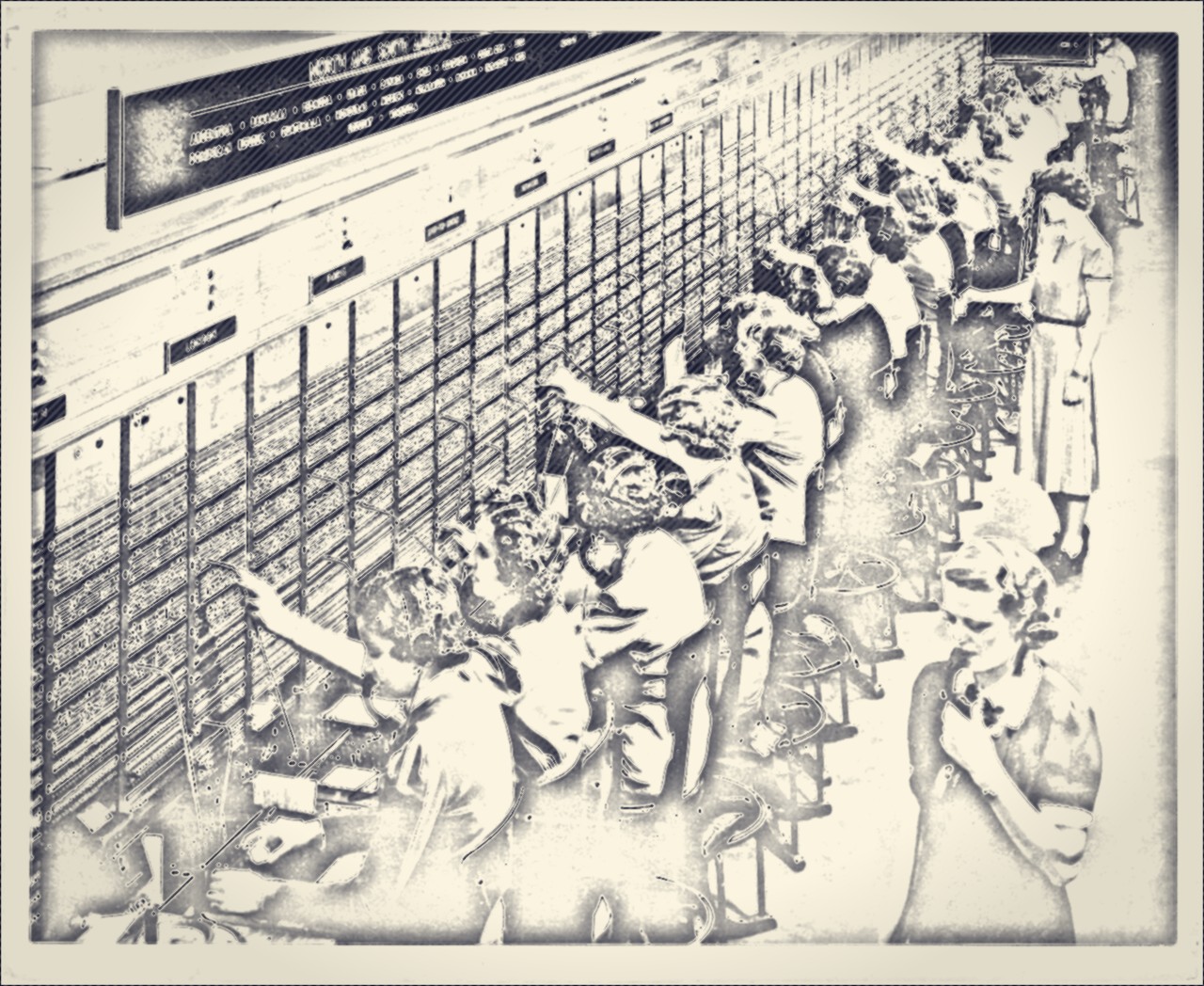
There is a reason the illustration at the top of this piece is a wall of switchboard operators. That room was the original help desk - a bank of humans physically routing every request in real time, listening, plugging in a cable, connecting you to the right place. We spent a century automating the room away. The operators became a phone tree, the phone tree became a ticket queue, the ticket queue became a chatbot, and now the chatbot is becoming something that can read, decide and reply on its own.
The job never changed. Someone needs help; someone (or something) figures out the answer and gets it to them. What is up for grabs in 2026 is only the "something" - and eight companies are betting large sums that customers would rather it not be a person, as long as the answer is right. Whether they are correct is the most interesting unsolved question in the least glamorous software you own.
The players — go direct
Questions people actually ask
What is help desk software, and how is it different from a ticketing system?
Help desk software is the tool support teams use to receive, track and resolve customer or employee requests across email, chat and phone. A ticketing system is its core - each request becomes a trackable ticket. In 2026 most help desks bundle ticketing with a knowledge base, automation and AI agents that can answer common questions directly.
Which is best in 2026 - Zendesk, Intercom or something else?
There is no single winner. Zendesk is the broad default for scaling support teams, Intercom is strong for AI-first chat-led support, InvGate and SolarWinds lean toward internal IT service management, and Jitbit, Kayako and Supportbench compete on price and simplicity. The right pick depends on team size, budget and how much you want AI to answer first.
How much does help desk software cost?
It ranges widely. InvGate can start near $17/user/year, Supportbench runs from about $32 up to $125 per agent per month, and Jitbit sells a perpetual license from around $1,699 one-time or $29/month as SaaS. Enterprise plans from Zendesk, Intercom and Microsoft are usually custom-quoted and can add per-resolution AI charges on top.
What does "AI ticket deflection" actually mean?
Deflection is when an AI agent resolves a customer's question directly - via chat, a knowledge-base answer or an automated action - so no human agent ever picks up the ticket. Vendors increasingly measure success by deflection rate, and some, like Intercom, bill per AI resolution rather than per seat.
Do companies still use on-premise help desk software?
Yes. While the market has largely moved to cloud SaaS, tools like SolarWinds Web Help Desk and Jitbit's self-hosted version still serve IT teams that need data to stay on their own servers for security, compliance or cost reasons.