At The Co-operative Bank, a contact-center colleague could need up to four intranets in a single day. Each had its own manner of doing things, its own voice and its own shortcomings. Somewhere among them sat the information needed to do the job. This is a wonderfully expensive way to organize an answer.
Interact Software helped replace that jumble with The Buzz, a shared intranet for communications, process maps and scripts. The bank’s account describes a further change: an old system that attracted virtually no new content gave way to one averaging 650 blog contributions a month. The homepage was subsequently redesigned to balance employee posts with practical tasks. Even a successful intranet, it turns out, needs an editor.
That is a useful introduction to Interact. The Manchester company sells software for the space between an organization’s information and the people who need it. Its commercial opportunity begins when that space gets crowded with portals, passwords, announcements and half-remembered links.
Up to four per dayA shared destination
The Buzz
Fewer places to look. Room for colleagues to contribute.
An old business with a current problem
Founded in 1996, Interact began as a services business. A company-hosted history published in 2013 identifies Nigel Danson as founder and dates its move into software to 2009, following the release of Interact 4. The same account describes an early American expansion through Irving, Texas. Relevance was already part of the pitch: its recommendation engine considered searches, document popularity and browsing activity.
Today, Interact describes itself as an AI-native employee experience platform. Strip away the category language and the proposition is straightforward. Give employees somewhere useful to start work: find a policy, read a relevant update, reach a colleague, open a familiar application or complete a routine request. Give communications teams the tools to publish and see whether anyone pays attention.
The audience extends beyond people permanently attached to a laptop. Interact’s customers include Levi Strauss & Co., Domino’s, New York Life and Teva Pharmaceuticals. Retail operations, financial services and healthcare bring different requirements, but dispersed employees recur throughout its customer roster. The company’s current customer page puts its reach at more than 1,500 customers and four million users.
The homepage gets a job
Interact combines intranet publishing, search, employee directories and social participation with communications tools. A message can travel through an intranet, email, mobile app, SMS, workplace chat or digital signage. Administrators can target material to particular audiences and examine measures such as readership, clicks and active users. The attractive idea is that employees receive material suited to their work without communications teams maintaining a separate editorial operation for every screen.
Consider the practical difference between publishing a benefits announcement and helping someone use it. The former gets a page online. The latter might put the announcement in front of the relevant group, connect it to an authoritative explanation and provide access to the system where the employee acts. Interact’s product range addresses those successive steps. The employer still has to decide who needs what.
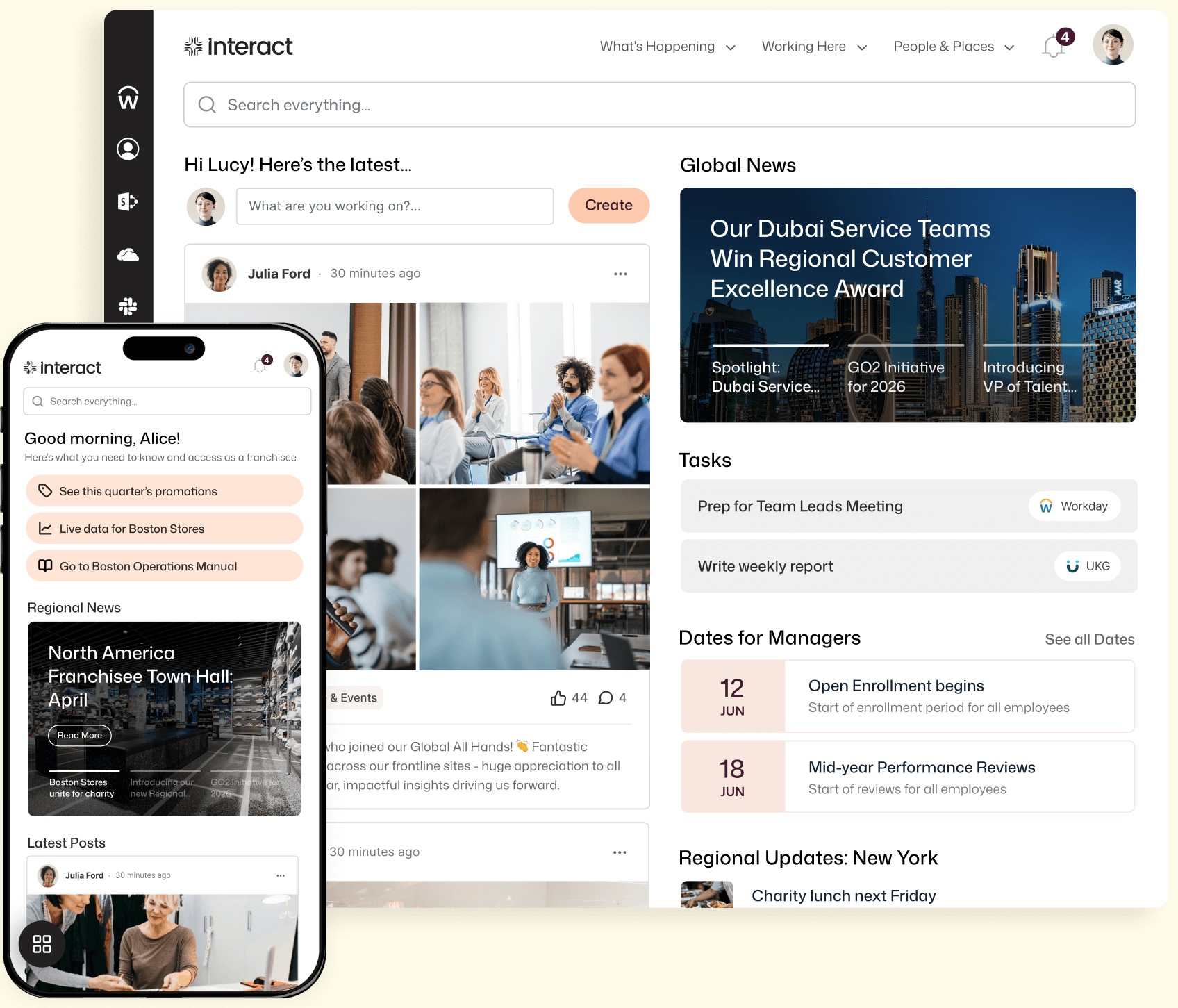
Its integration catalogue includes Microsoft 365, Google Workspace, ServiceNow, Workday, UKG and SAP SuccessFactors. An open API and developer framework allow customers to extend the experience. Interact can therefore sit above systems an organization already owns, bringing their information and tasks into a shared starting point. That makes the integration work part of the buying decision, well before anyone debates homepage colors.
The convention with a $741,000 difference
SERVPRO offers a more tangible test than a polished product tour. During the pandemic, its fire, water and disaster-recovery network needed clear information about cleaning and bio-remediation while thousands of corporate and franchise colleagues worked remotely. Its intranet, SERVPRONET, became a place to launch programs and keep their information available, reducing reliance on company-wide emails.
Then came an event with an actual budget. SERVPRO moved its regular week-long, in-person convention online using Interact. The published customer account reports a saving of $741,000. It also reports that site visits increased 57 percent in 2020, with pageviews up 27 percent year over year. Those figures describe a particular customer under exceptional circumstances; they are useful evidence of what the platform supported.
“While our intranet was already an important resource, it became critical for our business operations this past year.”SERVPRO / customer testimonial
The lesson worth borrowing is the connection between software and a specific operating choice. An event moved. Information stayed available. A cost changed. A buyer evaluating a new portal can use that sequence to frame a business case, while accounting separately for licenses, implementation and staff time. A savings figure needs a boundary around it.
At Equinox, people became the attraction
Equinox had a different gap. Its workforce was spread across the United States, United Kingdom and Canada, and it lacked a dedicated place to showcase employees and build a shared community. Its response was EQX Connect, including a “Life at EQX” area and a homepage that put colleagues in view.
Interact’s account reports more than 33,000 visits in the first year, over 200 employees spotlighted and 900 milestones celebrated. Adoption reached 100 percent among general managers and assistant general managers, the specific hard-to-reach groups identified in the case study. That is a narrower, more useful claim than saying every employee became engaged.
Together, these customer stories suggest an implementation principle: start with a reason to return. At the bank, that included the information required for everyday work. At Equinox, it included the people doing it. An empty portal offers neither. The product can accommodate both, but an employer must supply the material and keep it worth visiting.
AI moves into the routine
Interact’s May 2026 release gives its broader ambitions some concrete form. The company announced Action Agent, an AI moderation capability that can flag or remove inappropriate content. It also expanded Workday workflows so employees could request time off from the homepage, improved mobile authentication and enhanced search across uploaded documents and connected systems such as SharePoint and ServiceNow.
These are ordinary workplace chores, which is precisely why they matter. An employee who can finish a request where they started has one less system switch. A communications administrator with useful moderation assistance has another way to manage contributions at scale. Whether those benefits materialize depends on configuration, content quality and how employees actually work.
The company also reported a Strong Performer position in Forrester’s Q1 2026 intranet evaluation, following its Leader position in Gartner’s 2025 packaged-intranet assessment. Such recognition helps explain Interact’s place on enterprise shortlists. It does not settle the fit for a particular employer.
Buying a bigger place in the workday
Interact had already widened its range in April 2023 by acquiring Sideways 6, an employee idea-management company. The acquisition added a way to collect and develop suggestions through existing workplace platforms. Sideways 6’s customers included programs at Balfour Beatty, Marks & Spencer and Nestlé. The strategic logic is easy to see: an intranet can carry useful information upward as well as announcements downward.
Ownership changed on December 18, 2025, when Castik’s majority investment closed. CEO Simon Dance continued to lead Interact, and management and some existing shareholders retained stakes. The announced plan included product investment, international expansion and further acquisitions. In February 2026, Matt Taylor and Michael Whitfield joined as non-executive directors.
Castik’s portfolio description puts Interact at roughly 250 employees and more than £45 million in revenue, without specifying a reporting period. Transaction adviser Houlihan Lokey says more than 60 percent of revenue comes from the United States. For a business rooted near Manchester, that is a meaningful geographical shift.
The company’s own recruiting material offers a pleasingly plain statement of values: “We fix things.” It describes learning opportunities, mental health first aid and a belonging and inclusion committee. Those are employer-stated commitments, but the phrase fits the product’s most persuasive customer stories. People had something awkward to do; someone made it less awkward.
The purchase is only the beginning
Interact sells enterprise subscriptions tied to authorized users, alongside services that help organizations implement and sustain an intranet. AWS Marketplace provides another procurement route through contracts. A sensible budget includes the people who will migrate content, connect applications, train publishers and keep the information current. The subscription is one line in that calculation.
Its market includes Staffbase, Simpplr and Unily, while SharePoint can be an existing intranet foundation as well as an integration target. Interact’s particular pitch combines editorial control, knowledge discovery, multiple communications channels and employee participation. Buyers should test that combination against their own tasks: a frontline login, a policy search, a local announcement and a request that touches another system.
The customer evidence also points to conditions that software alone cannot repair. If nobody owns an answer, a more attractive search box cannot make it authoritative. If a team lacks permission or a practical way to log in, another announcement will not reach it. And a flood of undifferentiated notifications can reproduce the very clutter the project was meant to remove.
The useful ambition is modest enough to measure. An employee arrives with a question or a task and leaves with it resolved. Interact has assembled a growing business around making that happen. The four-intranet workday gives it plenty to improve.