At Pearson, a production editor needed a book cover changed. The deadline was close. The designer was on vacation. Somewhere inside the publishing company, another designer could help. The difficulty was finding that person. According to Jive’s Pearson case study, the editor used the company’s intranet, Neo, to locate help in another business unit and finish on time.
It is a pleasingly unglamorous advertisement for enterprise software. No sweeping transformation is required to appreciate a book cover getting fixed. The company had the talent. What it needed was a way to reach it.
- Jive connects workplace conversations, content and expertise.
- Its external community business, Jive-x, was sold in 2017.
- Under IgniteTech, the next chapter adds AI assistants and expert personas.
The answer was in another business unit
Pearson’s old arrangement included multiple intranets, directories and business-unit newsletters. Acquisitions made the communications problem harder. Jive’s account describes a 700-user pilot that spread to 5,000 users before the formal launch. By the end of 2011, it reported 75% employee adoption. Those are historical customer-case figures, but the sequence is useful: a practical service found an audience before the grand unveiling.
The attraction is easy to understand. A directory tells you who works somewhere. A useful community gives you clues about who can help. Every answered question can become a resource for the next employee who encounters the same obstacle.

A place for the answer to stay
Jive occupies the territory between the corporate intranet, the employee social network and the shared knowledge base. Employees can publish documents, discuss problems, follow people and topics, and work in groups. Communications teams can target updates. Community managers can inspect engagement and content performance. The current offering is marketed as Jive AI.
The distinction is about how work accumulates. A message can solve today’s problem. A maintained discussion, attached to useful content and discoverable people, can help tomorrow’s new hire. Jive’s documentation also describes personalized streams, decision badges and mobile access. These are ways to organize attention inside a growing organization.
The second person should benefit from the first person’s question.
Buyers have alternatives. SharePoint supplies an intranet foundation; Viva Engage supports employee communities; Teams and Slack handle workplace messaging; Confluence organizes documentation. These categories overlap. Jive’s case rests on bringing people, content and conversation together, especially across departmental boundaries.
It also works alongside existing tools. Its integration documentation covers Microsoft Teams, Outlook, SharePoint and Google Drive. That matters to companies already living inside several software ecosystems. It also creates homework: buyers need to check supported versions, permissions and configuration rather than assume every connector behaves identically.
The expensive part was growing
Matt Tucker and Bill Lynch started Jive in 2001 after studying computer science at the University of Iowa. Tucker began as chief technology officer, Lynch as vice president of engineering. Sun Microsystems was an early customer. Their ambition was enterprise software; their starting point was an office in downtown Iowa City.
The early trouble was less romantic. Stanford’s teaching case describes a company that expanded its sales force too quickly after a strong 2007, missed its third-quarter 2008 plan, and cut 20% of its workforce. Hiring ahead of demand had a human cost. Growth required more than enthusiasm for the product.
“It’s really the culture we built and the positive work environment we created.”Bill Lynch, reflecting on Jive in 2015
Jive later reached NASDAQ in 2011. Its final full-year public accounts tell a mixed story: 2016 revenue was $204.1 million, with a $14 million net loss. An established customer business had not yet produced sustained annual profitability. In 2017, Aurea completed an acquisition valued at approximately $462 million.
Rounded historical figures. Revenue and net loss measure different things; they are not a current valuation.
Then the product boundary moved. Lithium bought the external-community business, Jive-x, in October 2017. That distinction matters when reading old descriptions promising employee, customer and partner networks under one roof. IgniteTech announced Jive’s addition to its portfolio in May 2023, with generative AI explicitly on the agenda.
The change in ownership also changes what a buyer is evaluating. There is a long operating history, but the familiar brand sits inside a broader software portfolio. Ask which capabilities are in the agreement, who handles support, and what a migration would involve. A useful demonstration should follow a question through the whole system, including what happens when the answer is wrong.
Now the expert has a double
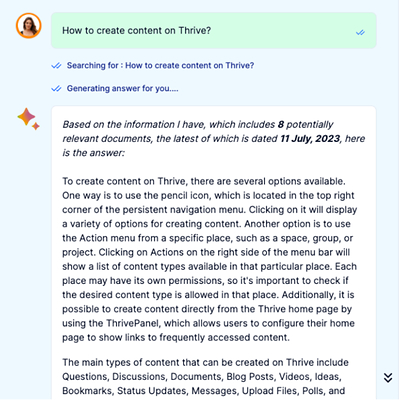
The newer tools approach the same knowledge problem from another direction. Jive’s AI assistant is designed to summarize and discover text content while respecting existing access controls. An employee can ask for help understanding information rather than manually reading every relevant document.
MyPersonas takes the idea further. Previewed as Jive Personas in March 2024 and launched for Jive AI that November, it creates digital representations of subject matter experts. IgniteTech says unanswered questions can be routed to the human expert through channels including Teams and Slack; the response then expands the persona’s knowledge. The design makes human involvement part of the answer pipeline.
Start with the question people keep asking
For a buyer, the useful lesson is operational. Choose a recurring problem, recruit the people who can answer it, and give those answers an obvious home. Measure whether colleagues find help and finish work. Assign someone to maintain the content. Jive’s support offerings include community-management guidance, an acknowledgement that participation takes tending.
The commercial model is enterprise subscriptions, with services and optional capabilities governed by agreements. Cloud contracts set purchases through quotes. A sensible budget therefore includes implementation, integration and community ownership alongside software fees. A small team with simple communication needs may find that overhead hard to justify. So may an organization unwilling to share knowledge or maintain permissions. AI makes those responsibilities more consequential. A polished response can still depend on an obsolete policy document. Someone must decide which information is authoritative, who may see it, and when it needs revision. The test is whether a colleague can trust the answer enough to act on it. Even a convincing digital expert needs something reliable to remember.