The weekly newsletter at Viggo was already organized into four divisions. Eindhoven airside. Eindhoven landside. Schiphol ramp. Schiphol passenger. On paper, this was sensible communication. Yet the people handling passengers and aircraft remained difficult to reach. An orderly inbox is a curious achievement when the intended reader is busy somewhere else.
Speakap’s business begins in that gap. A company can publish an update, congratulate itself on publishing the update, and still leave the worker who needs it uninformed. Its employee app tries to shorten the distance between headquarters’ intentions and the working day.
- A mobile workplace hub for people who rarely sit at a desk.
- Messages, onboarding, tasks and training in an employer-branded app.
- Annual subscriptions, with quotes tied to plans and licensed employees.
- The customer lesson: budget effort for adoption as well as software.
A supermarket problem with wider ambitions
Patrick van der Mijl and Erwin van der Vlist encountered the problem while working in a Dutch supermarket. Their early project, Supermarket Central, borrowed the familiar logic of social networks. Speakap’s own history even tips its hat to Hyves, the Dutch network that once made Facebook look like an overseas curiosity.
The first version was a website built by an outside company. Neither founder was technical. In a 2024 interview, van der Vlist described a difficult rebuilding period: hiring mistakes, development problems, and roughly two to two-and-a-half years to produce something scalable. A capable CTO helped them assemble the development team. Hotel Okura Amsterdam became their first customer beyond supermarkets.

That sequence matters. Recognizing an irritation did not confer the ability to engineer its cure. Their first constraint was technical execution. An investor’s backing encouraged them to leave their careers and commit to the company; the prototype still needed a substantial rebuild.
The app wears your employer’s clothes
Today Speakap sells an employee experience platform. The phrase is expansive; the functions are concrete. Managers publish news, ask for acknowledgments, send targeted updates, assign tasks and gather feedback. Employees can chat, find colleagues and consult a knowledge base. Access is organized around teams, roles and locations.
Targeting is the consequential detail. A message for one warehouse need not become everybody’s interruption. A new hire can receive information intended for that role. An employer can put its own name and visual identity on the mobile app, making an outside software product feel like a familiar workplace entrance.
Employee Journeys extends that entrance into a sequence. Rather than presenting a newcomer with a heap of documents, an organization can arrange onboarding and training in steps, add video and quizzes, and follow progress. Completing a course becomes visible work, rather than a manager’s hopeful assumption.
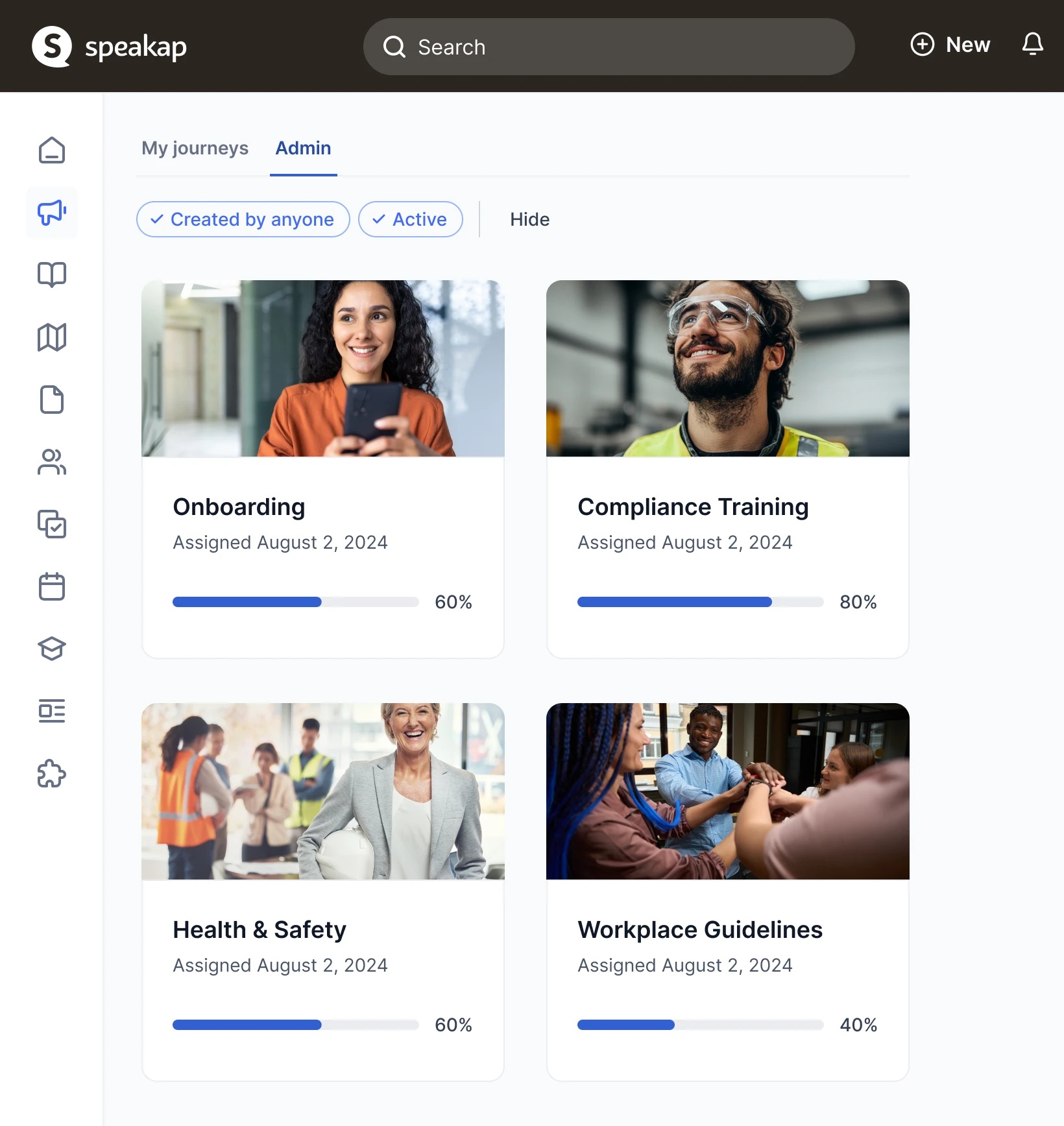
The surrounding tools can remain in place. Speakap’s app directory includes HR, scheduling, learning and recognition products. Its eduMe integration, for example, brings mobile training into the branded app without another login. The attraction is fewer doors to open during an already fragmented shift.
The calls behind the adoption curve
At Viggo, the requirements included team communication, interaction, existing-tool connections and branding. Speakap supplied stakeholder training. The company’s published case study reports 88% activation, 90% monthly active usage and 40% daily active usage after a year.
There is a less glamorous detail beneath those figures. Recruitment staff called employees to help them download the app, raising adoption from 70% to 80%. Managers and safety officers could then publish updates themselves. The useful interpretation: help people through the entrance, and give people close to the work permission to communicate.
A&M Group offers another perspective. Its published rollout account describes six weeks to launch and 67% activation within five months. Leadership and unions were involved early; teams installed the app at kickoff events. Its advice includes building a content team and keeping managers involved. Deployment and adoption plainly run on different clocks.
An annual contract for an everyday habit
Speakap’s published plans move from Basic communications to Premium branding and HR synchronization, then Premium Plus journeys, task management and more advanced analytics. Contracts are annual. Pricing depends on the selected plans and how many employees are licensed. Buying therefore starts with a quote and a discussion of requirements.
For customers, the investment also includes administration, content and rollout time. The case studies show those activities explicitly. A useful purchasing question follows: who will own the app after launch day? A platform full of outdated announcements would simply give the old noticeboard a battery.
“Contemporary, engaging, and involved.”Simone Meesters, communications officer at Viggo, describing Speakap
Beyond the digital noticeboard
Speakap reports more than 600 customer companies and over 300,000 daily users. Its customers span industries including retail, hospitality, construction and logistics. Connected Capital’s 2018 investment supported international expansion. The company now describes its proposition around the broader employee lifecycle, rather than communications alone.
In its own telling, the pandemic accelerated that change: frontline workers faced a proliferation of separate tools. Speakap sits in the employee communications market alongside alternatives such as Staffbase. Its emphasis is branded mobile access, targeted content and connected workflows. Those choices suit dispersed teams particularly well.
Security is another part of the proposition. Speakap says customer data is encrypted in transit and at rest, with hosting in either EU or US data centers. Its privacy statement places the employer in charge of employee data processing within the app. For a buyer, this makes permissions, account removal and identity synchronization part of the product discussion. The Awardco setup guide illustrates the point rather neatly: employee identifiers must match across systems. An elegant interface cannot compensate for recognition attached to the wrong person. The backstage arrangements deserve the same attention as the screen.
The conditions still matter. Employees need usable access, managers need time to participate, and someone must maintain relevant information. Compass analytics can reveal adoption and content performance; a read receipt alone cannot establish understanding. The lesson worth copying is fairly modest: make information accessible, make it specific, help people get started, and keep checking whether they return.