Before a search engine could help a mining company, it had to learn what the miners meant. At RAG, words such as “Rauben” carried meanings that ordinary language could not supply. Documents, maps and specialist vocabulary belonged to a working world with its own rules. A computer could recognise the letters and still miss the point. This was an unusually literal introduction to the problem Philipp Reißel would spend his time trying to solve.
Reißel, now co-founder and CEO of Aachen-based amber, worked on the company’s response to that challenge. He described teaching its algorithms the specialist terms as a substantial early difficulty. The job also involved searching across different file formats and systems. An answer might live in a PDF, a map, a spreadsheet or an intranet. The search box had to accommodate the company, with all its accumulated peculiarities.
It is a useful place to begin his story because it puts the customer’s vocabulary ahead of the technology’s vocabulary. Enterprise AI can sound wonderfully frictionless until somebody asks it a question about a particular mine. Then the nouns start to matter. So do the people who understand them.
The problem has remained recognisable as Reißel’s business has changed. In a public post, he proposed judging a company by how often people ask, “Does anyone know where the latest version is?” His subject is the distance between possessing knowledge and being able to use it. A business may have paid for both the expertise and the software that stores it, then pay again in time spent searching.
An engineer, before the search box
Reißel studied at RWTH Aachen University. His route into AI included research at Porsche, and a tangible piece of that work survives in a German patent. Alongside Jan Gutbrod and Nadine Drollinger, he is named as an inventor on a system for detecting extreme driving situations, particularly for highly automated driving functions. The application was filed in April 2020; the granted patent was published in October 2021.
That earlier work concerned finding significant situations in driving data. His later work concerns finding useful information inside organisations. The settings differ, but both ask how a machine can distinguish something that matters from the surrounding material. The continuity is a way of understanding his career, rather than a claim that a vehicle and an office present the same engineering problem.
His research interests also left a public trail beyond patents. With Philip May of Deutsche Telekom, Reißel trained and released a German ELECTRA language model. Its documentation gives attention to a detail many English speakers could happily overlook: retaining German umlauts while treating uppercase and lowercase text alike. Small marks on a vowel can carry meaning. Making software more convenient should not require the language to surrender them.
The work underneath the answer
Reißel also created GC4, a German text corpus derived from Common Crawl, with support from May. The project involved cleaning and preprocessing web text for uses including language-model training. Its documentation records approximately 50,000 CPU hours and 400 terabytes of network traffic for one preprocessing stage. Preparing the material was a considerable undertaking before a model could learn anything from it.
He and Igli Manaj, his future co-founder, trained and evaluated a multilingual passage-reranking model as well. A reranker has a fairly modest-sounding assignment: given a question and a passage, estimate how well they match. Yet the order of search results is often the difference between finding a useful answer and abandoning the search. Their model made that assignment available across more than 100 languages.
In a later recollection, Reißel described the welcome they received from Hugging Face. Julien Chaumond personally reviewed and merged their contribution. Thomas Wolf subsequently told him he would receive a T-shirt, which Reißel says he wore to many AI meetups. The souvenir seems fitting: recognition arrived as something to wear while meeting other people who cared about the work.
The anecdote offers a more revealing achievement than a list of affiliations. Reißel remembered the response of experienced founders to two students contributing code. The technical contribution mattered, and so did being treated as a participant. In his telling, that small exchange helped make him a lasting supporter of the community.
One stage in preparing German web text for language-model research.
Aachen had a problem worth keeping
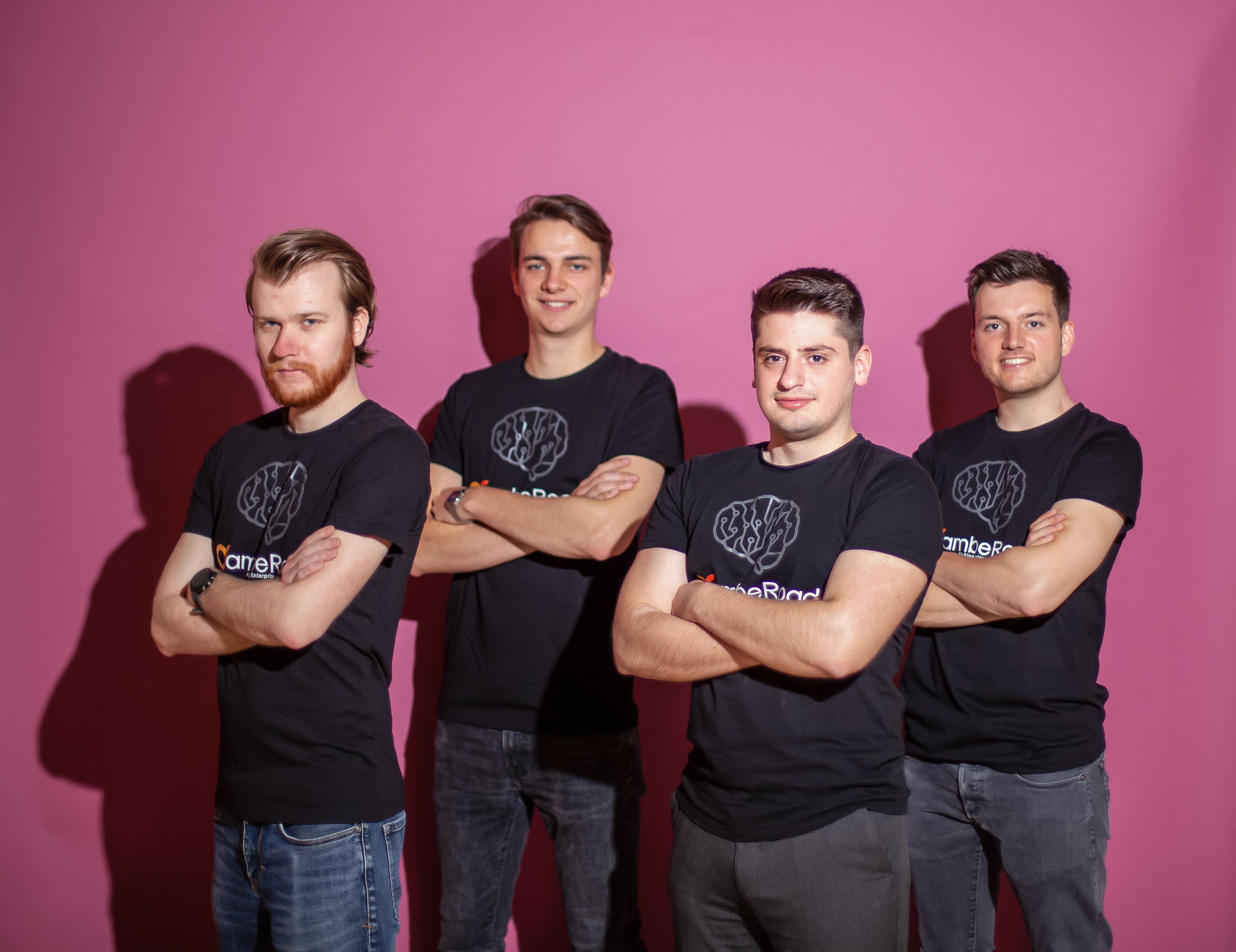
The people behind the early ambeRoad business met while studying at RWTH Aachen. The early team included four founders: Reißel, Julian Johannes Reinauer, Manaj and Bastian Maiworm. Reißel’s responsibility was strategic product development, shaping the product around market requirements. That division of labour placed him between what the technology could do and what customers actually wanted to buy.
The RAG opportunity came through the DataHub programme of Gründerallianz Ruhr. Another challenge, advertised by Siemens Energy at ruhrSUMMIT 2020, concerned making documents easier to find. These were concrete requests from organisations with real archives. The young team had evidence that its own frustration with internal search was shared by potential customers.
By 2023, the founders could explain the origin plainly. In their own jobs at large organisations, they had found it difficult to reach essential information, particularly when entering a new role. External search engines seemed to do a better job than the systems available inside the workplace. Two open tenders helped confirm there was demand.
The founders also discovered that a willing user and a buying organisation are different audiences. Large companies had complicated purchasing processes and numerous stakeholders. Mid-sized businesses offered more standardised IT environments and quicker routes through sales and setup. Narrowing their focus was a practical response to what they encountered, with direct consequences for how they built and sold the product.
California, then back to the customer
In February 2023, Reißel visited Google’s headquarters in Mountain View for the Sunnyvale Start-up Summit, joining more than 30 German startups. He met Tris Warkentin, associated with Google’s Bard product, PHP co-creator Andi Gutmans and Kubernetes executive Chen Goldberg. His account conveyed excitement about the pace of AI development and the opportunities still ahead.
There was time for the Golden Gate Bridge, too. The photograph of Reißel beside it provides a welcome interruption to the professional itinerary. Even a trip devoted to the future of software can accommodate a very large object that has stayed in roughly the same place for decades.
Later in 2023, amberSearch took part in the AI Founders programme at Campus Founders in Heilbronn. Reißel subsequently thanked the organisation for hosting the team in its apartments and offices for nearly six months. The memory was specific: somewhere to work, somewhere to live, and people helping the company progress.
The advice the founders gave during that period was similarly practical. They described the need to keep going through difficult stretches, and to listen closely to end users. Managers and stakeholders mattered, but the people using the software shaped whether it succeeded. Their account of iteration was rooted in receiving feedback and changing the product accordingly.

The wastepaper basket problem
One of Reißel’s more amusing examples concerns a file found in the trash. Search software might locate it perfectly, yet the result would hardly establish that it was the approved version. He has used this example when explaining why relevance requires more than looking inside a document. The surrounding clues matter: location, authorship, metadata and whether material is internal or external.
The same care applies to access. Reißel has explained that users should receive only information they already have permission to see. Connecting systems should not suddenly turn a search into unrestricted access to colleagues’ correspondence or salary records. A useful answer has to respect the boundaries that existed before the question was asked.
He has also been explicit that users need to check AI-generated results before sending them onward. That is a consequential qualification from someone selling the software. Finding and summarising information can save effort, but the user still carries responsibility for checking it. The daily value he describes is avoiding duplicated work and helping new colleagues make use of what earlier teams have already learned.
His example of an engineer reusing earlier bridge designs makes the point without requiring futuristic scenery. The completed project remains useful after construction ends. The challenge is getting its lessons to the next person who needs them. A well-kept archive earns its keep when someone can work with it.
- ConnectReach the company’s existing systems
- UnderstandUse context, versions and permissions
- AssistFind information and support the task
What seven million euros is meant to buy
In March 2025, amberSearch announced a €2.1 million seed round led by Ventech. By then, it reported more than 200 business customers in Germany, Austria and Switzerland. The intended direction extended beyond retrieval towards assistants and automated workflows. Search had provided an entry into the company’s information; the team wanted to do more with what it found.
On 17 August 2026, amber announced a €7 million Series A co-led by Ventech and NRW.Venture, NRW.BANK’s venture fund. The plans included European expansion, beginning with Benelux, as well as team growth and further development of its AI Data Layer. These were plans attached to the financing, rather than completed outcomes.
Reißel’s stated aspiration is software that understands business context and can increasingly carry out work. He has described the desired assistance in terms of “the context your best coworker would give you”. It is an approachable comparison for an ambitious engineering task. A colleague’s helpful answer usually depends on knowing which customer, which version, which deadline and which permission the question assumes.
That brings the story back to the mining vocabulary. Knowing what a word means in general was never sufficient. Reißel’s career has repeatedly returned to the details that make information useful to somebody in particular: an accent, a matching passage, an access rule, a project’s history. The next stage of amber will be judged in the working day, when somebody needs an answer and would quite like to get on with the job.
“the context your best coworker would give you”
Philipp Reißel, describing his ambition for amber
Keep following the question
Explore amber, Reißel’s LinkedIn, Twitter/X, GitHub and Hugging Face.
Read the 2023 founders’ conversation, browse GC4, or watch the Campus Founders interview on YouTube.
The August 2026 financing announcement · Reißel’s funding interview · His California visit