A broken fence is a useful place to begin a story about enterprise artificial intelligence. In a 2016 customer interview, HomeSquare co-founder Jonathan Heuer described an app through which homeowners could photograph storm damage, request repairs and approve estimates. Left Right Mind built the iOS front end around the company's existing QuickBase system. Heuer put the spending at $30,000. The first launch, he said, came in December 2014.
It was a modest, intelligible bargain: make a familiar chore easier without asking the business to replace its working machinery. A photograph became a request; a request became work someone could approve. That same concern with the handoff between information and action helps explain Left Right Mind's current direction, even as the technology has changed considerably.
Today, the company pitches an enterprise AI platform that compares contracts, policies and specifications with transactions and operating records. Its declared target is the discrepancy: the agreed discount that disappears from an invoice, the required approval that never arrives, the service promise that operations fail to meet. The fine print has acquired a checking mechanism.
Before the contracts came the nail art
Founded in 2013 and led by founder and CEO Ravi Apte, Left Right Mind developed through consulting and custom software. A Preemadonna filing lodged with the U.S. Securities and Exchange Commission describes Apte's engineering background in distributed computing and iOS development, and identifies him as an adviser to the company. The connection was practical as well as advisory.
Preemadonna hired Left Right Mind to help build successive versions of its mobile app, including augmented reality, image processing and printing features. The product let users create nail art on a phone and have it printed. In a customer interview summarized by The Manifest, the challenge was a strict deadline and a product that needed to work for focus groups and investors. The work grew with the client.
Another assignment, for Shriram Life Insurance, involved an e-commerce journey, website redevelopment and digital marketing. These were different businesses with different measures of success. A beauty product needed a convincing demonstration; an insurer needed a route through a purchase. Calling both “digital transformation” is accurate enough, but it hides the interesting work: deciding what a person should be able to accomplish next.
The early record also contains a useful imperfection. Preemadonna's Pree Walia identified Android development as an area where the team could expand its abilities. That was feedback in 2016, not a verdict on its present engineering. Her broader assessment was warmer: “They took on this project as their own.”
Pree Walia / Preemadonna / 2016“They took on this project as their own.”
NASA needed a better way to find things
The company's enterprise-search work offers firmer evidence of its technical range than a collection of client logos. NASA's 2023 Research and Technology Report names Left Right Mind and search specialist Sinequa as collaborators refining the Science Discovery Engine's front- and back-end features. The project brings information from NASA's five science divisions into a consolidated search experience.
That assignment contains a particularly stubborn information problem. Earth science, astrophysics and other disciplines have their own vocabularies, repositories and conventions. A researcher crossing those boundaries should not have to learn every filing system first. A 2024 NASA presentation, co-authored by Left Right Mind staff, describes a systematic curation process and a metadata crosswalk connecting the disciplines.
By 2025, a further NASA poster described the COSMOS curation tool, machine-learning-assisted classification and specialized astronomy searches. Historically manual curation was being supplemented with automated pipelines. Left Right Mind employees appear among the contributors alongside NASA, the University of Alabama in Huntsville and other research organizations. This was collaborative infrastructure, with responsibilities spread across a team.
The lesson for a corporate buyer is easy to miss: finding an answer starts well before a user types a question. Someone has to decide what belongs in the collection, preserve context and make terminology navigable. NASA's scientific-curation work makes that labor explicit. Applied to an enterprise, the same discipline asks whether a retrieved document is current, relevant and meaningful to the person who found it.
One way in.
NASA’s Science Discovery Engine connects information across scientific boundaries. Left Right Mind contributes as part of a wider team.
The promise and the paperwork
Left Right Mind's present platform organizes the job into three parts: Detect identifies discrepancies, Resolve moves findings through controlled workflows, and Explore lets users question the underlying material. Augmented IQ remains visible in the company's case studies and older product descriptions. The newer public-facing language puts Left Right Mind itself at the center of the platform offer.
Consider an illustrative purchasing workflow. A contract promises a rebate after a spending threshold. The invoices record the purchases. Comparing them could flag an unclaimed entitlement, attach the relevant terms and send the matter to an owner. That is an example of the advertised use case, not a reported recovery from a named customer. The distinction matters when evaluating a demo.
The product documentation describes checking for contradictions, missing actions, gradual drift and conflicting documents. It also describes human review, traceable answers and deployment inside the customer's environment. Its premise is that the evidence and the decision should remain connected. An alert without the governing clause merely gives an employee another investigation to start.
The company's case studies show the operational roots of that approach. A manufacturing deployment of Augmented IQ indexed SharePoint inside the organization's Azure environment, with document permissions and answer citations. TRAQ Audit turns flagged records into assigned tasks with evidence and a closure process. These examples describe attempts to repair an organizational handoff: information existed, but using it required too much hunting or chasing.

- 01Read the promiseContract, policy or specification
- 02Check the recordInvoice, transaction or operating log
- 03Assign the next moveEvidence, owner and human review
A helmet is a very different interface
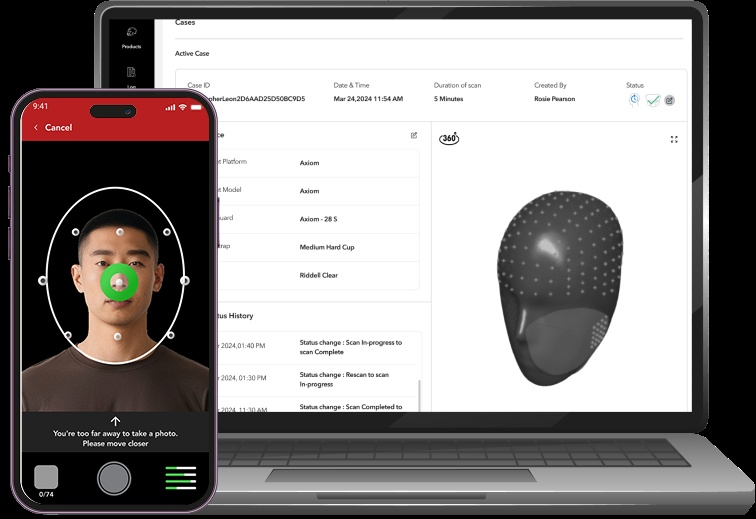
Left Right Mind's Riddell case study adds an unexpected object to the portfolio: the human head. The company describes a mobile scanning application for custom-fitted helmets, using guided image capture and a processing pipeline to produce a three-dimensional model. It reports sub-millimeter error tolerance and offline capture with later synchronization. Those are the supplier's stated capabilities.
There is a useful connection between that work and enterprise search. In both cases, a complicated technical process must fit the conditions of use. The scanning workflow begins with a person and a phone; scientific discovery begins with a researcher who has a question. Neither begins with someone volunteering to understand the implementation. That perspective is the most persuasive part of the company's design heritage.
It also places Left Right Mind in an unusual buying conversation. An organization may approach it for interface design, system integration, custom development or an AI workflow. The alternatives therefore depend on the assignment: a specialist development agency, an enterprise-search integrator, an internal engineering team or a platform implementation partner. Comparing the firm solely with a chatbot subscription would miss much of what it sells.
The price follows the workflow
Left Right Mind says its current platform is priced by deployed modules and active workflows, rather than individual users. Its contact process starts with a discovery workshop covering the use case, existing technology, constraints and timing. The company describes a first procurement deployment measured in weeks for a middle-market business with one ERP and a manageable collection of contracts.
Those conditions do considerable work. A buyer with several operating companies, conflicting policies and fragmented records has a different assignment from one with a single purchasing system. The platform documentation gives an indicative six-to-eight-week window for Explore, subject to workflow complexity. It also says compute and model-token consumption run on the customer's account. Platform fees are therefore only one part of the operating budget.
The historical $30,000 app project offers a concrete cost, but it belongs to another product and another decade. Clutch currently lists a $10,000 minimum project size and a $25-$49 hourly band for the firm's services. Those directory figures should be read as service-market context; they do not price an enterprise AI deployment.
The commercial design is a combination of reusable software and consulting. Left Right Mind describes deployments as 80 percent established platform and 20 percent work tailored to the use case. It includes ongoing tuning under the name Managed Intelligence. The proportion is the company's description, not an audited calculation. Its appeal is straightforward: reuse the machinery while paying attention to the customer's particular rules.
HomeSquare’s reported app spend, in a 2016 customer interview. First launch: December 2014.
Historical custom development project. Separate from today’s AI platform.The part a buyer can copy
The firm's cultural language is unusually willing to discuss uncertainty. Its careers page emphasizes emotional intelligence, questioning requirements and being comfortable with not knowing. Apte has also appeared in the University of Alabama in Huntsville's Intersections interview series to discuss innovation and mindfulness at work. These are public expressions of intent, rather than a measurement of every employee's experience.
The public record shows a change in emphasis from mobile experiences toward enterprise information and AI. A September 2024 company blog entry focused on interfaces for complex data; current messaging focuses on comparing documented expectations with business records. Read together with the NASA work, the continuity is clearer than any dramatic reinvention: the subject has become larger, while the problem of making information usable persists.
A buyer can borrow that discipline before buying anything. Choose one recurring discrepancy, identify the document that defines the rule and the record that can demonstrate compliance, then name the person authorized to resolve it. Keep examples of correct and incorrect outcomes. Test whether a proposed system can reconstruct the reasoning on those examples, including the awkward ones.
This is an editorial reading of the company's approach: a plausible starting point is narrow, observable and owned. If the underlying obligation is ambiguous, the operating record is missing or nobody can approve a remedy, a more fluent answer will not finish the job. If the task is simply writing public marketing copy, the value of private deployment and governed remediation is less obvious.
The most revealing demonstration would end with a resolved exception that a human can inspect. That returns the story to the homeowner's fence: a useful system lets somebody see the problem, understand the next step and get the work moving. The AI pitch is bigger now. The obligation to be useful remains pleasantly ordinary.