In an example on standrdX’s website, an engineering requirement makes an uneventful journey. A customer specification says a component must tolerate minus 29 degrees Celsius. The datasheet agrees. So does the drawing. Then comes the bill of materials: minus 20. Every document can look respectable on its own. Put them together, and nine degrees have gone missing.
The example is illustrative, not an account of an industrial accident. But it makes an unusually good introduction to Payoda Technology. The company builds software for places where information changes hands, and where the gap between what somebody meant and what somebody entered can become expensive. Its latest engineering platform is looking for precisely that gap.
- Payoda combines client engineering with products of its own.
- AppViewX became independent; HealthViewX and standrdX show the current product range.
- The practical test for its AI: inspect the evidence, then let a person decide.
01A product hiding in the project
Payoda was founded in 2005 by Karunya Sampath and Anand Purusothaman. Its own history places the beginning in New York. The business combined customer assignments with products of its own, funding itself for its first twelve years. That is a revealing arrangement: immediate customer problems alongside bets that might take much longer to mature.
AppViewX became the conspicuous example. Payoda dates development inside the company to around 2010. Engineers worked on making enterprise infrastructure visible and programmable, automating work across networks, security and application delivery. In 2017, the product became an independent company. Its scope later developed into certificate management and machine identity security.
Haveli Investments announced completion of its AppViewX acquisition in January 2025. This was a transaction involving the independent business, not an acquisition of Payoda. The distinction matters. Payoda’s interesting asset is the demonstrated ability to get a product out of the workshop and into a company of its own. The next product still has to earn its place.
Payoda
company
completed
02The lab has customers, too
Today, Payoda Labs offers engineering to enterprise innovation teams, growing technology companies and venture-backed businesses. Its menu includes voice interfaces, document intelligence, computer vision, security, automation and data systems. Buyers are paying for people to design and build working software, with the scope shaped around their operations.
The company’s public examples include location technology, cloud networking, private-market investment systems, mortgage infrastructure and localization. Most clients in those examples are unnamed. A separate customer-story collection describes conversational HR tools, investor-report drafting and technical-document search. These are useful clues to the work: getting a question answered, finding buried information, moving an existing process along.
This places Payoda among engineering consultancies and AI implementation firms, while its own platforms put it alongside specialist software vendors. A buyer can also choose an internal engineering team, a larger systems integrator or a narrow software product. Payoda’s argument for attention is that it has experience on both sides of the build-or-buy decision.
03Find the clause. Keep the engineer.
standrdX gives that argument a specific shape. It checks engineering deliverables against requirements, then carries evidence into a review. Oil and gas, construction, aerospace and utilities are among its target markets. A document-search tool can retrieve a relevant paragraph; this product is designed to test whether a drawing, datasheet or parts list actually follows it.
That requires deciding which requirement applies. A code, an owner’s specification and a project addendum may disagree. standrdX applies the precedence order configured by the customer’s team. The contractual hierarchy is an input, not something the buyer should expect a model to invent. Getting that order wrong can produce a thorough review against the wrong rule.
The workflow loads standards, project addenda and deliverables; checks the document set; presents findings; compares revisions; and records closure. An engineer accepts or rejects each finding. The record includes the evidence and decision, with exports for subsequent review. In this design, an accountable person remains part of the product’s operation.
The useful buying test follows naturally: give it a document your engineers already understand. Inspect the finding, the governing clause and a rejection. A persuasive demonstration should make checking the machine easier than repeating its work. A queue of confident answers without that evidence merely gives the reviewer another inbox.
One requirement.
Four chances to keep it.
04Healthcare has its own handoffs
HealthViewX, another platform built by Payoda, follows the movement of patients and clinical work. Its current offering spans referrals, care management, documentation and communication. It describes connections to electronic health records and human supervision of automated actions. The practical ambition is familiar: help the next person in the chain get the information needed to act.
On HealthViewX’s website, customer David Ramirez reports a 67% decrease in referral processing time after implementation. That is an attributed customer result, not a forecast for every clinic. Still, it puts the proposition in human terms. A referral sitting between systems is work waiting to happen, often for both the patient and the person chasing it.
“Small teams own real products, end to end.”Payoda / its stated approach to ownership
05The obstacle arrived before the answer
In a 2023 interview, Sampath identified a problem in adopting AI: obtaining good, diverse training data. Her account describes responding through data partnerships and augmentation. Privacy and access controls also required attention. Before a clever model could improve delivery, the company had to address the material feeding it.
That experience supplies a useful caution for buyers. A document system depends on having the relevant documents. A review tool depends on knowing the applicable revisions. And human oversight requires an actual reviewer with time and authority. These are operating requirements. If they are missing, faster processing can simply move uncertainty further downstream.
06Copy the experiment, not the slogan
The financial discipline is to count the whole job. For a buyer, that means implementation, preparing data, connecting systems, checking outputs and handling exceptions, alongside software and engineering fees. Measure the cost per completed, accepted task. Hours saved in a demonstration are only part of that calculation.
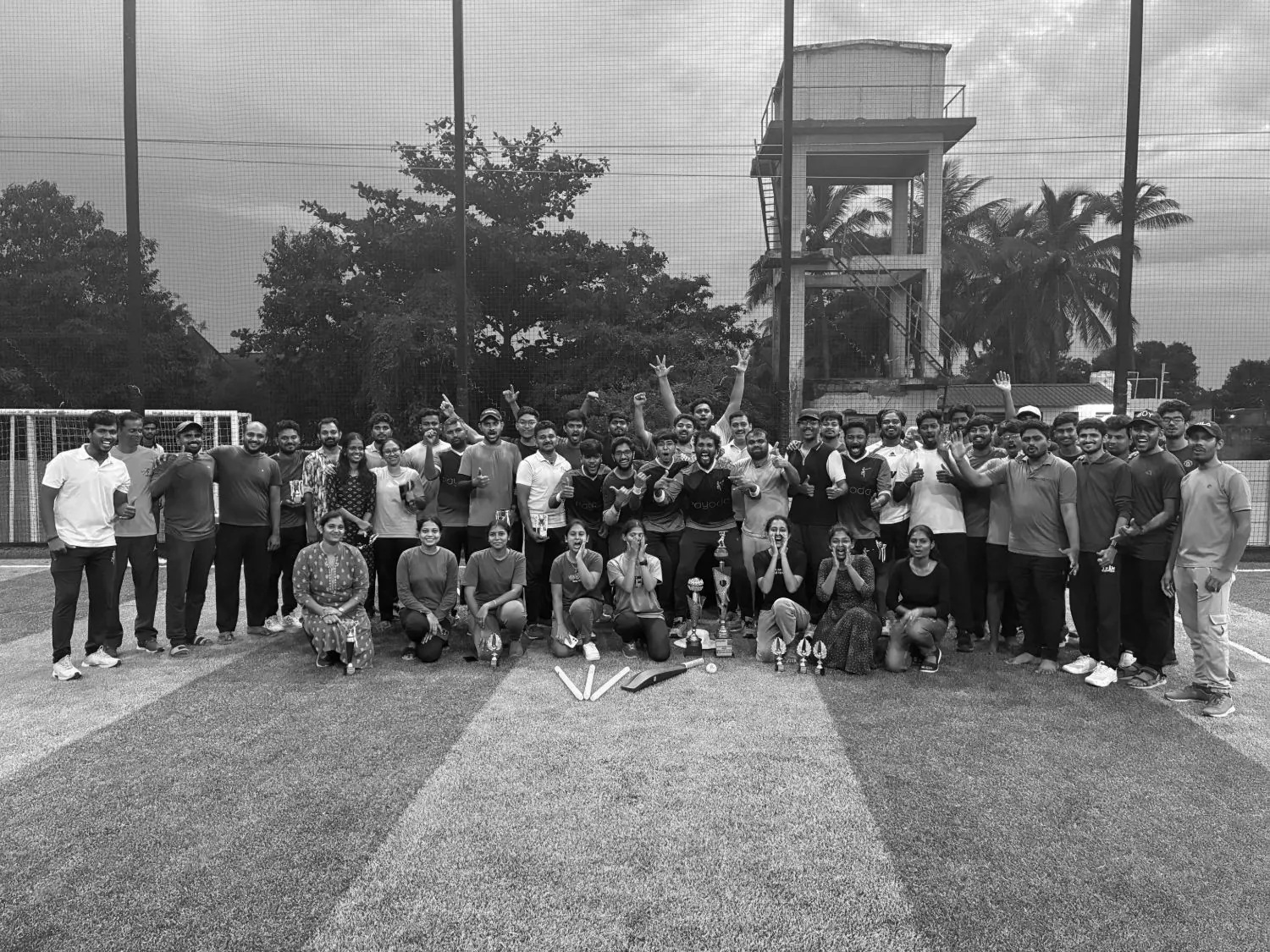
Payoda’s culture page says small teams own products end to end and prototype early. Its photographs add cricket trophies, Onam celebrations and paper-bag Halloween masks. None proves delivery quality. They do give a more particular picture of the workplace than another stock photograph of people pointing at a screen.
The experiment worth copying is modest: select one recurring handoff, establish what correct looks like, and let a small team improve it. Keep the evidence. Give someone responsibility for the result. Payoda’s history suggests how much can grow from that arrangement, provided the product keeps solving a problem somebody will pay to remove.