At SHEIN’s Hong Kong listing ceremony on September 1, 2026, Sky Xu stepped up for photographs with the staff. Then he left the ceremonial business to his chief financial officer, who delivered the remarks and struck the gong. For a founder taking his company public, this was a modest allocation of stage time. Even at the moment when the business acquired a public price, Xu appeared reluctant to acquire a public performance.
His company had spent years pursuing the opposite effect. SHEIN put clothes in feeds, advertisements in browsers and parcels on doorsteps. Its founder, born Xu Yangtian and previously known in English as Chris Xu, generally stayed behind the operation. There is a pleasing complication here: before he sold fashion, he worked in the business of helping companies get found online.
That early apprenticeship offers a useful way into his story. Xu’s career connects the problem of attracting a customer with the considerably messier problem of getting something made for that customer. Search marketing, manufacturing and delivery rarely share a glamorous photograph. They do, however, have to agree on what happens after someone presses “buy.”
The education before the clothes
Xu was born in 1984 in Zibo, in China’s Shandong province. He graduated from Qingdao University of Technology in 2007 with a bachelor’s degree in international trade. His route toward fashion began with commerce and customer acquisition. Before SHEIN, he worked at a company providing search-engine marketing services to exporters.
That job also supplied relationships. Molly Miao, Maggie Gu and Tony Ren, who became SHEIN’s co-founders, worked with Xu in that earlier business. The familiar lone-founder portrait needs a wider frame here. The people who would later help run the retailer already had experience working together on the commercial problem of bringing Chinese exporters to overseas buyers.
The current leadership gives those early relationships an institutional form. Miao serves as chief operating officer, while Gu is chief product officer. Ren remains a co-founder and executive director, having previously served as chief supply chain officer. Xu holds the chairmanship as well as the chief executive role. Product, operations and supply each have a place in that arrangement. The company’s beginnings in marketing did not spare it the need to organize all the work that follows a sale.
A search marketer meets demand in an unusually literal form. Somebody types what they want. The task is to put a relevant offer in front of them, then make the visit worth something. In fashion, the equivalent question keeps returning: which styles will people actually purchase? Xu’s subsequent business made that question part of production, rather than leaving it entirely with promotion.
By 2012, he and his partners were building the Nanjing-based business known as Sheinside. The shorter name arrived in 2015. SHEIN was easier to fit into a conversation, a search box or an app icon. A retailer selling clothes had quietly edited its own label.
The first order is a question
To understand the operating idea, begin with a new garment. SHEIN describes starting a style with a batch of 100 to 200 units. Customers then provide information through their purchases. If the style sells, the company can order more. The initial commitment is deliberately small; the next commitment depends on what happens.
This makes an inventory decision feel more like an ongoing conversation. A conventional seasonal bet commits resources before the shopper has spoken. A small first batch buys an opportunity to listen. Of course, listening only helps if the factory can answer. A popular dress that cannot be replenished quickly leaves the retailer with excellent information and an empty product page.
The coordination matters as much as the first order. Suppliers need timely instructions, available materials and production capacity. Delivery has to carry the result across borders. The screen makes the transaction look tidy. Behind it, a string of practical arrangements must hold together.
- Introduce100-200 units of a new style
- ObserveCustomer purchases reveal demand
- ReplenishOrder more of styles that sell
In May 2021, SHEIN displaced Amazon as the most-downloaded shopping app in the United States. Its mix of new offerings and game-like shopping features had found an audience. The business connected a constantly changing digital shop window to a production system intended to respond to buyers. Xu’s earlier concern with online discovery had grown into a much broader undertaking.
“We’ve reimagined fashion from a supply-driven model to a demand-driven model to make fashion accessible to all.”Sky Xu
The cloud has a Guangdong address
On February 24, 2026, Xu made a rare televised appearance at the Guangdong High-Quality Development Conference. His subject was the industrial region behind the retailer. He described the connection between garment factories, logistics and cross-border commerce, and committed to further investment in SHEIN’s smart supply-chain system.
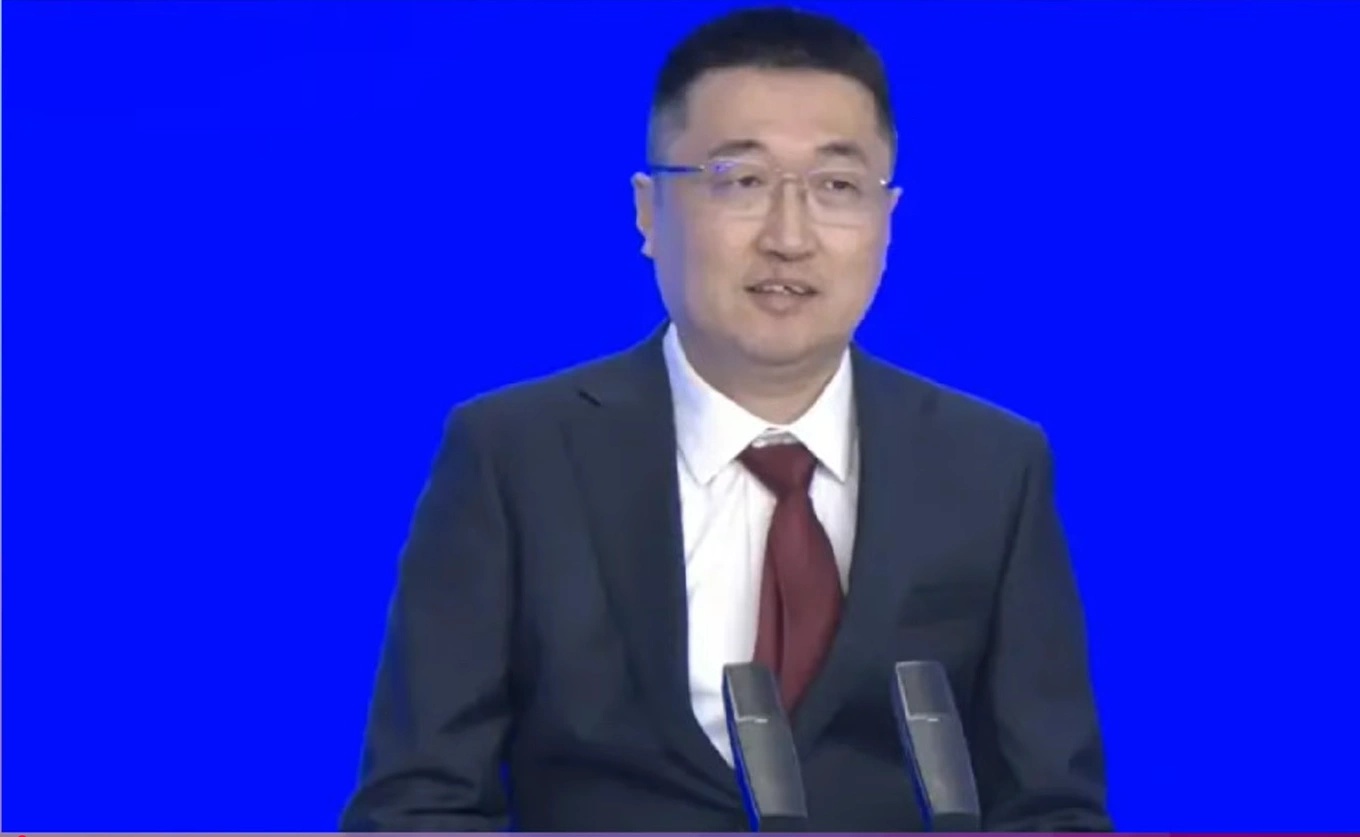
He put the business’s reach at more than 160 countries and regions. For all that international spread, his account kept bringing the operation back to a particular place. His commitment to invest more than RMB 10 billion in Guangdong’s supply-chain system gave that attachment a concrete scale. It was an operator’s subject for a public debut: where the work happens, and what it needs next.
A company can serve people who will never visit its manufacturing region. That distance can make the region disappear from the customer’s idea of the business. Xu’s speech brought it back. A product page can travel almost anywhere. The knowledge required to make, finish, pack and replenish the product belongs to people working in actual buildings.
SHEIN moved its headquarters to Singapore in 2022, while suppliers and warehouses largely remained in China. The two facts sit comfortably together in an organizational chart and less comfortably inside a simple national label. Xu’s business had become international without making its production network interchangeable.
A founder with very little stage furniture
Xu’s preference for a low profile produced some odd consequences. An account of a Guangzhou office elevator ride described employees failing to recognize their own chief executive. When an adviser remarked on it, Xu reportedly replied that recognition was “not our culture.” It is a memorable office anecdote for an age when some founders seem to regard a camera as standard workplace equipment.
Even the name caused trouble. Chris gave way to Sky, drawn from a character in his Chinese given name. Online pictures sometimes identified a Cornell engineering professor named Chris Xu as SHEIN’s founder. The professor occasionally received demands for refunds. An unfortunate customer-service assignment, especially for somebody whose work did not involve selling the clothes.
Xu’s limited public presence also shaped the leadership around him. Donald Tang, a former banker and media executive, became a prominent representative of the company, handling relationships with investors and politicians. Delegating that work let the founder remain closely associated with operations while another executive undertook much of the public explanation.
There are glimpses of a personal temperament in accounts of Xu, though they need to remain accounts rather than a diagnosis from afar. An industry acquaintance described him as patient, pragmatic and attentive to detail. He also reportedly collects antique coins. Fast-moving fashion and objects preserved for centuries make an unexpectedly companionable pair.
Speed acquires responsibilities
The system Xu built asks a great deal of its network. Frequent production decisions require cooperation, oversight and consistent execution. Affordable clothes reach the customer at the end of work that includes factory management, supplier relationships and quality checks. The price tag is brief. The chain of decisions behind it is considerably longer.
SHEIN said it conducted 4,288 on-site audits of China-based suppliers and subcontractors in 2024, covering about 95 percent of SHEIN-branded products by procurement value. Its annual update also described factory upgrades, supplier training and an external advisory board. These are company-reported measures, and they concern the operation beneath the shopping interface.
For a founder, that creates a continuing management task. More orders mean more occasions for the network to perform well, and more opportunities for failures to reach customers. Growth gives the coordination problem a larger audience. The business has to make its processes understandable to people who never see the factories, as well as useful to those who work inside them.
The market gets a turn to speak
The Hong Kong offering followed unsuccessful efforts to list in New York and London. SHEIN raised about US$1.7 billion, entering public trading with a valuation far below the roughly US$100 billion it had reached in private funding in 2022. The audience had changed, and so had the terms on which it would assess the business.
The debut also came with a more complicated financial picture. SHEIN reported a US$99 million loss in the first quarter of 2026, compared with a US$395 million profit a year earlier. For Xu, a public listing therefore arrived alongside questions about the durability of the operation’s economics. The company’s familiarity to shoppers could not settle those questions by itself.
Xu’s own appearance remained characteristically limited. He stood with employees for photographs, while the finance chief handled the gong and the speech. The scene offered a concise portrait of his approach: present at the center of the business, sparing with the ceremony around it.
The speech in Guangdong and the photographs in Hong Kong offered two settings for the same founder. One put him before officials in the region where the production network works. The other put him alongside colleagues as the business began trading publicly. In both, the organization around Xu was part of the picture.
His career began with helping exporters become visible to customers. It now includes making a global retailer legible to investors, regulators and the people who manufacture its products. Those audiences ask different questions. Xu has spent years organizing a business around responses to demand. The next responses will be judged in public, whether or not he takes the microphone.