Picture a rack holding 100 versions of a hunch. One ruched dress, one cropped jacket, one improbable shade of green. In conventional fashion, the hunch would have been made months earlier, multiplied into a large order and shipped toward stores with hope stitched into every hem. At SHEIN, the hunch is often a small opening wager. The company says a new stock-keeping unit can begin with roughly 100 to 200 pieces. Customer response decides whether the next order exists.
This is the useful way to understand SHEIN. The Singapore-headquartered retailer is famous for very low prices and a catalog that seems to regenerate whenever a shopper blinks. But the garment is only the visible end of the system. Underneath sits a digitized network connecting online behavior, merchandising decisions, contract manufacturers and global delivery. The feed is not merely a shop window. It is market research with a checkout button.
That mechanism helped turn a company founded in 2012 into one of the largest fashion businesses on earth. Reporting based on its Hong Kong listing materials put revenue at $38.8 billion in 2024 and $41.9 billion in 2025. SHEIN reaches more than 150 countries and regions. Its private valuation touched a reported $100 billion in 2022, then fell to $66 billion in 2023; expectations around a possible public listing have since moved lower. Fashion discovered that speed could create scale. SHEIN discovered that measurement could make speed repeatable.
01 The collection is a portfolio of bets
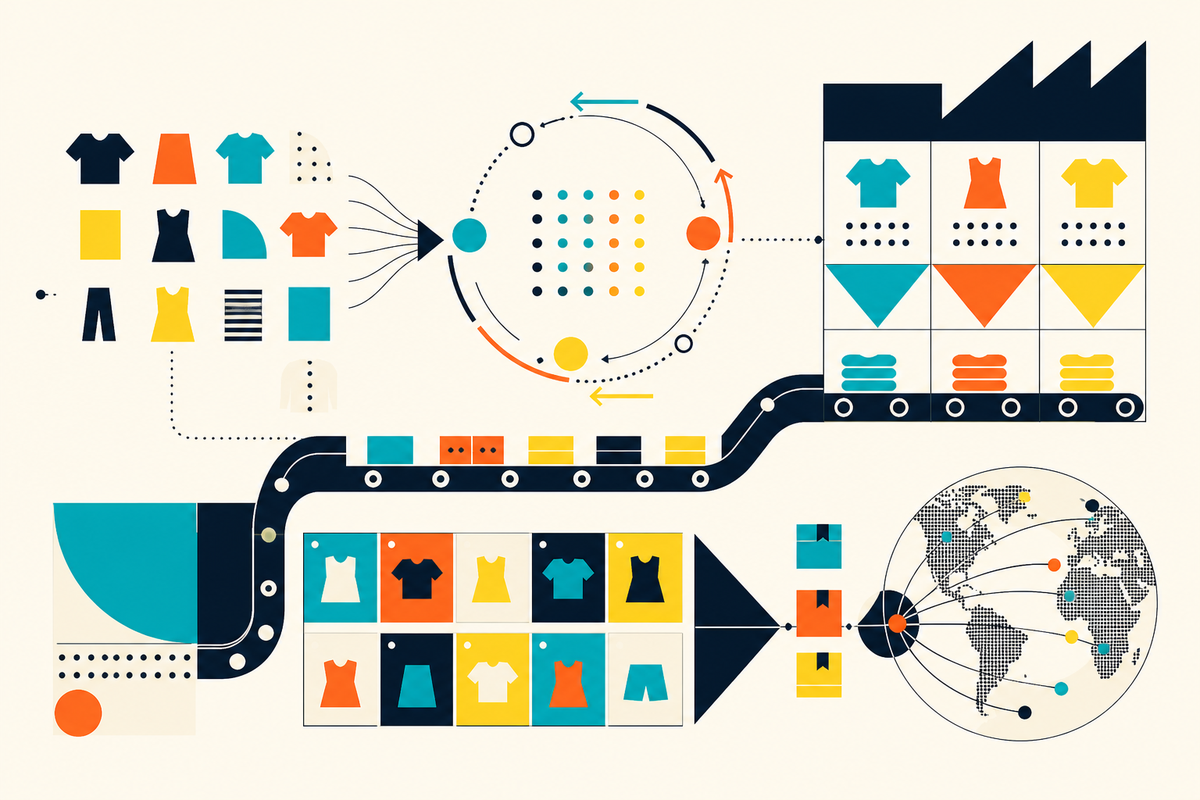
Traditional apparel companies place consequential orders before they know exactly what shoppers will want. Forecasting, creative judgment and retail calendars do the heavy lifting. SHEIN changes the size and timing of that risk. Its system introduces a great many styles in small quantities, reads actual browsing and purchase behavior, then replenishes the winners. Misses are supposed to remain small. Hits earn inventory.
Watch demand
Searches, clicks, saves and purchases reveal interest.
Make a little
A style can start with a batch of about 100 to 200.
Read the result
Real sales replace a large part of the seasonal guess.
Reorder winners
Supplier software pushes proven demand back into production.
The trick is not simply making clothes quickly. Zara taught the industry that lesson decades ago. SHEIN's distinction is granularity: more experiments, smaller first commitments and a business built almost entirely around the phone. A shopper in Manchester or Manila is not just choosing among finished products. In aggregate, shoppers are participating in the next production plan.
“The lack of inventory is really the key to driving the price discount.”Donald Tang, SHEIN executive chairman, speaking to Time in 2023
The operating lesson travels beyond fashion. When demand is uncertain, shrink the cost of being wrong. Release a narrow version. Observe behavior rather than compliments. Put resources behind evidence. Software companies call it iteration; restaurants call it a special; SHEIN turned it into an industrial rhythm for garments. The hard part is not the experiment. It is building suppliers, software and logistics that can respond when the result arrives.
02 A mall hiding inside an app
SHEIN began with fashion, but it increasingly behaves like a marketplace. The app now offers women's and men's clothing, childrenswear, plus sizes, footwear, accessories, beauty, home goods, pet products and electronics. SHEGLAM gives the group a beauty brand. GLOWMODE supplies activewear. SHEIN X connects independent designers to the company's production and distribution machinery. SHEIN Marketplace puts third-party merchants and names such as Skechers, Lansinoh and The Children's Place beside SHEIN's own goods.
That expansion changes the business model. Private-label retail earns the spread between product cost and sale price. A marketplace can add commissions, widen selection without owning every item and give shoppers another reason to keep the app installed. It also turns SHEIN from a competitor to a potential channel for brands. The customer stays the same in spirit: mobile-first, price-conscious and comfortable discovering products through an infinite visual feed. The basket, however, no longer has to stop at a dress.
US dollars
For shoppers, SHEIN solves three ordinary problems with unusual intensity: price, variety and the fear of arriving late to a trend. Search for an event, an aesthetic or a very specific silhouette and the odds are good that the catalog has an answer. For small sellers and designers, the proposition is reach and infrastructure. For suppliers, the company offers demand visibility and a stream of smaller, more responsive orders. These benefits explain the machine more convincingly than any debate over taste.
03 The contradiction in the cart
SHEIN argues that on-demand production reduces a chronic fashion problem: large runs of unwanted clothing. Starting small should mean fewer unsold piles, fewer markdowns and less cash trapped in inventory. Its 2024 sustainability report says new manufacturing tools lifted average supplier productivity by more than 40 percent. The company also reported water savings from alternative printing methods and expanded SHEIN Exchange, its peer-to-peer resale service, into France, Germany and the United Kingdom.
The efficiency claim
Small opening batches can reduce unsold inventory. Demand data directs reorders toward items people have demonstrated they want.
The scale question
Lower waste per decision does not automatically mean lower total impact when low prices and constant novelty encourage more purchasing.
That last distinction matters. Efficiency is not the same as sufficiency. A system can waste less on each product decision while selling more products overall. Air freight, synthetic fibers, returns and short garment lifespans remain part of the environmental bill. SHEIN's agreements with Lufthansa Cargo and DHL to explore sustainable aviation fuel address one piece of that footprint, but they do not dissolve the underlying tension between constant novelty and lower consumption.
The social questions are sharper. Investigations and campaigners have scrutinized working hours and conditions among contract manufacturers. Designers and brands have accused the retailer of copying their work. Regulators have examined product safety, customs treatment and supply-chain transparency. SHEIN says it has zero tolerance for forced labor, audits suppliers and conducted more than two million product safety tests in 2024. The company has also increased investment in supplier facilities, worker programs and compliance. Those responses are material; so is the fact that scrutiny keeps returning.
“We're not perfect for sure.”Donald Tang, in the same 2023 interview
SHEIN's advantage amplifies its responsibilities. A feedback loop that can discover a hit quickly can also reproduce a mistake quickly. A marketplace that adds assortment can make oversight harder. Thousands of suppliers create flexibility, but they also create thousands of places where standards must be checked. The operating system is the differentiator and the risk surface.
04 The market starts copying the method
SHEIN sits at the intersection of fast fashion, cross-border ecommerce, marketplace retail and supply-chain software. Zara and H&M remain apparel benchmarks. Temu, Amazon and AliExpress compete for the broad value-shopping basket. ASOS, Boohoo and Cider chase overlapping online fashion customers. What separates SHEIN is the degree to which merchandising, marketing and manufacturing behave as one measured loop.
The next phase is less certain. Customs changes can narrow the economics of shipping individual parcels across borders. A public listing invites disclosure that a private company has historically avoided. Marketplace growth can increase revenue diversity while making quality control more complex. Localized production partnerships, including Reliance Retail's operation of SHEIN in India, test whether the playbook can travel beyond its original supplier geography.
The supplier loop takes shape
SHEIN dates its founding and on-demand supply chain to this year.
A $100 billion private valuation
Investors briefly valued the fashion retailer alongside the world's largest startups.
The marketplace opens wider
Third-party sellers and established brands begin expanding the catalog.
India returns through Reliance
A locally operated platform tests a different route to market.
More numbers, harder questions
Listing reports reveal greater scale as investors debate a lower valuation.
For builders, the stealable idea is not “move faster.” It is more precise: redesign the business so that learning arrives before the largest commitment. SHEIN moved the moment of truth forward. A style has to earn its second batch. A supplier sees demand sooner. A marketer works with a catalog that is always producing new evidence.
For the fashion industry, the warning is equally useful. When a company shortens the distance between desire and supply, it also shortens the pause in which anyone might ask whether the item should exist. SHEIN built a machine exquisitely tuned to “more?” Its future will depend on whether it can answer the questions that follow: made where, under what conditions, carried how far and useful for how long.