The improbable thing about Simple Modern is not that three Oklahomans built a large water-bottle company. The improbable thing is that they looked at an aisle already occupied by Yeti, Hydro Flask, Corkcicle and S'well and saw room for another one. In 2015, co-founders Mike Beckham, Bryan Porter and Micah Ames had roughly $200,000, ecommerce experience and no product. They began with the kind of question that usually appears in a retreat after a company succeeds: What should this place be for?
Their answer was a for-profit company designed around generosity. The product came later. Insulated stainless-steel drinkware offered clear demand, healthy margins and a curious gap. Premium competitors had built prestige through specialty retail and premium prices. Simple Modern could sell online, offer more colors and sizes, keep prices accessible and use the resulting profit to support nonprofit work. Its first bottle was manufactured in March 2016 and sold on Amazon.
Ten years later, Beckham described Simple Modern as a $200 million company with no outside investors. Forbes reported $200 million in 2023 sales and $40 million in profit. By 2024, the company said it had manufactured 50 million cups, surpassed 100 employees and reached more than 10,000 storefronts. The object is ordinary. The operating system around it is not.
A crowded market is evidence
Beckham's reading of competition is almost cheerfully unfashionable. Founders like to search for blank maps. He prefers markets busy enough to prove that customers care. “Capturing a small percentage of a competitive market can make you insanely successful,” he told Practical Ecommerce. The trick is not pretending the incumbents do nothing well. It is locating what they have chosen not to do.
Simple Modern's original white space was digital. Its founders understood Amazon's search system, product pages, advertising and review economy. They could launch multiple sizes, colors and patterns without asking a physical retailer to give each one shelf space. A family could get the same vacuum insulation and polished look associated with outdoor brands at a friendlier price. The assortment itself became marketing: the customer did not merely need a bottle; she could find her bottle.
Capturing a small percentage of a competitive market can make you insanely successful.
That model solved a bundle of small daily problems: warm water, spilled coffee, a bottle that does not fit a cupholder, a lid too fussy for a child, or school gear scattered across unrelated designs. The Summit bottle and Classic tumbler established the hydration range. The handled, straw-equipped Trek arrived in October 2022. The Voyager, Mesa and Sidekick extend the same logic into coffee, mobility and covered-straw use. Backpacks, lunch bags, bento boxes, coolers and travel bags move the company beyond the cup.
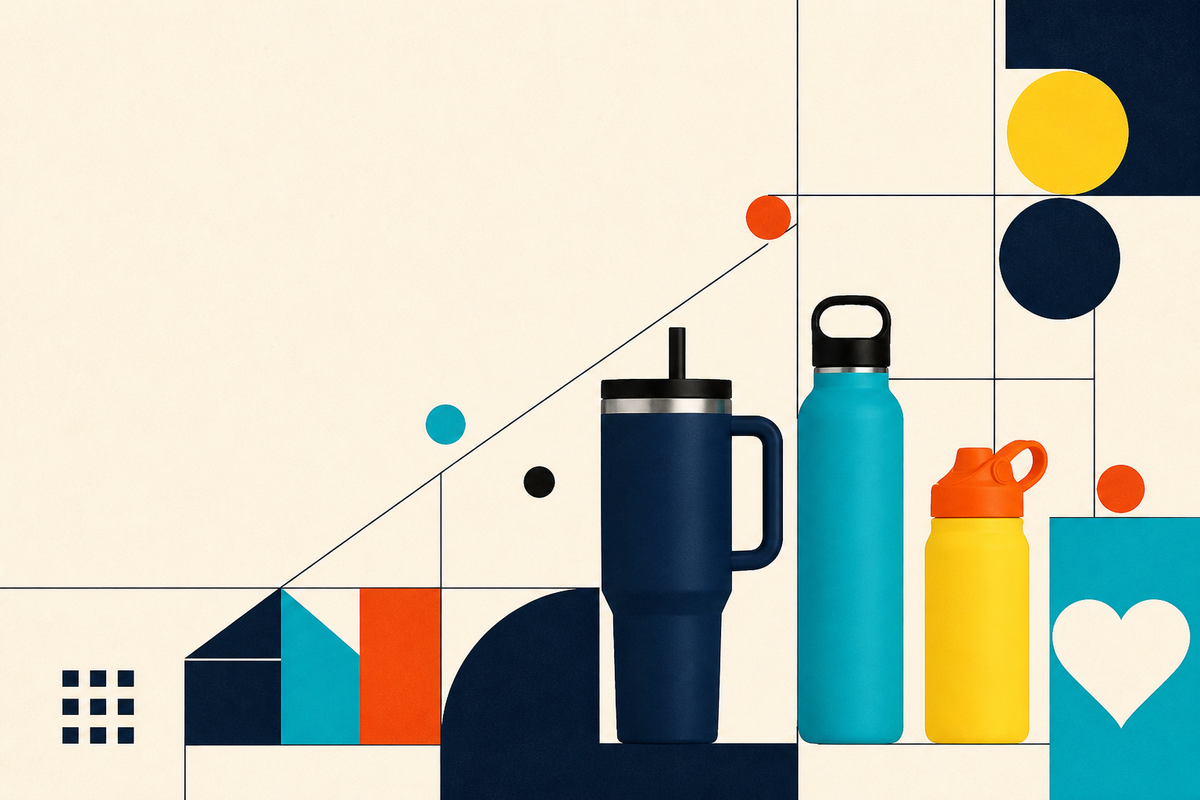
The cup becomes a canvas
Drinkware is functional, but it is also unusually public. It sits on desks, rides in cupholders and appears in school hallways. Simple Modern learned to treat that surface as identity. Its early retail program included designs from more than 100 universities. An NFL agreement followed in 2018, then relationships spanning major sports leagues and entertainment names including Disney, Marvel, Lucasfilm, Paramount, Hasbro and Warner Bros.
Licensing does more than put a familiar character on a cylinder. At Target, for example, the company can coordinate a child's bottle, backpack and lunch box across the hydration and back-to-school sections. It gives retailers a tidy story, licensors another useful expression of fandom, and parents one less aesthetic negotiation before 8 a.m. Simple Modern reported double-digit year-over-year growth in licensed sales after the 2026 Licensing Expo. Its NFL agreement now runs through 2029; Sesame Street runs through 2028 and extends into Europe.
The Simple Modern flywheel
The customer base is correspondingly broad: commuters, parents, children, athletes, teachers, sports fans, college alumni and corporate buyers. Simple Modern sells directly through its Shopify store and a mobile app; through Amazon; through national chains including Walmart, Target, Walgreens, Costco, Kohl's and Whole Foods; and through a bulk-custom business for branded orders. It began as an ecommerce seller. It now behaves like an omnichannel merchandising company with expertise in sourcing, analytics, licensing and rapid assortment design.
The day the marketplace went dark
The original advantage also contained an existential risk. Three days before Black Friday in 2018, Amazon suspended Simple Modern's seller account. The marketplace represented about 95% of sales, and Beckham was sitting on roughly $2 million of inventory. The account returned in time for the holiday rush, but the episode clarified the cost of letting one gatekeeper own the customer.
Retail expansion became a hedge as well as a growth plan. Simple Modern moved from Sam's Club and university licensing into Walmart and Target, then added more chains and its own direct channels. Walgreens brought select Trek, Classic and Voyager products to more than 5,700 locations in 2025. In 2026, toddler drinkware debuted at Walmart and expanded through an exclusive Target range in more than 1,000 stores.
A second hedge sits closer to home. Supply shortages, congested ports and freight inflation prompted Simple Modern to open a 175,000-square-foot Oklahoma City facility in 2022. The operation focused on plastic drinkware, with more than $6 million invested. It does not replace the global supply chain behind stainless steel, but it adds capacity, shorter feedback loops and some control when shipping lanes misbehave.
Generosity as a constraint
“We exist to give generously” can sound like soft copy until it reaches the income statement. Simple Modern commits at least 10% of annual profits to nonprofit work. Its five stated priorities are clean drinking water, education, marginalized communities, human trafficking prevention and homelessness. In 2026, the company said $1.8 million would go to nearly 75 nonprofit partners, pushing cumulative cash and in-kind contributions beyond $15 million.
Where 2025 giving went
The program is structured to resist becoming a check-writing photo opportunity. An annual Giving Summit brings nonprofit leaders into conversation with employees. Every employee receives an allocation to direct to a nonprofit. Most giving remains in Oklahoma, while national and international work broadens the map. In 2026, funded outcomes included clean-water access through Water4, anti-trafficking work through Love Justice Kenya and material support through Infant Crisis Services.
Bootstrapping matters here. Beckham has said outside shareholders might have challenged a recurring donation policy. Retaining control allowed the founders to preserve it. The company then widened ownership: in December 2023, it announced an employee stock ownership plan for everyone from senior leaders to manufacturing workers, with $5 million in stock planned for the first year. Culture, in this version, is not office décor. It is a claim on future equity.
What competitors cannot simply copy
Yeti can make durable drinkware. Stanley can create a color frenzy. Owala can engineer a memorable lid. Retailers can undercut prices. Simple Modern's differentiation is not a single patent-sized fact; it is a stack of mutually reinforcing habits. Digital merchandising produces demand signals. A broad assortment captures them. Licensing turns fandom into reasons to refresh that assortment. National retailers add reach. Affordable premium positioning keeps the audience wide. Giving supplies meaning without asking the product to become a sermon.
That stack also points to the company's limit. Drinkware is easy to enter, trends move quickly and shelf space must be re-earned. Expanding into bags, lunch gear and coolers risks diluting what customers recognize. Licensed demand belongs partly to someone else's characters. Simple Modern has to keep doing the unglamorous work - forecasting, sourcing, lid testing, retailer coordination and inventory discipline - while the cup itself looks effortless.
Its market position is therefore more interesting than “another tumbler brand.” Simple Modern sits between high-priced outdoor heritage labels and undifferentiated mass-market goods. It is a design-led, data-literate consumer-products operator that uses hydration as an entry point into family routines and licensed lifestyle merchandise. Customers get useful objects with more personality and less sticker shock. Retailers get a vendor able to coordinate products, departments and intellectual property.
The founders' original question still provides the cleanest test. Can a company choose generosity before the product, grow without selling that choice to investors, and keep the promise after the numbers become large? So far, Simple Modern's answer is sitting in millions of cupholders: practical, brightly colored and easy to overlook. Exactly the sort of ordinary object from which a durable business can be built.
For shoppers, the proposition stays uncomplicated: choose the size, lid, color or character that fits the day. For builders, the lesson is richer. A familiar product can still support an original company when channel knowledge, assortment discipline and ownership reinforce one another.
Figures reflect public company statements and reporting available through August 2026. Simple Modern is privately held, so current revenue and valuation are not continuously disclosed.