A brown bottle, a yellow cap and an ape with an admirably uncomplicated expression: Sun Bum makes an unusually cheerful object out of sunscreen. The packaging resembles wood grain. The atmosphere is beach bag, not medicine cabinet. Before anyone reads the active ingredients, the bottle has already made its pitch: you probably want to spend the day with these people.
That invitation carries a serious business. Founded in 2010, Sun Bum sells sun protection, hair care and lip care, with products for everyday routines as well as long afternoons outside. SC Johnson bought the company in 2019. The reported price was about $400 million, although the buyer did not publish financial terms. A sunscreen brand with an ape on the bottle had become an acquisition worth watching.
The interesting question is how it earned that attention. Sunscreen is a crowded category with a practical job and plenty of established suppliers. Sun Bum gave the purchase a social identity. Its bet, visible in everything from its photographs to its music events, is that people can enjoy belonging to a sun-care brand before they need another bottle.
The business needed help before it needed a beach party
Co-founder Tom Rinks told Inc. in 2024 that the opportunity came through another parent at his child’s elementary school. The parent had a sunscreen business losing money and wondered whether to abandon it. Rinks saw room for a credible beach brand. He and his partner René Canetti initially developed Sun Bum for a fee and a small equity stake; the owners later offered to sell it to them.
Rinks recruited surfers in Cocoa Beach, Florida, to help shape the company. “They became the authenticity,” he said. They tested products and made decisions about events. He also said SC Johnson’s commitment to keeping the crew and taking a long view helped make the eventual sale attractive. Afterward, he stayed for about 18 months to prepare a brand guide.
“They became the authenticity.”
Tom Rinks, on the surfers who helped build Sun Bum
The useful lesson is about authority. Hiring people who understand a customer’s world means little if they cannot influence what the company does. A beach photograph is easy to commission. A team capable of noticing when an event, phrase or product feels wrong is harder to assemble. Sun Bum’s origin suggests that its early creative work involved deciding who got a vote.

A whole bathroom, starting with one bottle
Today’s range makes the company’s ambition plain. Original sunscreens come in familiar lotions and sprays. Mineral products provide another formulation choice. Signature targets active outdoor use. Daily combines moisturizer and SPF. Kids and Baby Bum give parents dedicated ranges to browse. The customer can be a surfer, a beachgoing family or someone who wants sunscreen beside the toothbrush.
Those categories solve different shopping problems. A parent packing for several children cares about quantity and application. Someone buying face sunscreen may prioritize fragrance, texture or how it fits into a morning routine. Sun Bum’s Original SPF 50 face lotion is described as oil-free and fragrance-free. That matters because the smell associated with the brand is not a feature every customer wants on every part of the body.
The distinction is visible on the label. Original SPF 50 body lotion uses avobenzone, homosalate, octisalate and octocrylene as active ingredients. Its directions specify application 15 minutes before sun exposure, reapplication at least every two hours, after 80 minutes of swimming or sweating, and immediately after towel drying. The bottle’s easygoing appearance does not make the instructions optional.
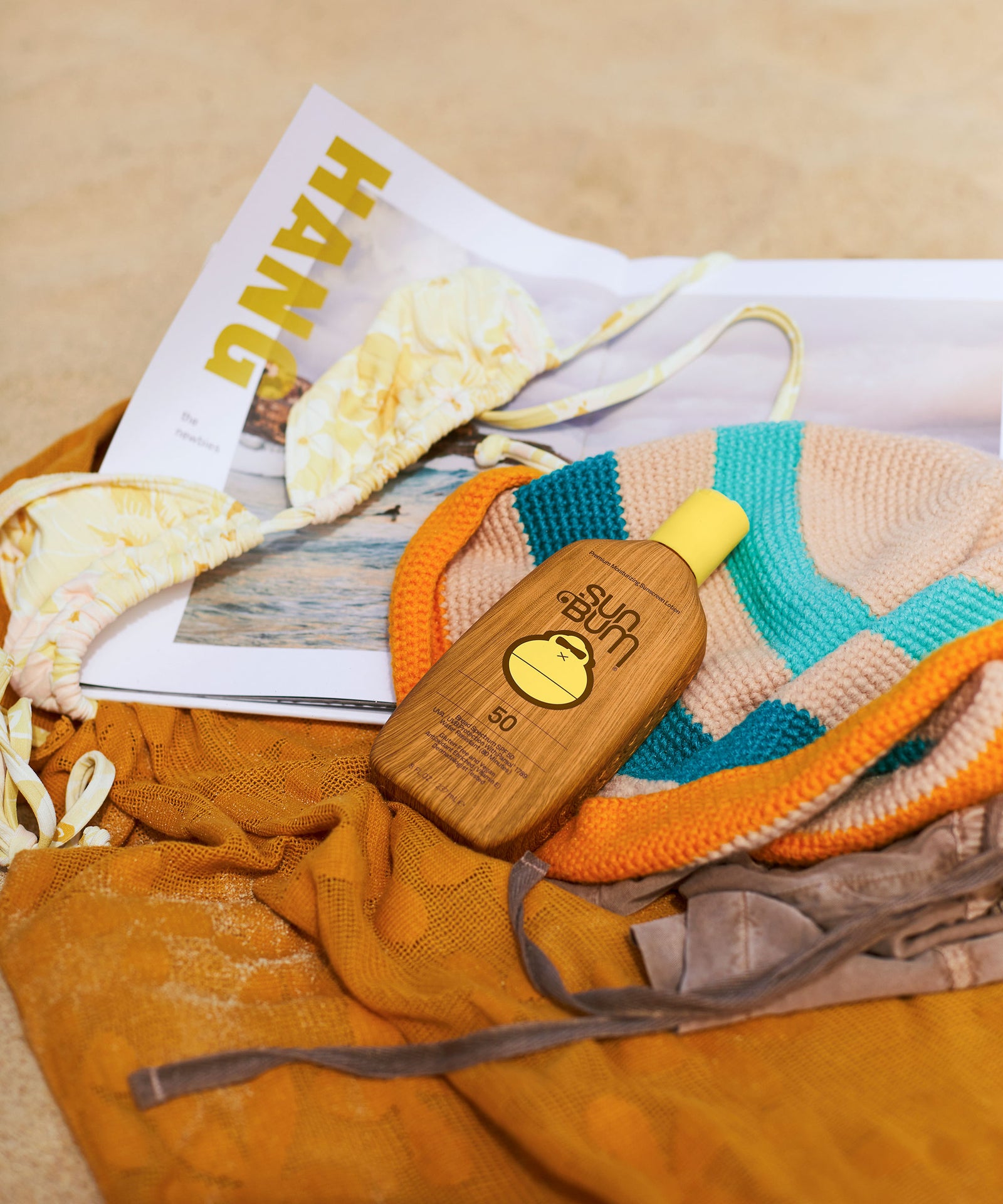
Hair care extends the relationship beyond the moment of applying SPF. The assortment includes revitalizing, blonde, curl, texturizing and protecting ranges, alongside tools and accessories. This is a sensible adjacency: the same shopper can return for a leave-in product or shampoo between sunscreen purchases. It also gives the company more shelf space to compete for, and more reasons to appear in a bathroom throughout the year.
Sun Bum’s expertise is therefore broader than graphic design. Its business joins personal-care formulation, packaging, consumer education and a consistent retail identity. The commercial proposition is that these products belong together. Buying into that proposition need not mean buying the whole range: the practical starting point is the product whose label, feel and format fit the intended use.
What the beach bag actually costs
The business model is straightforward: sell replenishable products through its own online store and retail partners. Target and Ulta carry Sun Bum, putting the brand within ordinary shopping trips. Its website adds bundles and subscriptions. Direct sales create room for a fuller brand experience; retail makes it possible to find a replacement bottle without planning a special order.
At the time of research, the U.S. website priced Original SPF 50 lotion at $11.49 for three ounces, $17.49 for six ounces, $18.99 for eight ounces and $33.49 for a 16-ounce pump. Those are different tickets into the same formula. The small tube makes packing easier. The pump makes the arithmetic friendlier when a household uses a lot.
The price of going small
USD per fl oz • Original SPF 50 lotion
Website prices, September 8, 2026. Before tax and shipping; rounded.
Calculated per ounce, the travel size costs about 83 percent more than the pump. That does not make it a bad purchase; it makes convenience a priced feature. For consumers, comparing unit prices is an easy habit to copy. For founders, the lesson is to offer formats that correspond to real situations instead of assuming one package serves every customer.
Sun Bum competes for space in a market stretching from mass-market sun protection to beauty-focused daily SPF. Its particular territory is visible and accessible beach culture. The wood grain, yellow accents and Sonny mascot give the assortment continuity. That can help a shopper recognize a related product quickly, although recognition alone cannot settle whether a formula suits their skin or budget.
A grant you can measure in shade
The company’s outdoor identity has a practical expression in Protect The Groms, a 501(c)(3) nonprofit working with schools and outdoor organizations. Its activities include shade structures, sunscreen and sun-safety education. The idea addresses a weakness in any bottle-based solution: children’s surroundings and routines also determine how much protection they get.
In November 2016, the program celebrated its first shade structure at Lanikai Elementary Public Charter School on Oahu. The awning measured 24 by 34 feet and covered a kindergarten play area. Sun Bum’s account described a community effort involving school staff, volunteers and local partners, with photographer and waterman Zak Noyle joining the occasion to talk about sun safety.
Protect The Groms shade grant accepted for Lincoln Elementary School in Edison Township, New Jersey, in October 2023.
That later grant appears in Edison Township’s public board minutes. It is a useful number because it describes an actual award to a named school, rather than a sweeping claim about changing the world. It is not a measure of the nonprofit’s total spending. For another company considering a community program, the copyable idea is to fund a specific improvement that the recipient can identify and use.
The words on the bottle matter, too
Environmental language is where a breezy brand needs precision. Sun Bum says its U.S. sunscreens are made without oxybenzone and octinoxate and uses the phrase “Hawaii Act 104 Compliant.” Its explanation acknowledges the lack of an agreed testing protocol for claims about being safe for waterways. The narrower wording is more informative than treating every beach-friendly phrase as a scientific guarantee.
For shoppers, that leaves a sensible distinction: a claim about excluding two ingredients does not establish that a product has no environmental impact. Nor does a brand’s general personality tell you which formulation is in a particular package. Sun Bum sells both mineral and non-mineral options. Reading the actual label remains part of the purchase, even when the front looks reassuringly familiar.
Packaging presents another small tradeoff. Sun Bum offers an SPF 50 face stick in an FSC-certified paper tube, but recommends keeping that tube away from water and storing it somewhere cool and dry. A less conventional package can be attractive while requiring different handling. Tossing everything into a wet beach bag is not a universal test that every design is meant to pass.
The porch is still open
Seven years after the acquisition, the company continues publishing work that would look unusual on a purely functional sunscreen site. On August 21, 2026, it posted a Rio Kosta performance at Sonny’s Porch. The connection included a band collaborator who grew up in Cocoa Beach and employees who were already fans. The series dates to a first show at the Florida home-office in 2015.
On August 31, Sun Bum featured Sun Song, a Mikey February film presented by Spearhead Unlimited with support from the brand. Set around surfing in Fiji, the project brings together film, art and music, including a soundtrack featuring South African artists. These projects give people something to watch or hear when they have no immediate reason to shop for SPF.
They also explain the limits of copying Sun Bum. A company needs products that earn repeat use, enough commercial discipline to support its activities, and people with credible connections to the world it depicts. Costume bananas alone will not do it. The durable idea is to make the protective routine feel welcome in the life customers already want to lead, then keep delivering when they open the cap.
Take it to the beach
Explore the Sun Bum store, browse its journal or visit Protect The Groms. Watch Sun Song, hear Rio Kosta at Sonny’s Porch or see this independent SPF 50 product demonstration on YouTube.