The Curiosity Machine: How SightX Turned Slow, Expensive Market Research Into Something You Can Finish Before Lunch
For a decade, SightX chased a stubborn idea: that testing a price, a package, or an ad should not require three vendors and a month of waiting. Then it taught an AI to do the asking.
Ask anyone who has run a real market-research study how it goes, and you will hear a version of the same complaint. The survey tool lives in one place. The panel of people who take the survey lives with a second vendor. The data cleaning happens somewhere else, often by hand, often late. By the time a chart lands on the marketing director's desk, the question that prompted it has moved on. SightX, a New York company founded in 2015, was built to collapse that whole relay race into a single tab.
The pitch sounds modest until you have lived the alternative: own every step, from designing a study to fielding it to reading the results, in one platform. No handoffs. No stitching. SightX calls its guiding idea "the automation of curiosity," which reads like a poster slogan until you notice what it actually means - the tedious parts of research (programming a survey, cleaning the data, formatting the summary) get handled by software, so the people can spend their hours on the part that is genuinely hard: knowing what to ask.
01 / The ProblemResearch was a group project nobody signed up for
Traditional insights work forces a trade nobody likes. You can go fast with a cheap DIY survey tool and get shallow answers, or you can go deep with a full-service agency and wait weeks for a deck. You can automate and lose control, or keep control and do everything by hand. SightX's founders looked at that menu and decided it was a false choice. Their platform is a bet that speed and rigor are not opposites - that a brand manager should be able to run a proper pricing study on Tuesday and act on it Thursday.
That consolidation is the entire product philosophy. Instead of a survey app here and an analytics package there, SightX puts the survey builder, the consumer panel, and the analysis engine under one roof - and then hands the researcher the keys. You set it up, you run it, you read it, and you export the report, without emailing a spreadsheet to a third party in between.
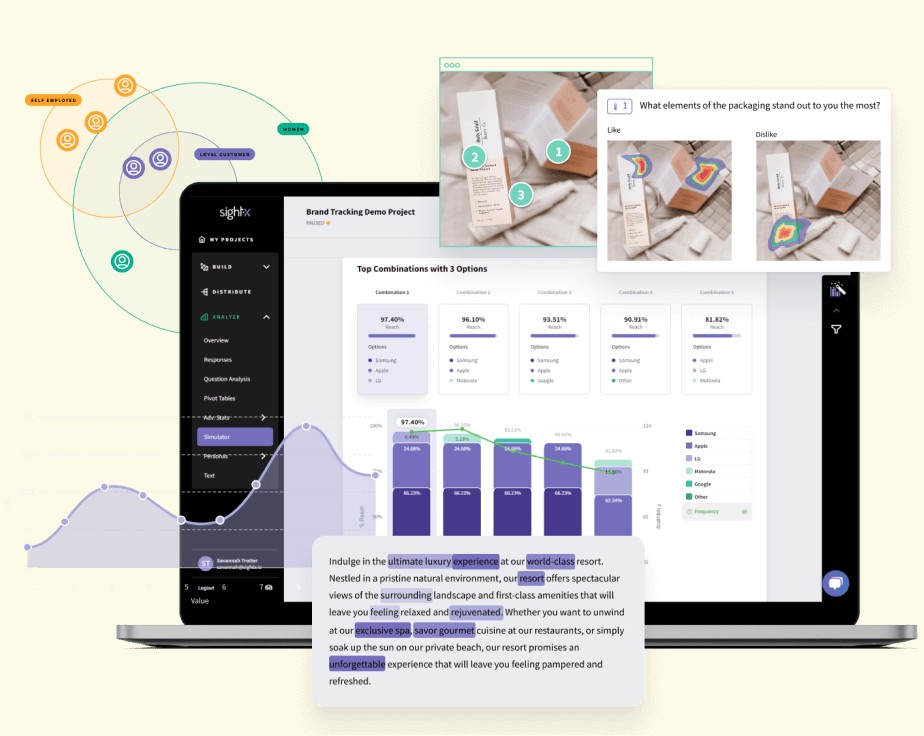
02 / What It DoesThe scary words, made clickable
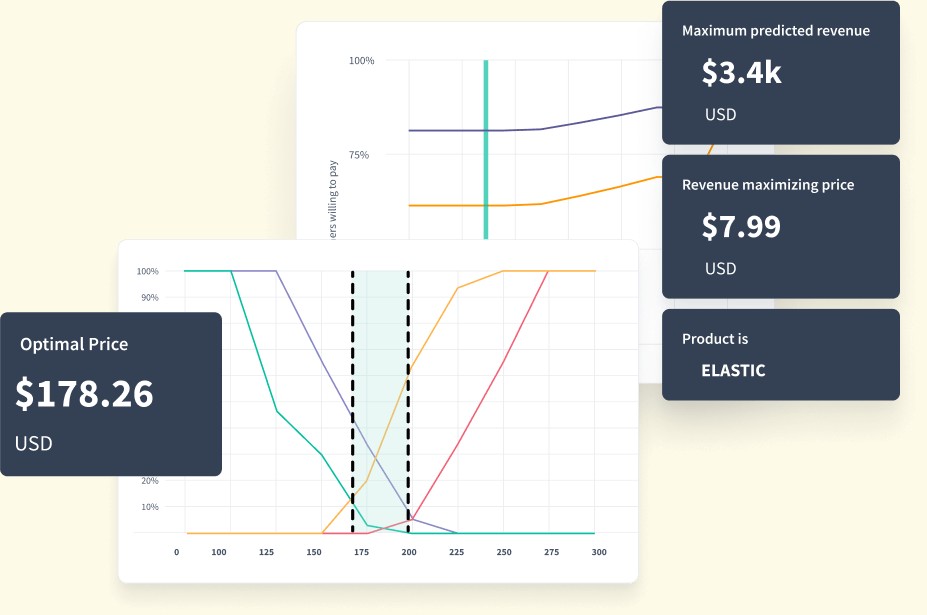
Under the hood, SightX is a full quantitative-and-qualitative toolkit. The methods it packages are the ones that usually send marketers running for a consultant: conjoint analysis to see which product features people actually pay for, MaxDiff to rank what matters most, Gabor-Granger and Van Westendorp for pricing, TURF to find the smallest bundle that reaches the most people, plus brand tracking, concept and ad testing, segmentation, heat maps, and open-ended sentiment analysis. The point is not that these are new - it is that SightX makes them self-serve, so you do not need a statistics degree to run one.
Around the analytics sits the fielding side: access to a panel of more than 100 million qualified consumers worldwide, so you can find and survey the exact audience a study needs without leaving the platform. In 2025 the company added asynchronous video interviews - with AI transcription, translation, sentiment analysis, and thematic coding - and a Branding Suite that turns raw results into branded reports and PowerPoint exports automatically. The direction of travel is clear: fewer manual steps between a question and a deck.
03 / The DifferentiatorMeet Ada, the research consultant that never sleeps
In November 2023, SightX launched Ada, which it billed as the industry's first generative-AI market research consultant. Ada is not a chatbot bolted onto a menu. It suggests which experiment to run, builds the project, picks the target audience, analyzes the incoming data, and writes the executive summary - the sort of work that used to eat an analyst's week. It will even draft a blog post or ad copy from the customer feedback it just read.
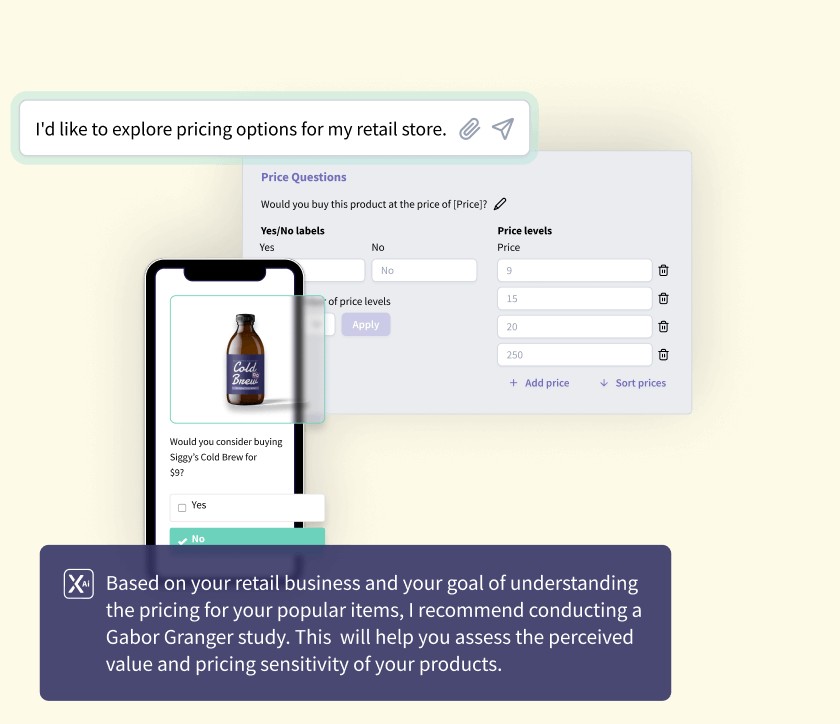
By blending seasoned research methodologies with GPT algorithms and advanced AI models, Ada transforms the entire market research process. Naira Musallam, PhD - Co-Founder & Co-CEO
The founders are careful about where the line sits. Ada handles the repetitive work - the formatting, the early drafts, the first cut of analysis - while the researcher stays the strategist. As Musallam put it, "Researchers remain the strategic thinkers. Ada handles the repetitive work, the formatting, the early drafts. Together, they move faster and deliver more impact." That is a more honest framing than most AI launches manage, and it is closer to how the tool is actually used.
04 / The CustomersWho is actually running studies on it
For a company that stayed small - roughly two dozen employees - SightX signed an unusually blue-chip roster. Its customer wall includes Bloomberg, HBO Max, Hershey, Home Depot, Johnson & Johnson, McGraw Hill, Amplify, NRG, Boll & Branch, Bonterra, Tarkett, and the Carolina Panthers. These are shopper-insights teams, brand managers, and category leads - people who need answers about pricing, packaging, messaging, and brand health on a schedule, and who do not have a month to spare.
05 / ExpertiseA statistician and a Ranger walk into a startup
The founding pair approached the same problem from opposite ends. Naira Musallam holds a PhD from Columbia and taught research and statistics there and at NYU; she is the methodological conscience of the company, the reason its conjoint and pricing tools are built to hold up. Tim Lawton came the other way - a West Point graduate and former Army Ranger who went on to an MBA at MIT Sloan and stints at Barclays and UBS before co-founding the company. One knew exactly how the research should be done; the other knew how to build and sell the thing that does it. The company started life as Frontier7 and rebranded to SightX in 2019 to match its ambition as an integrated platform.
The best research changes how companies think, how products are built, and how markets evolve. Tim Lawton - Co-Founder & Co-CEO
06 / The Model & The MarketWhere it fits, and who it is up against
SightX sells the way you would expect: B2B software-as-a-service, with a Professional tier for core methods and an Enterprise tier that unlocks the heavier machinery - MaxDiff, conjoint, TURF, automated segmentation, data weighting, and dedicated support. Ada arrived as an add-on. Reported revenue was around $2.9M in 2024, on roughly $6.84M raised from investors including Scout Ventures and Baleon Capital, with early help from NYU's Summer Launchpad.
The category is crowded. On one side sit the enterprise heavyweights like Qualtrics and agile-research players like Zappi, Suzy, and Quantilope; on the other, testing and qualitative tools like UserTesting and dscout, and sample marketplaces like Cint. SightX's wedge is the all-in-one workflow with real analytical depth and an AI layer that does more than autocomplete - a combination that is easier to claim than to build.
07 / The TurnWhy Rep Data bought the whole thing
In April 2026, at an industry event in New Orleans, Rep Data announced it had acquired SightX. Financial terms were not disclosed. The logic is a neat fit: Rep Data spent years being the company that checks whether survey responses are real, through its Research Defender and ReDem quality technology. SightX is the company that builds and fields the surveys. Bolt them together and you get a single pipeline - build it, field it, and trust the data - without switching vendors between steps.
Researchers have been forced to choose between speed and confidence for too long. This acquisition brings those together in a single workflow. Patrick Stokes - CEO & Founder, Rep Data
What is worth stealing from the SightX story has little to do with AI hype. It is the discipline of picking one workflow that everyone quietly hates - fragmented, slow, expensive research - and refusing, for ten years, to accept that it has to stay that way. Where it works best is exactly where the pain is sharpest: teams that run frequent studies and cannot afford the vendor relay. Where it would struggle is at the edges - a one-off, highly bespoke ethnographic project may still want a specialist agency, and any AI-assisted layer is only as good as the human framing the question. SightX never pretended otherwise. It just made the rest faster.