The Garage-Built Machine That Reads a Room in Three Hours, Not Three Weeks
Christopher South and Rick Nguyen bet that the focus group was already dead. Their four-person, self-funded company has spent a decade selling Fortune 100 marketers a faster way to find out if their ads actually work.
Sometime in late 2011, two engineers in a garage in the San Francisco Bay Area looked at YouTube and reached an uncomfortable conclusion for a multi-billion-dollar industry: the focus group was finished. High-speed internet had put a video screen in front of nearly everyone, and the traditional way of finding out whether an ad worked - a room, a two-way mirror, three weeks, a large invoice - suddenly looked like a horse and buggy parked next to a highway. Christopher South and Rick Nguyen decided to build the highway.
The company they launched in 2013, Spot Trender, does one deceptively simple thing: it tells brands whether their advertising is any good before they spend the media budget behind it. Feed it a TV spot, an online video, a radio cut, a print layout - even a rough storyboard that hasn't been shot yet - and it puts that creative in front of real consumers drawn from a pool of more than 100 million people worldwide. Then it hands back a verdict. Not in three weeks. In as little as three hours.
01 — THE PROBLEMGuessing is the most expensive line item in marketing
Every marketer has lived some version of the same nightmare. A campaign gets built, shot, approved up a chain of executives, and launched - and only then, with millions already committed to media, does anyone learn that the ad doesn't land. The joke falls flat. The message confuses. The audience checks out four seconds in. By the time the performance data confirms it, the money is gone. Spot Trender's entire reason for existing is to move that verdict to the left - to before the spend, not after.
Traditional research could technically catch these problems, but it was too slow and too expensive to use on every piece of creative. So marketers rationed it, tested the big campaigns, and guessed on the rest. Spot Trender's bet was that if you made testing fast and cheap enough, marketers would test everything - and stop guessing.
02 — HOW IT WORKSA machine that watches you watch the ad
The piece Spot Trender is proudest of is what it calls the industry's only patented live audience emotion-capturing system. While a consumer watches an ad, the platform records their emotional reaction second-by-second and layers it on top of demographic data and survey answers. The output isn't a single thumbs-up or thumbs-down - it's a curve. A client can see the exact moment an ad gains the room and the exact moment it loses it, then cut, re-edit, or re-shoot with a reason rather than a hunch.
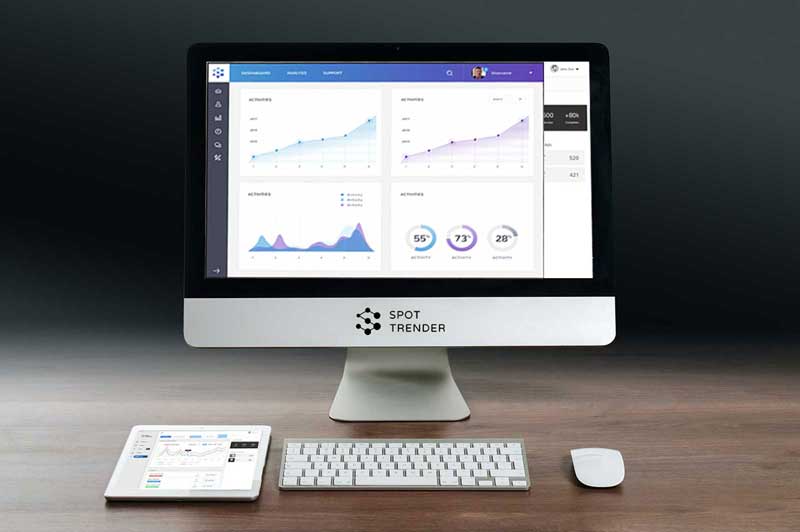
Around that emotion engine sits a fairly ordinary-sounding but hard-to-build stack: a mobile-friendly survey system, connections into top consumer and B2B panel companies, methodology and target-market setup, a preview-and-approve workflow, and an analytics dashboard. Clients can run it themselves, self-service, or hand the whole study to Spot Trender's team for a custom report. The point of all of it is compression - taking a process measured in weeks and squeezing it into an afternoon.
03 — WHAT YOU CAN DO WITH ITTest the storyboard before you shoot the ad
The most useful trick in the box is testing creative that doesn't fully exist yet. Because Spot Trender can put a storyboard, a value statement, or a rough concept in front of consumers, brands can kill a bad idea while it's still cheap - a sketch, not a finished production. That reframes the whole economics of the thing. A test that costs a four-figure sum can head off a six- or seven-figure mistake.

The platform's three named workhorses are Ad Testing, Brand Tracking, and Data Collection. Ad Testing covers concept-to-final for TV, video, radio, and print. Brand Tracking watches awareness, perception, and sentiment move over time across markets. Data Collection is the survey-and-recruitment engine underneath, reaching consumer, B2B, and niche audiences - down to healthcare providers - when a client needs a hard-to-find sample. Spot Trender says consistent testing can lift campaign performance by double-digit percentages.
04 — THE AI CHAPTERBolting NLP onto a decade of reaction data
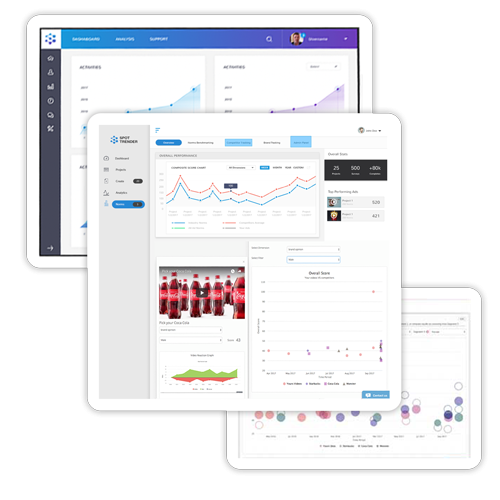
In March 2023, Spot Trender added AI features - and the order of operations is worth noting. This wasn't an AI company that discovered ad testing; it was an ad-testing company that had been collecting emotional and open-ended response data for a decade and then used AI to read it faster. The new tools summarize open-ended answers with natural-language processing, run sentiment analysis, and surface trends across demographic groups automatically. The pitch, launched into a jittery economy, was blunt: get to decisions in minutes instead of days, and stop wasting money.
05 — WHO BUYS ITFortune 100 logos, four-person team
The client list is the surprising part. For a company that has stayed at roughly four people, Spot Trender names work with Fortune 100 and Global 5000 brands and agencies: BBDO, Innocean, Publicis, Pfizer, Hyundai, Red Robin, Intuit. Agencies use it to test client creative; brands use it to keep their own campaigns honest. When Spot Trender rolled out its reimagined cloud platform in 2018, it says more than 80% of its full-service clients moved over to it within the year - a decent sign the product was doing real work, not just demos.
| The old way | The Spot Trender way |
|---|---|
| Timeline | Roughly three weeks to a full read |
| Cost | Tests starting under $1,500 a spot |
| Feedback | Second-by-second emotional reaction curve |
| Stage | Concept and storyboard, before you shoot |
| Reach | 100M+ consumers, global panels |
06 — THE BUSINESSSmall on purpose, and proud of it
Spot Trender never turned into a venture rocket ship, and that appears to be the point. Public records show a modest amount of financing - roughly $400K, including a small debt round in 2017 - rather than the venture rounds its Silicon Valley origins might suggest. Independent estimates put revenue in the mid-six-figures and growing, run by a team you could fit around one table. It is, in the language of the moment, a lean, profitable, bootstrapped software business selling to enterprises far larger than itself.
That structure is also the strategy. A four-person company that sells to Fortune 100 marketers has to be almost entirely product - the software has to do the work that headcount would do elsewhere. The whole design of Spot Trender, from the self-service dashboard to the automated AI summaries, points in the same direction: let the platform carry the load so the company doesn't have to grow to serve big clients.
07 — WHERE IT FITSThe fast-testing pack
Spot Trender sits in the fast-growing category of automated insight platforms that have been eating the traditional research firms' lunch - alongside names like Zappi, Suzy, System1, Qualtrics, UserTesting, and Innovid. Its differentiators are the patented live-emotion capture, the concept-stage testing, and the price point that makes testing routine rather than reserved for tentpole campaigns. Its constraint is scale: a tiny team competing with well-funded rivals wins on focus and product, not on sales armies.
There's a clean lesson buried in the story for anyone building. Pick a process people hate - slow, costly, rationed - and make it fast and cheap enough that they'll do it all the time. Stay small enough that the product has to be the differentiator. Add the shiny technology, AI included, only after you've collected the data that makes it worth anything. Spot Trender has run that playbook quietly for more than a decade, which is arguably the most convincing endorsement of it.
The obvious caveat: fast, affordable testing is not a substitute for taste or strategy, and a curve that says an ad works is only as good as the sample and the questions behind it. Spot Trender's own framing is careful about this - it sells confidence and speed, not certainty. For a marketer choosing between a guess and a same-day read from real consumers, that trade has been enough to keep the logos coming back.