The food business has always had a costly way of discovering a bad idea: cook it, ship it, print it on a menu, train a crew to make it, and wait for customers not to order it. Datassential sells an earlier warning. The Chicago company collects the traces left by what people eat - menus, prices, limited-time offers, surveys, operator records, social chatter - and turns them into software for the people deciding what appears next on a shelf or plate.
This is not a restaurant recommendation app, and diners are not the customer. Datassential is business-to-business infrastructure for manufacturers, restaurant chains, distributors, retailers, suppliers and food-tech companies. An innovation team can check whether hot honey is still climbing. A brand manager can test the wording and price of a sandwich before launch. A salesperson can find operators whose menus have an obvious gap. An executive can ask the new AI interface a plain-English question and inspect which filters produced the answer.
The company says its platform has analyzed more than 7.5 billion menu items, accumulated more than a billion survey data points and interprets 1.3 billion social signals each month. Those are company-reported figures, but they explain the proposition. Datassential is not selling omniscience. It is selling a very large memory.
The actual product
A research report learned to do the next job
Datassential began in 2001, founded by Jack Li, Hooman Lahijani and Deron Quon. It was a small foodservice research company with an unfashionably specific obsession. That specificity compounded. A report about what was happening on menus became a historical menu database. The database supported forecasts. Forecasts led naturally to concept testing, consumer preferences, competitive pricing and brand benchmarking. Operator intelligence made the same information useful to sales teams.
Today those pieces sit inside Datassential One. Menu Trends tracks the incidence, penetration, price and predicted growth of ingredients and dishes. Consumer Preferences measures awareness, trial and affinity across thousands of foods, flavors and brands. Launches & Ratings watches limited-time offers and new items, then puts concepts in front of consumers. Sales Intelligence maps operators and helps suppliers choose prospects. Report Pro packages analyst research. Custom studies answer questions the standard databases do not.
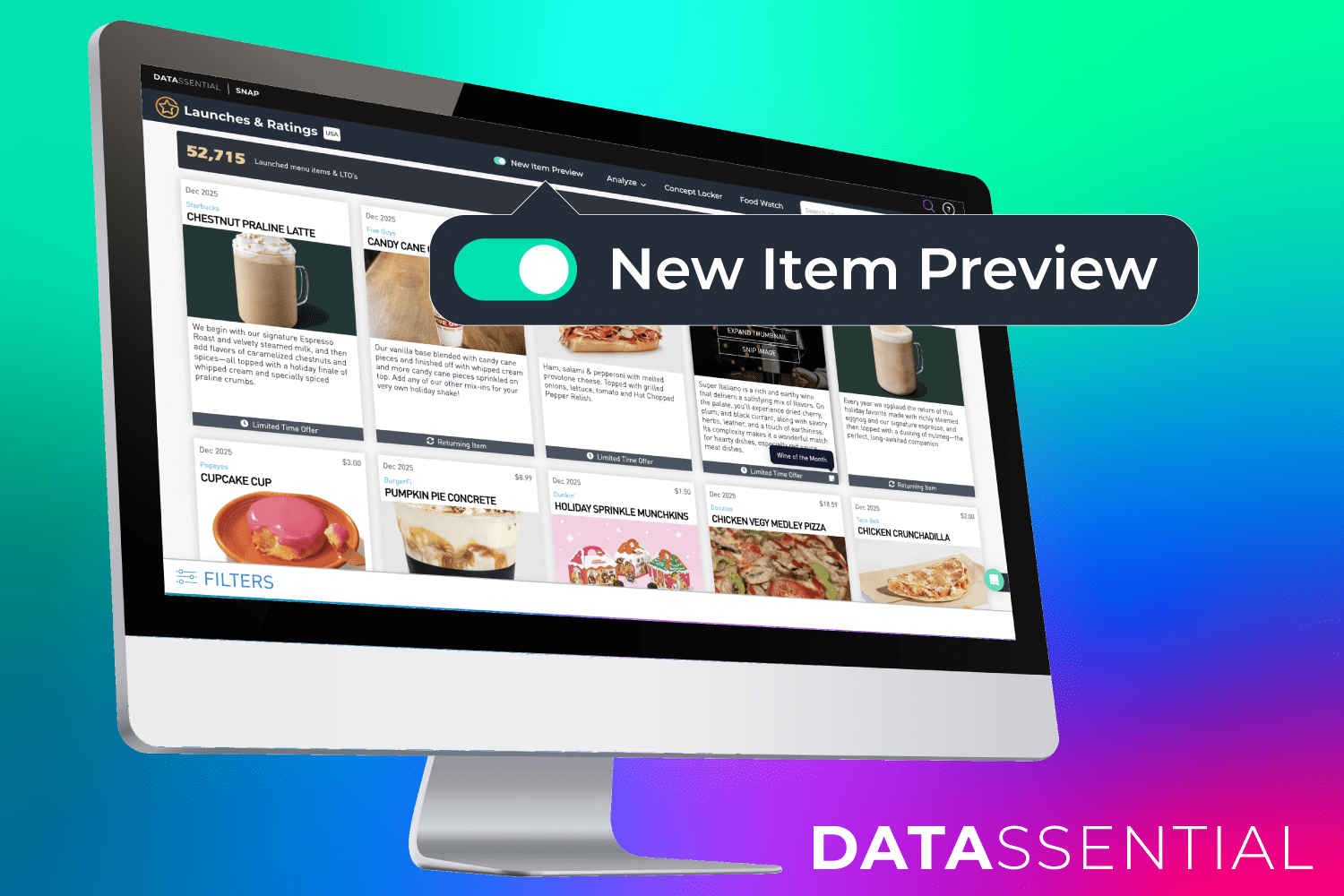
In 2026, the front door changed. AI Chat now reaches across consumer sentiment, published research and menu activity. Menu Trends AI Search returns the relevant table or visual and shows the filters it applied. An MCP product can feed licensed Datassential intelligence into a customer’s own AI workflow. Sales Strategy Builder turns an operator record and a seller’s product - pre-marinated wings, say - into talking points, discovery questions and a leave-behind report.
That is the company’s important product decision: it did not stop at insight. “Gochujang is growing” is a pleasant slide. A connected workflow asks how fast it is growing, among whom, on which menus, with what pairings, at what price, and whether a particular concept beats a relevant benchmark. The research becomes useful at the moment money moves.
The moat is not the chatbot. It is the peculiar, proprietary history underneath it.YesPress analysis
The customer math
What it cost - and what failed first
Datassential does not publish a rate card. Subscriptions and custom research are sold by quote, which makes exact buyer economics hard to compare. Its case studies are more revealing. A top-200 burger chain had relied on conventional in-market testing and a third-party vendor. That process let it evaluate about 25 concepts a year. The bottleneck failed first: too few ideas could make it through a slow, expensive gate.
The chain’s innovation director researched alternatives and adopted Launches & Ratings. Datassential says the chain then tested 100 concepts a year for the same price and cut concept-testing costs by 75 percent. It also reduced live market tests and reported some of its strongest limited-time launches in a decade. The vendor does not identify the chain or publish the underlying invoices, so the result is a customer claim, not a universal benchmark. Still, it answers the useful question. The software paid by replacing repetitions of a costly physical experiment.
More concepts tested for the same budget
A burger-chain case study reports a move from 25 concepts to 100 annually, alongside a 75% reduction in testing cost. The exact subscription price remains private.
Another change of mind came at Barilla. Pandemic research showed overworked restaurant kitchens looking for labor-saving formats. That evidence helped an internal champion make the case to test frozen pasta, a product the company ultimately launched. The lesson is not that a database invented frozen pasta. It gave a person inside a large organization credible outside evidence to challenge an old assumption.
The same pattern appears in sales. Vegan mozzarella maker NUMU says Datassential research helped it speak with authority at an industry conference and book more than 12 meetings with major operator and university prospects. Disaronno reports cutting request-for-proposal preparation time by as much as 90 percent. Freddy’s reports 35 percent growth in chicken sandwich sales. The outcomes vary, but the purchased job is stable: reduce the time between a question and a defensible commercial move.
The market position
Part database, part consultant, part rehearsal room
Datassential sits between broad market-measurement firms and narrower trend tools. Circana and NIQ measure markets and purchasing. Technomic and Black Box Intelligence cover foodservice research and performance. Tastewise applies AI to food trends. Internal teams stitch together surveys, CRM data, syndicated reports and spreadsheets. Datassential’s distinction is the attempt to connect menu history, consumer response, operator detail, testing and selling inside one food-specific system.
Its relationship with Circana makes the boundaries especially interesting. The two could look like alternatives in a research budget, yet in 2026 they announced reports combining Circana SupplyTrack purchasing and volume data with Datassential’s menu and consumer intelligence. One sees what operators bought; the other adds what appeared on menus and what consumers may want. In vertical data, a rival dataset can become a missing layer.
Ownership has helped widen the stack. Spectrum Equity invested in 2019. Over the following five years, Datassential more than tripled its customer count, launched products including Report Pro and Price Monitor, and bought CHD Expert, adding global operator records. New Mountain Capital and Endicott Capital invested in 2024 as Spectrum exited. Datassential acquired Brizo FoodMetrics in 2025, adding granular intelligence on more than 2.1 million establishments. Deal values were not disclosed.
That expansion also shows the business model: recurring enterprise software subscriptions, plus custom research, consulting and integrations. Hundreds of customers use the products, and the company says more than 90 percent of leading foodservice and consumer packaged goods companies rely on it. Publicly named users include Burger King, DoorDash, General Mills, Pepsi, Starbucks, Target, Whole Foods Market, Barilla and Dot Foods.
The stealable playbook
Copy the sequence, not the food puns
Pick one industry and one expensive decision. Depth compounds faster when every new record makes the old records more valuable.
A snapshot answers what. Repeated observation answers direction, velocity and timing - the questions budgets care about.
Do not strand the customer at a chart. Connect evidence to testing, targeting, pricing, pitching or another paid workflow.
Natural-language access is useful when answers expose their datasets and filters. The interface should shorten inspection, not conceal it.
There is a cultural footnote worth stealing too. Datassential’s published values mix seriousness about craft with deliberate silliness about food, including speculation about cockroach milk. That sounds like employer-brand garnish, but it fits the product. Food is emotional and playful; enterprise data software is usually neither. A company studying both chefs and spreadsheets benefits from respecting both.
When the crystal ball cracks
- When a cuisine, format or market is so new that the historical sample is thin.
- When national patterns obscure a neighborhood, demographic or cultural context.
- When supply, labor, food safety or unit economics kill an appealing concept.
- When a team treats a forecast as an instruction instead of evidence for a decision.
- When the organization cannot act quickly enough for early detection to matter.
Even Datassential’s amusing misses make this point. The company says Menucast AI predicted yuzu would reach 4.4 percent menu penetration in 2025; actual penetration reached 6.6 percent. It got the direction right and the magnitude wrong. That can still be commercially useful if a team is choosing whether to investigate yuzu. It is less useful if someone mistakes 4.4 for destiny.
The reader can copy Datassential’s architecture: proprietary history, one costly decision, a workflow that ends in action, and an interface that lets more employees use the evidence. What cannot be copied quickly is the 25-year head start. That is the quiet appeal of the company. In an industry addicted to what is new, Datassential’s advantage is remembering what happened the last time everyone got hungry.
Keep digging