A watch is a small object on which to hang a large assumption. Timex was considering new licensed entertainment properties, with more than 20 designs in contention. The team had preferences. It also had a commercially proven line against which new ideas could be measured. The awkward question was whether consumers would share the enthusiasm of the people making the watches.
- Knit combines consumer surveys, video feedback and AI analysis with dedicated researchers.
- Enterprise teams use it to test products, messages and customer assumptions.
- The useful promise: answers before production, marketing or inventory decisions harden.
The favourite design meets the consumer
Timex worked with Knit across two phases, surveying more than 1,100 people. Designs appeared individually in randomized order, with a successful existing line providing a benchmark. Video responses added explanation to the scores. The work took six weeks, according to Knit’s published case study.
“Intuitively, we thought [one property] was definitely the way to go.”
Shawn Lawson, Timex · Knit customer case study
The findings revised that view. Research helped establish which designs should lead and which should wait. Here was a useful role for a research company: giving a product team grounds to disagree with itself while disagreement was still affordable. A preference is cheap. A production commitment has rather less sense of humour.
A faster survey can still mean a slow decision
Knit operates in the gap between collecting answers and making them useful. It sells consumer research to enterprise teams, combining numerical survey responses with qualitative material, including video. Its customers include Amazon, Mars Wrigley, NASCAR and Overtime. The output is meant for the stakeholder meeting: charts, explanations, consumer voices and a report that can travel beyond the research department.
Consider seasonal chocolate. Mars Wrigley wanted to understand purchases of chocolate shapes: where people bought them, which attributes mattered and what size a piece should be. Its insights manager, Cassie Jackson, had previously needed several vendors to assemble quantitative and qualitative evidence. In Knit’s account, the combined study produced a report within a week.
Jackson described another familiar problem with DIY research: the team still had to dig through written answers and videos. Software had made gathering evidence easier; interpretation remained a job. Knit’s service combines automated analysis with a researcher who helps decide what deserves attention. The candy question is modest. The organizational problem is not.
Put the researcher at the beginning
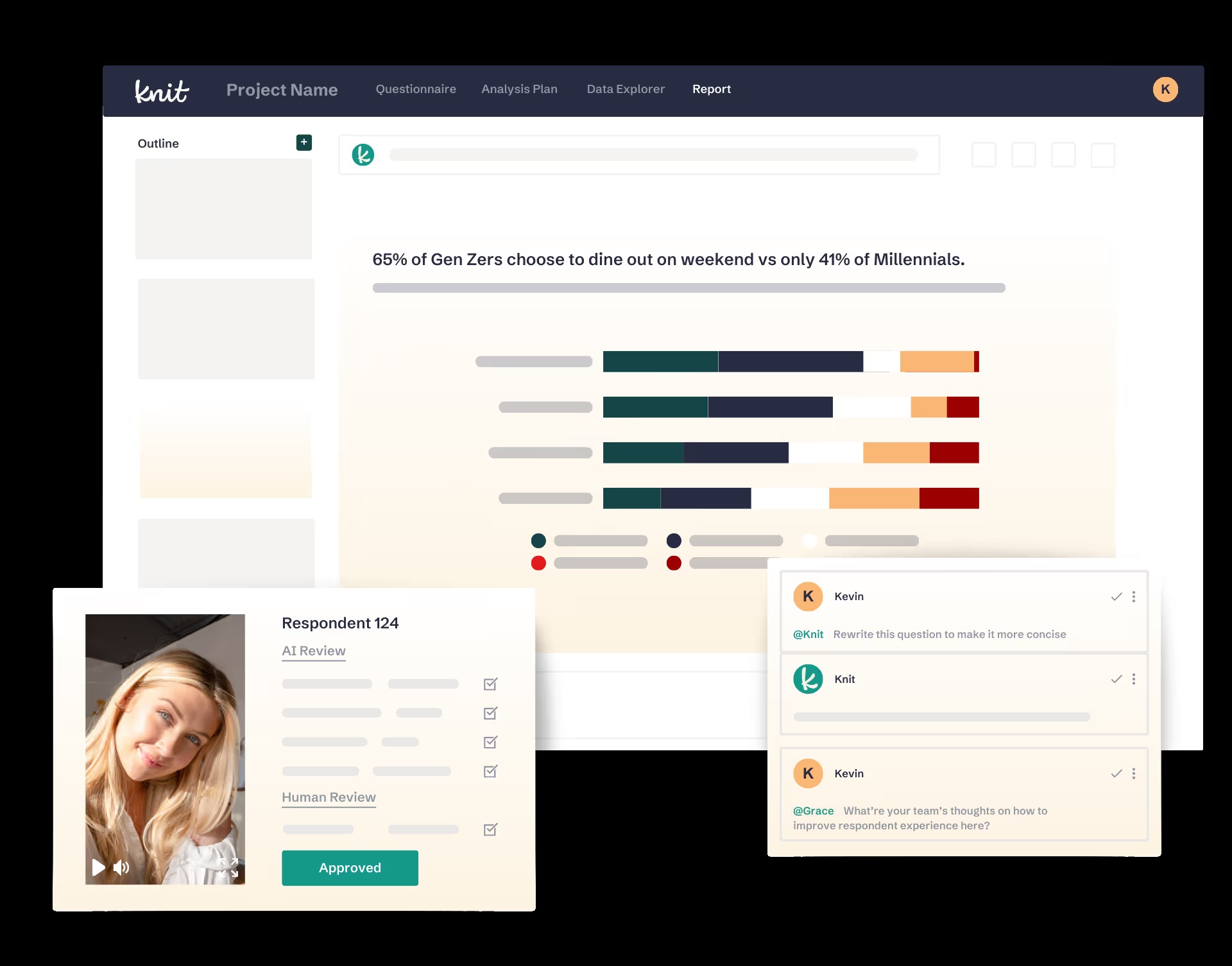
The company calls its approach Researcher-Driven AI. The distinction concerns timing. On its current website, Knit describes researchers shaping methodology, questionnaire and analysis from the outset. A final review cannot rescue every mistake in the original question. The human contribution is therefore part of the study’s design, rather than a ceremonial signature on the finished slides.
The workflow begins with objectives, audience and business context. Teams can supply previous research, brand guidelines and examples of preferred reports. AI drafts a brief and questionnaire; the researcher and client refine them. This is a practical form of customization: a question about a new product should reflect the decision being made, not merely contain the correct product name.
- 01 Business context
- 02 Questionnaire
- 03 Respondents
- 04 Quant + qual
- 05 Shareable report
Researchers guide the study; AI handles execution throughout.
That places Knit between familiar purchases. A conventional agency takes responsibility for research work. A self-service platform gives an internal team tools to perform it. Knit now presents itself as an AI-native agency, pairing managed expertise with automation. Buyers are choosing who will carry the work, as well as which software will process the answers.
The calendar is part of the bill
The cost worth examining is also time inside the client organization. Timex’s case study estimates about 20 hours of client involvement, against 50-60 for a conventional engagement. Those are reported comparisons for one project, not a universal saving. Still, they suggest a useful procurement question: how much of your own team’s week will the service consume?
Knit’s terms describe enterprise customers entering separate master services agreements for platform access and research analysis. Its public purchase route starts with a demo. This is a sales-led combination of software and service, where the study’s audience, method and deliverables matter to the engagement.
Investors have financed that combination. Knit announced $9 million in funding in September 2024 alongside Report-Ready Insights. A $16.1 million Series A followed in July 2025, led by GFT Ventures and Sound Ventures. The latter announcement reported more than $30 million raised in total. Funding establishes investor conviction; the customer’s next decision still has to earn its own.
A number needs a voice
Knit advertises access to more than 65 million respondents through global panel networks. That is potential reach, not the size of any study. Screeners narrow the audience; quality checks operate before, during and after surveys, with human reviewers checking the final dataset. Recruiting a useful sample remains a specific task, however impressive the headline number looks.
Analysis connects the two kinds of evidence. Teams can filter qualitative feedback by quantitative responses, inspect transcripts and citations, and examine themes. Reporting exports to PowerPoint or Google Slides. Ask Knit supports follow-up questions and additional slides. These features address the unglamorous journey from a finding in a database to an argument someone else can inspect.
For NASCAR’s in-season tournament planning, Knit reports 950 respondents and five days from design to report. Fans and non-fans supplied evidence about interest and barriers. Segmentation helped inform marketing and broadcast planning. A new format needs more than approval from people already inclined to approve it.
Borrow the benchmark
The practice a reader can copy is simple: define the decision, establish a meaningful comparison, and collect explanations alongside scores. Timex’s benchmark made new designs legible across studies. That approach depends on relevant respondents and a comparison that deserves its authority. Fast fielding cannot repair a poor screener; purchase intent is still an answer to a question, rather than a sale. Knit’s proposition becomes interesting where research can change the plan. The best moment to learn you are wrong is before the watches exist.