A coffee capsule can be convenient and still feel wrong. In a Streetbees study of 2,000 coffee drinkers in Saudi Arabia and the United Arab Emirates, 71% identified a lack of authenticity as a barrier to adoption. A brand preparing to enter the market needed to know more than whether people liked coffee. It needed to understand whether its proposed shortcut belonged in their lives.
Streetbees specialised in that awkward space between a purchase and its explanation. People used its app to describe daily routines, answer follow-up questions and send photographs or videos. Brands bought the resulting research. The company’s case study says the coffee project took eight days from brief to insights and helped bring the launch forward by two to three weeks.
There is an awkward fact in Streetbees’ own story, too. The original business entered administration on August 26, 2025. Investment talks failed, and all 26 employees were to be made redundant. Its technology subsequently found a buyer. A September 2, 2026 website notice says a US-based team is redeploying assets acquired the previous November. The product’s history and the company’s survival have become separate questions.
The missing information was out in the street
Tugce Bulut’s frustration began before the bee mascot. Working in strategy consulting, she encountered businesses trying to enter markets without basic information about them. In a 2018 interview, she recalled a food-delivery client exploring Brazil and the difficulty of establishing how many takeaway restaurants existed there. Advice becomes rather theoretical when nobody can count the restaurants.
Bulut and Oliver May founded Streetbees in 2015. She became chief executive; he was chief operating officer. Their proposition made the smartphone a research instrument carried by the people whose behaviour clients wanted to understand. Participants, called “bees,” could supply information directly and receive payment for it.
By 2018, the ambition extended to an Always On platform that would continuously collect consumer experiences. Photos, video and text would form a database that natural language processing could help interrogate. Rather than commission a fresh investigation only after a brand lost share, companies could consult a growing record of everyday behaviour. The proposed asset was the accumulated detail of ordinary life.
A survey that could ask “why?” again
SBX brought a newer generation of AI to that proposition. Shaf Shajahan, Streetbees’ vice-president of product, said the tool originated in a two-week hackathon in 2023. It went on to win Innovation of the Year at the 2024 MRS Awards.
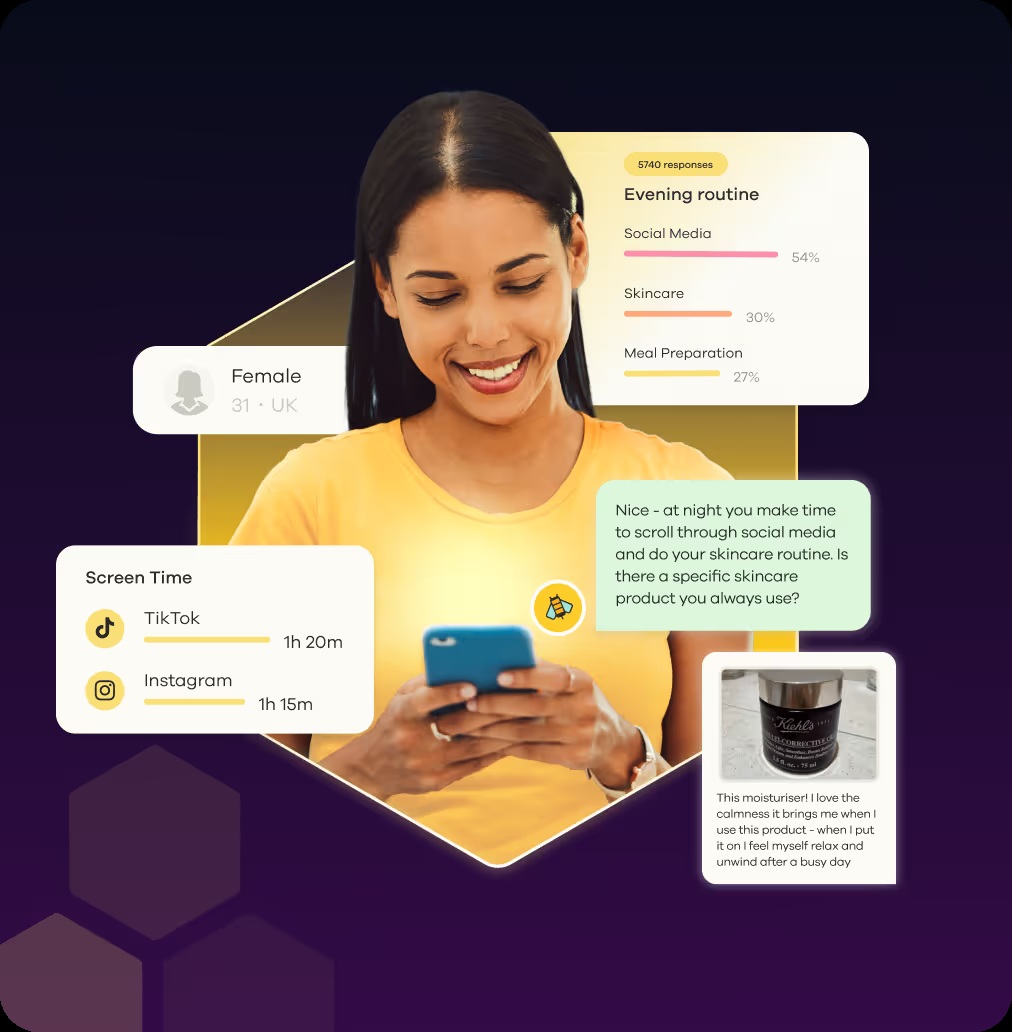
The workflow connected research design, interviewing and analysis. A client described a business question; the system helped turn it into a brief and conversation guide. During fieldwork, the survey combined closed questions with open answers and adapted its follow-ups to what participants said. The report then organised responses into quantified themes, charts and consumer quotations.
That division of labour matters. A respondent could explain an unexpected preference without waiting for a researcher to invent a new answer box. A buyer could then examine both the prevalence of a theme and the language behind it. Streetbees’ expertise sat in the connection between collecting messy material and making it useful for a decision.
The company’s FAQ described human checkpoints: clients approved briefs, specialists checked survey plans, and experts reviewed reports. Automation still needed supervision. A polished chart could only help if the questions, sample and interpretation deserved the reader’s confidence.
Research brief
Adaptive follow-ups
Reviewed report
“SBX is the result of a two-week hackathon that we kicked off in 2023.”
Shaf Shajahan / VP of product / 2024
The buyer wanted a decision, not another dashboard
Streetbees sold to consumer-insights, marketing, innovation and strategy teams. Its historical customer roster included Unilever, PepsiCo and Procter & Gamble. In its October 2020 funding announcement, the company said it worked with eight of the world’s ten largest consumer-goods businesses. That was a claim about its position then, rather than evidence of relationships continuing through administration.
The work covered questions close to revenue: which product concept to launch, what a brand should say, why shoppers chose a competitor and which customers needed a different approach. In market terms, Streetbees occupied territory shared with research groups such as Kantar, Ipsos and Nielsen, while selling its own conversational method and technology.
Its offer combined software, respondent recruitment and research service. That combination relieved buyers of some questionnaire-writing and analysis work. SBX Direct extended the method to a company’s own customers through branded links or QR codes. The distinction was useful: a general consumer community can explain a category, while existing customers can describe the friction in a particular experience.
The published tool family reflected that range. Explore addressed unknowns; Test examined concepts; Capture gathered multimedia material; Segment separated consumer groups; Track followed change. Pulse offered a shorter research format. These were different ways to approach a business question, rather than six reasons to buy more software.
Coffee machines and the trouble with assumptions
A separate coffee-machine project shows how the method worked in practice. A manufacturer wanted to understand the US market for espresso machines, where it faced competition and comparatively low household penetration. Streetbees spoke with more than 1,800 consumers, including machine users, espresso buyers and prospective buyers.
The study ran two phases in parallel. One looked broadly at coffee-machine ownership and habits; the other examined the purchase journey for espresso machines. Streetbees reported delivering quantitative and qualitative findings in seven days. The design let the client place a narrower buying audience inside a wider market picture.
Its account says the findings challenged assumptions about sustainability’s importance in the purchase decision and helped identify communication touchpoints. The practical value lay in making a marketing choice more specific. Knowing that sustainability matters somewhere in consumers’ lives is less useful than knowing whether it changes how they choose this appliance.
A grooming brand supplied another example. Losing younger customers to emerging competitors, it commissioned research encompassing 1,650 conversations and photos from men in Britain and the US. Streetbees’ case study describes a subsequent move toward the emotions attached to particular grooming occasions, away from an emphasis on functional standards. The company reported that 31% considered authenticity an important brand attribute. The work changed the message; the published account does not establish a measured recovery in market share.
The price of a better answer
The business model had money moving in both directions. Brands paid for research; participants received incentives for approved contributions. An earlier SBX FAQ put a typical payment at the equivalent of $1 per submission, varying with the audience. The app’s published guidance described short conversational tasks, usually taking five to ten minutes, with payments reviewed before release.
For clients, Streetbees marketed lower costs and shorter turnaround. The Arabic coffee case includes a buyer’s comparison suggesting roughly half the price of alternatives. Such comparisons describe a particular project, not a universal tariff. Sample size, recruitment difficulty and the work required to interpret answers all affect what an equivalent study would involve.
Time claims also came with a useful qualification. Streetbees’ FAQ said rapid delivery depended on the target audience representing at least 10% of the general population. Rarer audiences required discussion of achievable timing. An AI interviewer could accelerate questioning and analysis, but finding enough of the right people remained a practical constraint.
There was a larger bill behind the platform. Streetbees raised a $12 million Series A in 2018, led by Atomico, and announced a $40 million Series B in October 2020, led by Lakestar. Those rounds financed an ambition that included proprietary data and technology development. They were investments in the business, not evidence that each research project paid for itself.
An award could not close the funding gap
The financial strain was visible before the final announcement. A published summary of Streetbees’ accounts put 2023 turnover at about £6.6 million, down from £9.3 million the previous year. Its post-tax loss narrowed from £12.8 million to £5.4 million. Costs were falling, but the business remained loss-making as revenue declined.
Leadership had changed in September 2023, when Bulut and May left. Vidisha Gaglani and Sean O’Connell took over leadership as the business introduced an insights co-pilot. By December 2024, SBX had industry recognition. Neither event guaranteed another investor would finance the company.
When the funding process failed in August 2025, Streetbees attributed the outcome to market conditions and legacy business challenges. It also said SBX had seen strong traction. That is the company’s explanation, and it leaves room for a useful distinction: the documented immediate failure was securing enough capital to continue operations. It does not establish that consumers stopped answering or that clients rejected every new product.
The subsequent asset acquisition offered a route for the technology to continue under a US-based team. As of the September 2026 notice, the website described redeployment and said it was not fully functional. The old case studies therefore record what Streetbees delivered historically. They should not be read as promises of uninterrupted service today.
Keep the inconvenient answer
For a research buyer, the most portable Streetbees lesson is methodological. Define the decision before writing the questions. Combine a count with the explanation behind it. Study the occasion as well as the person. Keep the answer that unsettles the team’s favourite hypothesis, whether it concerns sustainability, coffee authenticity or the emotional meaning of a shave.
Its examples also suggest a discipline for reading research claims. A faster launch is different from a successful launch. A revised campaign is different from recovered market share. A large community is different from a representative sample for a specific question. Treat each result at the level the evidence supports.
The consumer may be standing beside a coffee machine, not sitting in a focus group. Streetbees found a way to ask that person a useful question. Its next chapter will depend on making the economics of listening work as well.
Follow the conversation
Company channels & further reading