The standard focus group is a dinner party with a clipboard. Eight people sit in a room, one confident guest talks too much, and a moderator tries to distinguish signal from the cheese plate. A survey fixes the scale problem but introduces another: it can count only the answers its designer remembered to offer. Remesh built its company in the narrow, valuable gap between those formats. It asks hundreds of people to type what they actually think, then quietly recruits the audience to help rank the room.
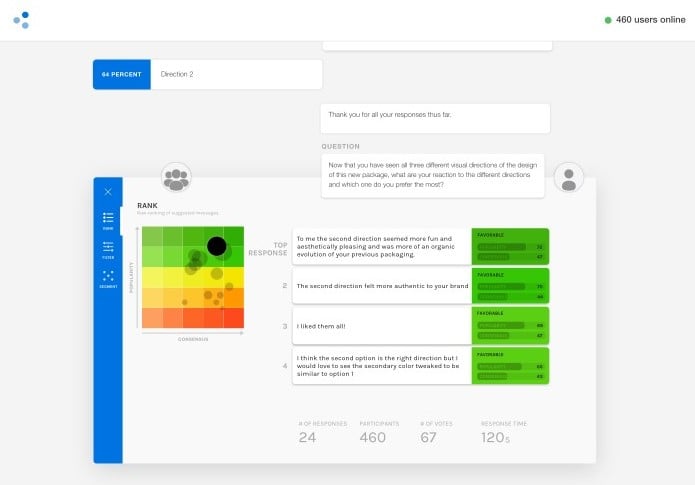
That voting loop is the clever part. In a Remesh Live conversation, a moderator asks an open-ended question. Participants respond in their own words. They then see a sample of other responses and indicate which ones resonate. The platform analyzes those interactions as they happen, giving the researcher a view of agreement, disagreement and audience segments. The moderator can follow the odd comment that suddenly finds a constituency instead of waiting two weeks for a transcript and a tidy deck.
The crowd is the sorting machine
Remesh grew from a distinctly non-corporate question: could technology help a large group speak with a collective voice? Andrew Konya, trained in theoretical physics and complex systems, and engineer Aaron Slodov prototyped the idea around a Kent State hackathon in 2013. The company took shape in Cleveland in 2014, with Gary Ellis joining as a co-founder and commercial operator. Flashstarts supplied early scaffolding; the Barclays Accelerator powered by Techstars brought the team to New York and closer to the institutions that would eventually buy the product.
The original ambition ranged from civic dialogue to conflict resolution. The paid wedge was more concrete. Brands, agencies, consultants and HR teams already spent money trying to understand customers and employees. They routinely chose between small, rich conversations and large, shallow questionnaires. Remesh could sell a third option: conversational research with enough structure to compare responses.
General Catalyst led a $10 million Series A in 2018. At the time, Remesh said its approach could deliver insights five times faster and at roughly one-third the cost of conventional market research initiatives. Those were company claims, not a universal price sheet, but they explain the sales pitch: the economic gain came from compressing fieldwork and analysis, not from charging pennies per survey response. In 2020, General Catalyst led a further $25 million extension. A later company record lists $4.25 million in debt financing in December 2022.
So what did it cost?
Remesh does not publish a menu of subscription prices. It sells enterprise contracts, participant recruiting and optional full-service research through scoped demos. The public comparison that matters is historical: the company claimed in 2018 that its method was three times cheaper than the industry standard because teams could move from conversation to usable findings in hours.
Three rooms, one research stack
The product is now a small suite. Live is the synchronous room, built for a 30-to-60-minute session with as many as 1,000 participants. Flex is asynchronous and supports up to 5,000, useful when the audience spans time zones or includes doctors, shift workers and other people who do not arrange their lives around a moderator's calendar. Video adds live interviews, with pre- and post-interview questions, transcripts, clips and analysis. Teams can begin wide in Live or Flex, spot an interesting participant, then go deep on camera.
Around those collection modes sit the less glamorous pieces that make enterprise research possible: recruiting, quotas, multilingual conversations, external-data imports, merged studies, exports, sentiment, themes, summaries and automatic coding. Remesh can be software for an experienced insights team or a managed project for a buyer who would rather hand over the work. That combination makes the business more than a SaaS seat license. It sells workflow, sample and expertise.
“We get both - a means of quantifying qualitative input, and along the way, creating a participant experience that's engaging, fast-paced, and fun.”Julie Wittes Schlack, C Space
Named users include Nestlé, Barclays, Mercer, Ipsos, Yum! Brands, C Space and Kobie Marketing. The company's own customer page says more than 1,000 research teams trust the platform and cites strong penetration among major advertising, CPG, consulting, technology and research firms. The use cases are pleasingly ordinary: test an advertisement before launch, explore a skincare extension, understand why sunglasses annoy people, or find the employee comment that a satisfaction score would bury.
The first thing that failed was a beautiful report
Remesh's most revealing product story arrived much later. In 2024, its R&D, engineering and product teams reverse-engineered exemplary research reports. The goal was to take raw study data and prompt a large language model into producing customer-ready documents. The system worked well enough. They did not ship it.
The reason was almost comic in its specificity: customers were not asking for text-dense, hyper-nuanced reports. They were asking questions. Those questions changed as evidence appeared. A finding raised a new doubt; the doubt required another cut of the data; the next answer changed the decision. The polished report was a destination built for a journey that behaved more like pinball.
That changed the product. Remesh launched Remy in 2025 as an embedded AI research assistant, initially able to analyze data across Live, Flex, Merge, Import and Video. Instead of presenting a single final document, Remy answers questions with data-backed assertions, surfaces themes and comparisons, and lets a researcher keep digging. Remesh has described a larger ambition for the agent to orchestrate study design, analysis and follow-up. In 2026 it announced Remesh Connect, intended to make that research and the agent available inside tools such as Claude and ChatGPT through the Model Context Protocol.
Deep, small, human
Conversational, modest scale
Conversational, measured, large
Structured, very large
The part worth stealing
A founder need not build research software to copy the central move. Remesh makes users part of the processing system. Participants do not merely create raw material; their reactions help organize it. That is a potent pattern for communities, review products, knowledge tools and any marketplace drowning in unstructured text. The trick is to ask users for a tiny judgment they can make honestly, then aggregate those judgments into something an operator can act on.
The conditions matter. Remesh is a poor substitute when the subject demands hours of trust-building, physical observation, ethnography or a tiny set of rare experts. A large conversation can still be unrepresentative if recruitment is weak. Peer evaluation can measure resonance, but agreement is not truth and popularity is not causality. A bad discussion guide merely industrializes a bad question. For sensitive employee work, anonymity, psychological safety and the employer's willingness to act are part of the product whether the software invoice mentions them or not.
The company itself seems to understand the boundary. Its stated culture pairs “human-powered” with “technology-fueled,” and its product gives moderators the ability to pivot rather than asking them to surrender judgment to a machine. Gary Ellis, who ran revenue and operations for nearly a decade, became CEO as Konya moved to Chief Science Officer. The division is apt: one founder is responsible for making the method commercially useful; the other keeps working on the strange mathematics of collective speech.
A machine for the next question
Remesh occupies a busy market. Qualtrics owns broad experience management. Suzy sells rapid consumer research. Discuss.io, dscout, Recollective, Outset and a growing parade of AI research tools cover interviews, communities and automated analysis. Any competent agency can reproduce pieces of the workflow with Zoom, survey software, spreadsheets and patience. Remesh's durable distinction is not the phrase “AI-powered.” It is the older interaction loop: a crowd produces language, samples the crowd's language, and helps expose the comments that deserve attention.
That is why the unshipped report matters. Plenty of software companies would have launched it, attached a sparkle icon and called the work finished. Remesh noticed that a researcher's real job is not document production. It is managed curiosity under a deadline. The product becomes useful when it shortens the distance between “What do people think?” and “Wait, why do they think that?” The payoff is not an instant oracle. It is another intelligent question while the people, the evidence and the decision are still in the room.