The awkward thing about listening to customers used to be getting there. A company could assemble a focus group in Chicago, but the executives who needed to hear it might work in Detroit or New York. Their reward for curiosity was an airport. FocusVision’s original proposition was wonderfully literal: send the conversation instead.
- FocusVision started with remote observation of real focus groups.
- Acquisitions added surveys, diaries and research reporting.
- The name became part of Forsta; the product lineage now sits within Qualtrics.
The journey was the problem
Founded in 1990 by market researcher John Houlahan, FocusVision tested video transmission with General Motors and Ogilvy & Mather. More than 40 focus groups and qualitative events were transmitted from facilities in Boston, Dallas and Chicago to client reception consoles. A contemporary account dates the commercial service launch to January 1991.
The design respected an existing ritual. Participants still gathered at research facilities. Moderators still conducted discussions. Observers could watch elsewhere. FocusVision installed and maintained the equipment, making the arrangement a supported service rather than a technical project the customer had to nurse into existence.
Early pictures were less obliging. In a 2002 trade interview, Houlahan recalled the motion problems of low-bandwidth transmission. Falling equipment and transmission costs helped. After September 11 curtailed travel, he reported adding 104 clients. The obstacle was partly technical, partly habit: people needed a reason to reconsider where observation happened.
The audience nobody counted
Saving a journey seems the obvious benefit. Then comes the inconvenient detail. In a 2006 study commissioned by FocusVision and conducted by InsightExpress, only 10% of end-client users named replacing their own travel as the primary reason for using video transmission.
Researchers often still wanted to attend in person. Video let other colleagues participate when travel was inconvenient. The valuable change was a larger audience: customer testimony could reach beyond the specialist assigned to turn it into a presentation.
The study also recorded concerns about distracted viewers and premature conclusions. Moving the observer’s chair did not automatically improve the observer’s judgment. Teams still needed to consider who was watching and how they would interpret what they heard.
Buying the missing questions
A live discussion can reveal why an answer matters. A survey can test how widely that answer is shared. FocusVision’s expansion joined these different jobs. Thompson Street Capital Partners invested with management in 2013; during its ownership, five acquisitions added complementary capabilities.
Revelation, acquired in 2014, brought mobile diaries, communities and bulletin boards. Researchers could follow experiences over time instead of asking everyone to remember them in a single sitting. Decipher followed in January 2015, adding survey programming, software licensing, data collection and reporting. ResearchReporter supplied project archiving and reporting; ActiveGroup and Qualvu / 24Tru extended the video side.
Surveys + reporting
Live interviews + groups
Diaries + communities
These were tools for corporate insights departments, agencies and moderators. Salesforce Research, for example, documented an international study of 900 advertising professionals conducted online via FocusVision in November 2017. The business sat behind research production: gathering and managing evidence that customers would interpret and use.
Its commercial model combined software with services. Survey programming and managed sessions sat alongside licensing and SaaS revenue. The American Marketing Association reported $50.5 million in worldwide revenue for 2017. That historical figure describes FocusVision’s scale then; it should not be mistaken for the revenue of its much larger successors.
A video call with a backstage crew
The distinction becomes tangible in InterVu, a FocusVision product that continues under Forsta. A moderator can share material, run polls and let participants mark stimuli. Observers have a separate backroom and chat. Recordings can be revisited, marked and clipped, so a telling reaction need not disappear with the meeting.
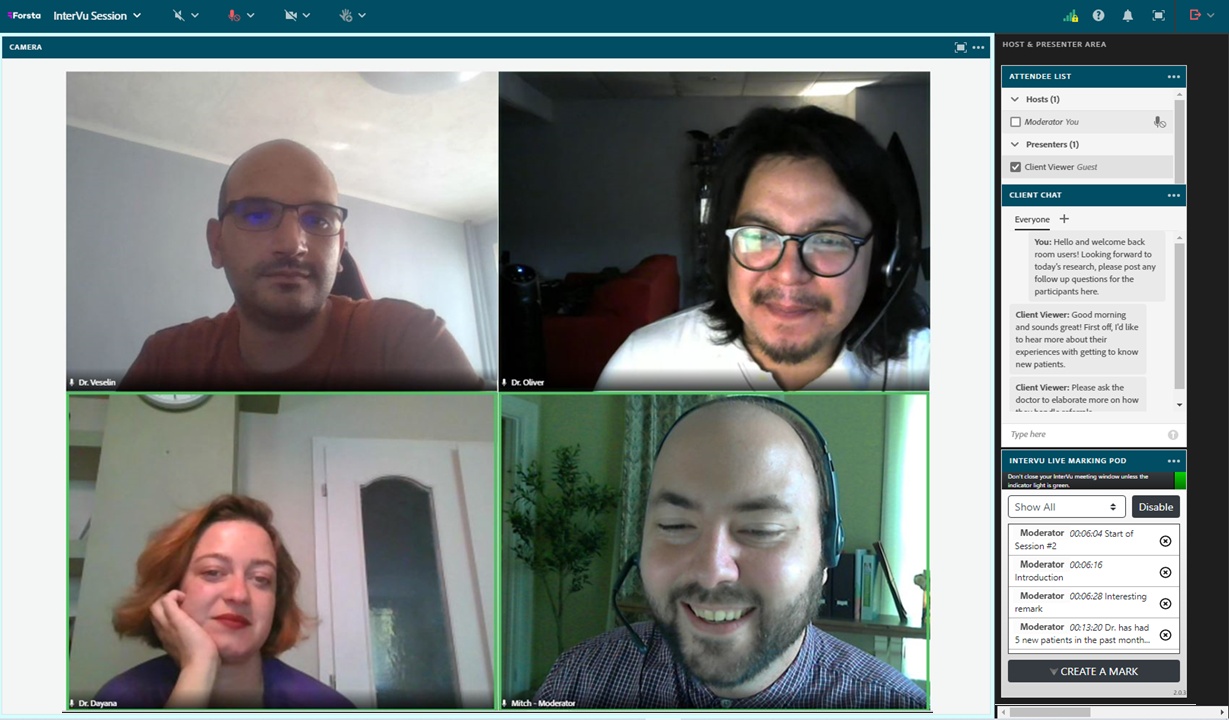
The product includes people, too: a dedicated project manager, scheduling assistance and a technician during live sessions. That service layer is a meaningful purchase for a team conducting demanding interviews. The moderator has enough to do without becoming the emergency microphone department.
Forsta announced an InterVu upgrade in September 2022 incorporating Adobe Connect 12 and 1080p video. Current tools include browser access, controlled observer roles and translation support. Specialist alternatives such as Discuss also provide research interviews and services; survey vendors such as Alchemer address quantitative work. Breadth and supported workflows help explain FocusVision’s position, rather than an imaginary monopoly on listening.
One name gives way to another
Buying capabilities brought an integration problem. In 2018, FocusVision announced a strategy to combine its tools and data sources under one brand. Chief executive Zlatko Vucetic wanted a single platform spanning behavioral evidence, qualitative work and surveys. The portfolio had grown; making it feel coherent became another job.
“the single source platform for behavioural, qualitative and survey data”Zlatko Vucetic / January 2018
In March 2021, FocusVision and Confirmit completed their merger. The combined business announced the Forsta name in April, bringing together the legacies of FocusVision, Confirmit and Dapresy. Press Ganey acquired Forsta in April 2022. On May 18, 2026, Qualtrics completed its $6.75 billion acquisition of Press Ganey Forsta. That price belongs to the combined parent business.
What a research team can borrow
The practical lesson is to remove friction from a job people already value. Start with the research question, choose a method, and make the evidence easy for the relevant colleagues to encounter. FocusVision’s history suggests that widening participation can matter as much as accelerating collection.
The conditions still matter. Remote interviews require usable connections and prepared participants. Diaries require sustained engagement. Surveys require defensible sampling. A clip supplies an example, not a population estimate. The software helps people reach and examine customers; deciding what their answers warrant remains a human responsibility.