The first persuasive version of Feather & Bone was made by hand in a college chemistry lab. Shubhangini Prakash was at Babson, combining pricing and product-development classes, when a powder cleanser became a more interesting proposition: press it into a tablet. She made a small batch, mocked up the packaging and carried the lot to a Whole Foods trade show. The samples were rough. The logic was crisp. Thirty stores placed an order.
There is a popular founder story in which conviction looks loud. Prakash’s version could fit in a palm. The tablet made several arguments before she had to speak: it was measured, portable and activated only when the customer added water. Its short ingredient list was visible rather than ceremonial. The object was the pitch.
That early order did not instantly produce an empire. It offered something more valuable and less cinematic: evidence. A buyer could understand the format. A customer could understand how to use it. A future company could be organized around the same habit of removal.
01 / The education of Shubs
A career with several keys
Prakash, known as Shubs, grew up in Dubai, attended boarding school in England and describes herself simply as Indian. The route gave her an international education long before business school did. Her own list of countries visited has passed 30. She still prefers beaches and nature, where, as she puts it, “the quiet is so sublime.”
Then there is the musical education. Prakash has played classical piano since she was six. She recorded an album under the name Bananas for Mowgli, a fact so charmingly specific that a brand consultant would be foolish to invent it. She met her husband at a rave in New York. At home, where she is raising two boys in Jersey City, Bollywood and Polish music share the playlist.
Her professional life began in a more buttoned-up register. Prakash spent six years in finance, including time at BNP Paribas and Silicon Valley Bank. She graduated from Babson in 2007, returned for an MBA from 2011 to 2013, and went back to banking before leaving to build Feather & Bone. Finance gave her fluency in price, risk and the unsentimental arithmetic that keeps a physical product alive. Music supplied a useful counterweight: an ear for rhythm, variation and when enough notes are already on the page.
“Our products are inspired by Indian traditions but backed by science.”Shubhangini Prakash
The company’s aesthetic vocabulary comes from Indian traditions familiar to her family, including sandalwood and clay. Prakash translated that familiarity into a contemporary format without sanding away its origin. The result is neither a museum piece nor a vague mood board. It is a product decision: use a deliberately short list, remove added water and ask the customer to complete the final step.
02 / Small object, serious company
Make the constraint do the marketing
Feather & Bone launched in 2015. Its signature Face Gems took the lab prototype into commerce: a small cleansing tablet made with sandalwood, Fuller’s Earth and starch. Add water, turn it into a paste, use it, move on. The portability is obvious. So is the discipline. A long claim on a box can be ignored; three named ingredients are harder to misunderstand.
In 2017, the company joined the fourth cohort of XRC Labs, the retail accelerator now known as XRC Ventures. The program brought mentorship, retailer access and investment to a group of ten businesses. Prakash presented at demo day among companies working across the changing retail landscape. Feather & Bone’s proposition was modest in scale and clear in shape: personal care made simple, compact and portable.
The finance background matters here in a less obvious way than fundraising. Physical goods punish fuzzy thinking. Every unit has a cost, every package occupies space and every retail promise creates an operational consequence. Prakash arrived with years spent around institutions that make risk visible in columns. Her later work replaced currencies and credit with ingredients, inventory and shipping, but the founder’s question stayed recognizable: what is this decision really buying?
That question also protects a small company from imitating a large one. A giant beauty business can distribute dozens of variations, purchase broad attention and tolerate products that overlap. A founder-led brand has to know why each object exists. Feather & Bone’s answer has remained narrow enough to repeat: plant-based products, waterless formats and purposeful formulas. Narrowness can look like a limitation until it becomes the reason a customer remembers you.
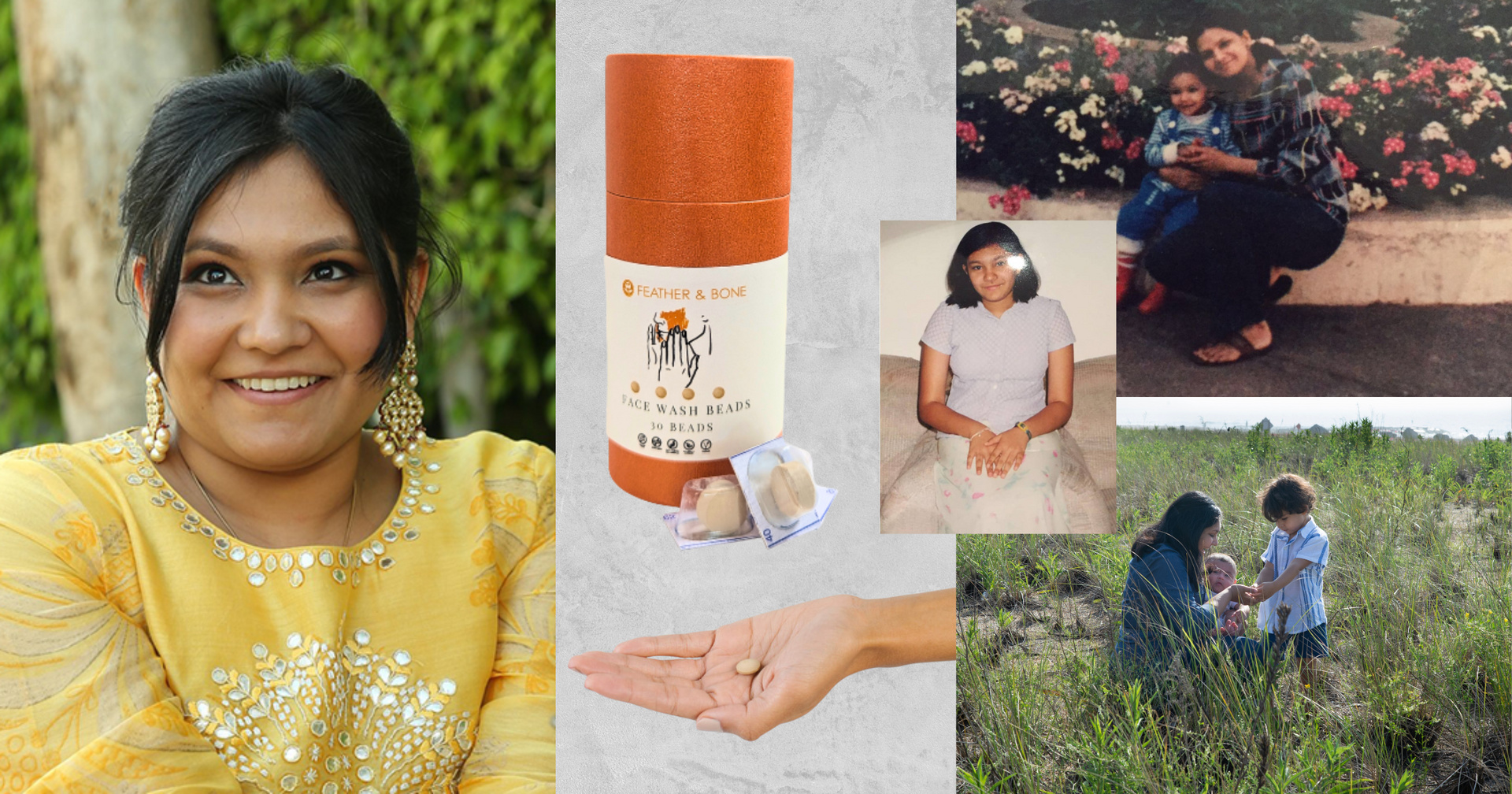
The more interesting business choice is not that Prakash found a trend. It is that she made a constraint perform several jobs. The tablet shapes manufacturing, portions the product, changes the travel experience and supplies the opening line of the sales pitch. “Waterless” is not a campaign placed on top. It lives inside the object.
That alignment is worth stealing. Small companies rarely have the budget to explain a complicated identity over and over. A constraint can become an operating system. If the product, package and explanation all point in one direction, marketing has less hauling to do.
03 / The night two clocks started
Efficiency, without the marble statue
Years later, another institutional door opened with absurd timing. Prakash learned she had been accepted into the Target accelerator on the night her second son arrived. The program began immediately. She was suddenly holding a newborn and a fresh set of obligations at once.
It is tempting to polish that scene into a monument to founder stamina. Prakash’s own account is wiser. She talks about patience, support and allowing plans to bend. Motherhood, she says, made her dramatically more efficient because a crowded day forces a blunt question: what is the most important task?
The Shubs operating list
- Choose the important task quickly.
- Keep the paper notebook close.
- Let family and work occasionally overlap.
- Practice resilience, then reflection.
Her children sometimes join a run to the post office or help fill packages. The arrangement is practical, affectionate and appropriately unglamorous. Boxes still need tape. Orders still need to leave. A child can learn what work looks like without work pretending it exists in a sealed room.
Prakash names a paper to-do notebook among the things she relies on professionally. She also names her people: advisers, entrepreneurial friends and her husband. In founder folklore, dependence is edited out. In an actual small business, support is infrastructure. So is self-forgiveness. A system that survives only a perfect day is not much of a system.
Her approach to founder-led content follows the same principle. She does not present personal branding as an immaculate second self. Her stated ambition is for viewers to feel that they are already enough, with permission to be peculiar in public. For a consumer company, that stance is commercially useful because it supplies a voice competitors cannot easily copy. It also asks something difficult of the founder: appear as a person before appearing as a campaign.
“I have learned to figure out quickly what is the most important task.”Shubhangini Prakash
04 / The shelf test
Ten years is a form of applause
By 2025, Feather & Bone had crossed its tenth year. Prakash described the milestone through the home rather than the cap table: “It’s rare to find customers that stay with a brand for 10 years. It feels special that my products are sitting on a shelf in someone’s home.”
A shelf is a useful place to measure a consumer company. It is intimate but unforgiving. Objects compete there with habit, clutter and indifference. A product that remains has graduated from novelty into routine. For a founder who talks about putting the “person” back in personal care, the household is also where the philosophy has to cash out.
Prakash’s public manner is playful enough to keep the mission from becoming solemn. She encourages people to “embrace their inner weirdo.” She loves dosas and pizza, Indian and Italian food, and calls herself a homebody despite the long country count. The contradictions feel comfortable. A pianist can become a banker. A banker can press beauty tablets. A founder can value ambition and quiet in equal measure.
In February 2026, she brought Feather & Bone to television, joining The Marissa Mitchell Show on FOX 5 DC. The format had changed from a trade-show table to a broadcast segment, but the founder’s job was familiar: hold up the thing, make its logic legible, invite someone to try a different ritual.
The durable lesson of Prakash’s story is not minimalism as decoration. It is subtraction as clarity. Remove the water and the format changes. Remove the sprawling ingredient list and the customer can remember it. Remove the demand to look like everyone else and a phrase such as “inner weird” becomes a practical brand position.
Feather & Bone began as a small object that made sense in a hand. Ten years later, that remains the company’s sharpest advantage. Prakash has kept the proposition close enough to touch, explain and carry. In a category inclined toward crowded shelves and crowded language, she built her argument around space.