Benjamin Bernet found his way back to perfume by taking a detour through other people's bathrooms. There were beauty counters that failed to serve women of color, foam inserts slipped into shoes, and grooming products sent out for military field testing. By October 2025, when BRAVO SIERRA introduced three body fragrances, the former Giorgio Armani marketing executive had accumulated a rather unusual route to the fragrance shelf. A bottle can contain a scent. His contained a few changes of mind.
The route matters because Bernet knows the polished end of the beauty business. He spent years inside L'Oréal, working with established names and the machinery that puts them in front of customers. His entrepreneurial career has repeatedly taken him closer to the people at the other end of that machinery. The interesting question becomes who gets to help decide what goes into the bottle.
The customer outside the beauty counter
Bernet was born and raised in Paris, studied at McGill and earned an MBA at INSEAD. His work took him through L'Oréal, Kiehl's and Giorgio Armani Beauty. It was an education in how an established beauty business works, followed by a growing interest in what it was leaving undone. The internet offered a way to build something without first winning a place at somebody else's counter.
In 2013, he cofounded DooBop with Jodie Patterson. Patterson brought experience in fashion public relations, her own beauty line and a former Manhattan shop. Bernet brought the marketing background. Their online store focused on women with brown skin and textured hair, putting a selection of products and advice together for shoppers poorly served by conventional beauty retail. The opportunity was specific enough to explain without a manifesto: help the customer find something that suits her.
The small details carried that idea. Orders included samples, and products arrived in reusable cotton pouches. The site also assembled experts to answer questions and demonstrate techniques. A customer could learn as well as buy. The transaction began to look like a relationship, with the retailer taking responsibility for some of the uncertainty that normally travels home in the shopping bag.
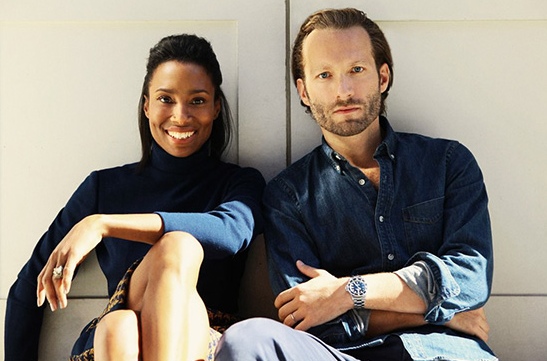
Then Oprah Winfrey noticed. A product Bernet had selected for her appeared on her O List, bringing a rush of orders. It was a useful demonstration of how quickly a small operation could become busy. DooBop also committed a dollar from each order to Community of Unity, which ran after-school programs in Harlem. Bernet later served on the organization's board. Commerce and a contribution to a particular community were already sharing space in his business.
A business slipped into a shoe
His next experiment had a less solemn entrance. His wife brought foam heel inserts back from Asia; her friends wanted them, and Bernet saw an opening in the American market. The appeal was a little extra height inside ordinary shoes. Entrepreneurship sometimes begins with a grand thesis. Here, a perfectly serviceable starting point was a pair of sneakers.
Working with creative director Pierre Jeand'heur and another friend who helped locate manufacturing, he built Say Hello to Longer Legs. A dinner helped bring the project together. By April 2016, the inserts had reached about 1,000 points of sale across the United States, Sweden and France. That led to Say Hello to Sexy Legs, which took the idea into body makeup, including products for highlighting and contouring legs. Sephora picked up the line in the United States.
DooBop was acquired by Sundial Brands in 2016. Say Hello to Sexy Legs would also be acquired, by Cosmax. The ventures gave Bernet experience with two different entrepreneurial jobs: finding an audience that had been overlooked, and finding a product people could understand almost immediately. Both required getting past the founder's enthusiasm to something a stranger would actually buy.
An old friend, a different brief
Justin Guilbert had known Bernet since their childhood in Paris. Their later careers both passed through L'Oréal, before Guilbert cofounded Harmless Harvest. By 2017, the two were in New York considering what to build next. Bernet had also begun consulting for Glossier. There was plenty of beauty experience around the table. The question was where to put it.
BRAVO SIERRA was established in 2018 and launched commercially in 2019. Its development process enlisted service members to try products under conditions rather less forgiving than a showroom demonstration. Charles Kim, a Marine veteran, was part of the founding team. Military experience supplied knowledge the beauty veterans could not conjure from a marketing brief.
For Bernet, the connection had a personal dimension. He had become an American citizen after two decades in the country. He wanted to express patriotism through something inclusive, with service members and military families at its center. Supporting that community gave his expertise a practical destination. The company name supplied a joke alongside the earnestness: Bravo Sierra spells B.S. in the phonetic alphabet. An ambitious choice for anyone employed in marketing.
“Sometimes we reformulate, sometimes we cancel.”
Benjamin Bernet, on acting on product feedback, 2021
The people who could say no
The testing community became known as the Battalion. Participants described what they needed and tried prototypes. In the early program, people who contributed input could receive a year's supply when the product launched. There was something admirably concrete about that exchange. The reward had to be a product worth receiving.
Bernet's comment about cancellation gets to the consequential part. A feedback process means little if every answer leads to the same launch. A disappointed tester has to be able to change the result. In this arrangement, development could include revision or abandonment, with an audience involved before packaging and advertising made the decision expensive to reverse.
The original range included eight products, priced between $5 and $14. Military exchanges gave service members early access, with civilian customers able to buy too. The wipe became an especially popular item. Much of the concept's appeal sat in that unglamorous object: a product made for the circumstances of use, rather than an elaborate fantasy about the person using it.
- 01 Ask
- 02 Field-test
- 03 Revise / cancel
- 04 Release
The marketing executive turns off the ads
Listening also meant paying attention when a familiar sales method stopped making financial sense. In August 2021, BRAVO SIERRA stopped buying advertising on Facebook and Instagram. Bernet explained the decision a year later using customer acquisition costs. Facebook had climbed to about $70 per customer in 2021; Amazon was coming in below $10. A marketing platform is easier to leave when the arithmetic starts doing the talking.
The company redirected spending toward Amazon, community activity and brand marketing. Its own website's acquisition cost was around $20 by 2022, while its reported conversion rate remained between 6% and 7%. Those were figures from a particular period, rather than a promise that every brand could repeat the experiment. They show Bernet applying a marketer's skepticism to the tools of his own profession.
Expansion was happening in physical retail as well. An August 2022 announcement paired a $17 million Series B, led by The Merchant Club, with a nationwide Walmart launch. Investors included Capstar Ventures, Redo Ventures, AF Ventures and Mousse Partners. Nicolas Geiger joined the board. The business built around a defined founding community was taking on the logistical demands of a much wider audience.
What a new customer cost
A more expensive bottle, an old interest
In 2024, BRAVO SIERRA raised $2.5 million from existing investors to support a premium range. The new collection brought revised scents, packaging and formulas, with eight products priced from $17 to $25 at launch. The existing Performance Hygiene range was to become an Amazon exclusive. The change gave Bernet room to work on the sensory qualities he wanted to develop.
That decision creates an interesting tension in his story. Affordability had been central to the original proposition. A premium collection asks customers to consider a different price and experience. Bernet explained the move in terms of what he wanted to make: more developed fragrances, different textures and improved packaging. The product developer was returning to interests that his earlier career had helped form.
In October 2025 came Marine Salt, Smoked Orris and Suede Musk, three unisex body fragrances developed with Givaudan. Customers had been asking for fragrances related to the scents they already enjoyed in the brand's body products. Bernet also described wanting to return to fine fragrance since his Armani days. Personal taste and customer requests had arrived at the same shelf.
The first audience still gets a say
By his fifth-anniversary reflection in 2024, Bernet was publicly celebrating the founding team, domestic manufacturing relationships and more than half a million dollars donated to support military families and veterans. His account gave room to colleagues and partners as well as products. A founder's biography can become crowded with solitary verbs. This one keeps acquiring other names.
By October 2026, the military exchange channel remained part of the business following the premium shift. That continuity matters to the shape of Bernet's career. The audiences change, and so do the products and prices. Again and again, the work begins with people describing what the available choices have missed. A woman at a beauty counter. Friends comparing shoe inserts. Service members trying a prototype. Customers asking for a scent in its own bottle. Bernet's long route back to perfume has involved a considerable amount of listening.
Continue the conversation
Bernet’s public profile, company and further reading.
Benjamin Bernet on LinkedIn ↗BRAVO SIERRA ↗The founders’ backstory / The Daily Front Row ↗The advertising decision / Modern Retail ↗The fragrance chapter / WWD ↗Military exchanges in 2026 / BeautyMatter ↗