Samantha Martin’s first shop had a promising opening day and an unexpectedly demanding landlord. She was about six or seven, the shop was in her family’s home, and the landlord was her father. She wanted a doll. He wanted her to understand what it would take to pay for one.
He brought home toys and postcards advertising Samantha’s Toy Shop. She delivered the cards around the apartment building and sold the toys for a dollar apiece. At the end of the sale, she had $54. Then came his deductions: manufacturing, marketing, rent. The pile of money shrank. Her proposed solution was to put the next shop in the street, where she thought the premises would be free.
It is an unusually tidy introduction to a publicist. Customers had appeared because someone told them where to come. Merchandise had to be obtained. The room cost something, even when it looked like home. Martin got her doll, along with an early acquaintance with the distance between a sale and a profit.
Revenue, before the grown-ups explained expenses.
A room full of people, a head full of details
Martin grew up in Hong Kong in a family involved in toy invention and manufacturing. She speaks Cantonese. The family background supplied a practical vocabulary for objects that had to be made, packaged, and sold. Later, at Media Maison, she would work with people facing those same tasks, sometimes long before they had anything ready to publicize.
There was another education at home. Her mother entertained business clients with elaborate dinners: eight courses, different plates, careful choices about who sat beside whom. Martin remembers humor and storytelling as part of the occasion. A dinner could be planned down to the crockery while still depending on the people around the table.
She carried that interest into Table for 8, bringing singles together over hosted restaurant dinners, and into the event business Maison Soirée. There is a pleasing domestic continuity here. The child who cared about matching party details became an adult who could turn those details into work. Even an invitation has a job to do. It sets expectations before anyone reaches the door: what sort of evening this will be, and why they might enjoy being there.
Her event biography includes one limitation on all this sociability: she leaves at nine. The guests may continue. The organizer reserves the right to have organized enough.
When the publicist makes the product
Martin founded Media Maison in 2008. In 2015, she launched Props in a Box, a family storytelling product built around costumes, props, and backdrops. Promoting a toy and making one place different demands on a person. With her own product, she had something tangible to put behind the language of a launch.
The idea gave families materials for inventing stories together. A costume suggests a character; a backdrop suggests somewhere for that character to go. The box offered a beginning and left the rest to the people opening it. For someone whose working life involves helping other people tell stories, the choice of product makes sense.
In 2016, she was named among the Designer/Innovator finalists for the Women in Toys Wonder Women Awards, listed as CEO of Props in a Box. The recognition placed her product work alongside her agency work. Both belonged on the résumé.
A further business grew from a recurring request. People arrived at Media Maison with sketches or prototypes and needed help making a business around them. In 2017, Métier Maison formalized that work, covering areas including branding, packaging, manufacturing, and product development. Publicity could follow once there was something ready to explain.
- 01Idea &
prototype - 02Brand &
packaging - 03Manufacturing &
market preparation - 04Public relations &
social media
A service sequence, not a promise of sales.
The person on the other end of the pitch
One way to understand Martin’s publicity work is through a florist who suddenly needed to be ready for television. Kim Foren, the founder of Portland’s Geranium Lake, remembers Martin helping secure a Today appearance. Foren had a week to prepare seven floral ideas for viewers around the country. Booking the slot created a new assignment: making the person appearing in it comfortable and useful on camera.
Martin coached her, including a request to ration the word amazing. It is the sort of advice that sounds small until you imagine trying to explain seven arrangements while excited, nervous, and aware of a camera. Enthusiasm can arrive with a very limited vocabulary.
Their collaboration extended to events. Martin continued working with the Portland florist after moving her firm to New York because she trusted Foren to handle the decoration while she handled publicity. Familiarity had a practical return: one part of the evening could proceed without constant supervision.

Other collaborators describe a similar attention to the assignment. CNBC correspondent Contessa Brewer recalls Martin arranging an urban-farming live shot with goats and chickens in less than a day. Today producer Sarah Clagett emphasizes understanding what can work on the program. A contact becomes more useful when the person calling understands what the recipient has to make.
Martin’s own advice about networking puts weight on the time between requests. In 2019, she urged people to stay in contact even when they needed nothing. The less theatrical part of a publicist’s life is the check-in that produces no immediate announcement, meeting, or invoice.
“Keep those connections, keep in touch”
Samantha Martin, 2019
The people who have to come back tomorrow
The people inside the agency require attention too. In 2015, Martin was running a 14-person firm and described the disruption caused by an employee’s departure. Another company could offer a few thousand dollars more and an appealing assignment. A small employer had to consider how to make staying attractive.
Her measures included help with the first and last month’s rent for new employees, educational assistance, promotions, and a trip after three years. One employee had gone to Paris. These were the arrangements she described then, belonging to that stage of the business. The underlying question was how to retain people when the firm could not always compete on salary.
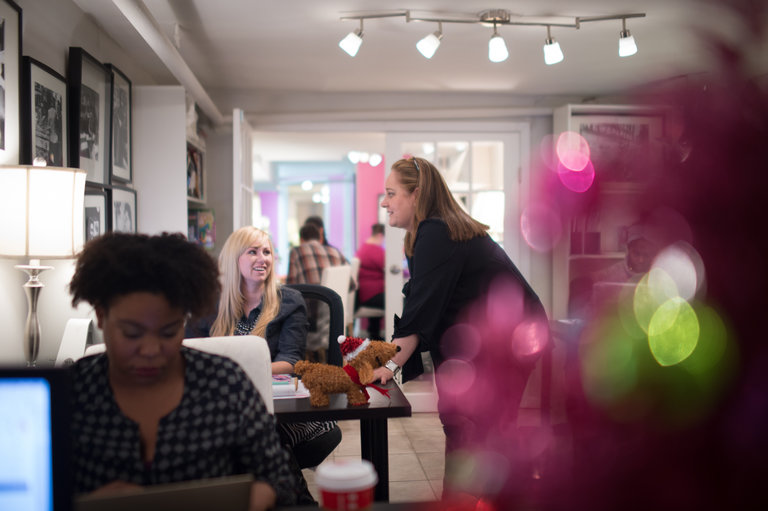
In a 2017 reflection on company culture, she described smaller gestures: surprise lunches, birthdays, time off between Christmas and New Year. She wanted people at different levels to learn. She also acknowledged that the business would occupy a chapter in an employee’s career, with no guarantee about how long that chapter would be.
That is a useful admission from a founder. The company may organize the founder’s life; an employee has a career of their own. A pleasant lunch cannot settle every question about ambition, money, or what comes next. It can still make an ordinary day better.
By April 2019, a different staffing problem had emerged. Clients were struggling to obtain funding and cutting publicity and marketing budgets. Martin reduced her hiring plans and said she would use hourly freelancers if work exceeded the team’s capacity. The decision connected her commitments to the work available. Running a people business includes deciding when to avoid making promises the budget may struggle to support.
A house with everything still to do
There was a separate project away from the agency. In 2018, Martin described finding a red farmhouse in Millbrook, New York, through an online property auction. The house needed extensive work. She could picture how it might look; her husband was less immediately persuaded by what stood in front of them.
They made their offer on December 22, 2017, won the auction, and faced a deadline imposed by the end of their rental lease. The renovation began in January. There were rooms to remake and choices to settle before an imagined home could become an inhabitable one.
Her account includes a longstanding wish for farm life, complete with animals, a Laura Ashley dress, and Hunter boots. She had grown up in Hong Kong, then lived in Los Angeles and New York. A farmhouse introduced a different setting for the same appetite for deciding how things might look and then getting them arranged.
The overlap with her work is easy to recognize without making a business lesson out of every tile. She likes a project with visible details. Sometimes those details belong to a client’s event. Sometimes they are the bathroom fixtures.
A plan, in her work, has to survive the participation of other people. A producer has a program to fill. A colleague has a career to consider. A collaborator has a room to finish before guests arrive. Each brings a timetable that the founder does not entirely control. Much of the job described by Martin and the people around her consists of noticing those timetables and getting the pieces ready in time. The occasions differ, but the dependence on preparation gives the stories something in common.
What the dollar bought
Today, Media Maison operates in New York and Hong Kong, with team members across the United States. Martin’s work spans publicity, brand development, and events. The agency presents direct feedback as part of the service, including criticism of packaging or an outdated website. That requires a client willing to hear something less agreeable than congratulations.
Her story keeps returning to the work around the attractive moment: preparing a guest before the camera turns on, finding collaborators who can be trusted with a room, making a product before announcing it. The childhood toy sale supplied an early version. The customers came. The money arrived. Then somebody had to account for everything that had made the afternoon possible.
Follow the conversations
- Media Maison / Samantha Martin
- Sam Martin / LinkedIn
- Media Maison / Instagram
- Media Maison / Facebook
- Media Maison / X
- Maison Soirée / her event work
- Her first-business recollection
- The 2019 conversation on running a company
- Kim Foren / working with Sam
- The 2015 employee-retention story
- Her 2017 reflection on company culture
- Her 2019 comments on hiring
- The Props in a Box background
- The 2016 Wonder Women finalist list
- Métier Maison / product development
- Her farmhouse renovation essay
- The agency’s working approach
- Media collaborators on working with Martin